How Out-of-State Real Estate Investing Works [Video + Transcript]
Joe Torre: Hello, investors. My name is Joe Torre. I’m an investment counselor with RealWealth, a real estate investment firm. Today we’re going to do a quick video on out-of-state real estate investing. This is a question that comes up a lot.
Here is a scenario: you live in a place that’s great to live, but not a great place to invest. It might be a highly expensive place like Manhattan, where the property prices are too high and the rents are too low relative to the purchase price, so we have a negative cash flow of $1,000 a month, or maybe you live in some rural area out in the country and there’s just no opportunities for investment.
That means you have to invest in real estate out of state, but that’s scary because you’re going to be investing in a property that’s 1,000 miles away or 3,000 miles away, and you’re not going to be there to look after it. That’s the problem that we’re going to solve today. The goal here is to live where you want but invest where it makes sense.
How to Invest in Out-of-State Real Estate Successfully
Key Factors
1. Job & population Growth
What you’ll need are a couple of things. First thing is finding a good market. I’ll go through these quickly. Job and population growth, a fairly large metro population (500,000 or more), a diverse economy, favorable landlord-tenant laws, and positive cash flow.
Job and population growth are critical for out-of-state real estate investing (or investing in any market) because if the population is growing and jobs are moving into the area, that means demand for housing is going to go up. That means rents will increase and property values will rise over time.
The reason you want a good-sized metro population is that you need good property management. Preferably, you want to identify two good property management companies in a given area, so if the first one you hire doesn’t work out, you have a backup. If you’re in a small town or small city of 50,000 people, you’re not going to have that many options when it comes to property management. There might only be one in town.
Also, if a local factory closes down or something in a small metro of 50,000, that could really devastate the local economy. A larger economy or metro area with 500,000 people or more is a safer bet.
2. Diverse Economy
The next thing you want is a diverse economy. An economy with a diverse range of industries is more resilient during difficult times. A good example is Atlanta. If you look at the top 10 employers in Atlanta, you’ll see no two are in the same industry. Coca-Cola is there, UPS is there. Home Depot is headquartered there. The Centers for Disease Control are there. Delta Airlines is there. If one part of the economy is not performing well, then other parts can take up the slack.
The economies that have problems are places like Detroit, which is heavily reliant on the automobile industry, and Las Vegas, which is largely dependent on tourism. During a recession, single-industry cities tend to suffer disproportionately. Your tenants will lose their jobs and not be able to pay rent. This creates a bunch of problems for out-of-state real estate investors and landlords in general. A diverse economy is a good thing to look for. The next thing is landlord-tenant laws that either favor the landlord or are at least neutral.
There are some states where it’s almost impossible to evict a tenant who’s not paying rent. A street-smart tenant who knows how to game the system will just live in your house for free for six months until you get rid of them. Other states, if they’re not out in 14 days, the sheriff’s deputy shows up and evicts them. You want to be in a place where the landlord-tenant laws favor you the landlord.
3. Positive Cash Flow
Then finally, you want positive cash flow when choosing a market for out-of-state investing. You don’t want to have to have negative $500 a month or $300 a month. That’ll just eat away at your savings. If you lose your job at some point, which you will, because real estate is a long-term investment, so at some point during the time you own it, you’re going to lose your job… having a negative cash flow is going to hurt you.
4. Good Property Providers
In addition to a good market, you also need good property providers. That could be new home builders, or it could be a turnkey provider. These are people who buy an existing home, say, built in the ’80s, and then they renovate it. They put in new kitchens, new baths, new carpet, new paint, and fix it up so it’s nice and rentable. Either of those two is a good option. Also, multi-family units like duplexes and fourplexes, but all of these must cash flow. There are some markets where you can buy a brand new house, but it’s going to be negative cash flow, and that’s going to introduce a lot of risk.
5. Experienced Property Management
This one is the most important thing with out-of-state real estate investing: property management. You’ll need good property management. When investors do fail, the number one cause of their failure is property management. Either they’re incompetent or sometimes they’re just outright crooks. They’ll tell you that you need a new water heater and charge you $400. You don’t need a new water heater. How do you know? You’re 1,000 miles away. They’ll rip you off. You have to have good property management and preferably several in the same market. That’s why we said earlier that you want to be in a major metro area where you can identify multiple good property management companies.
It should be a professional operation, not a mom-and-pop shop. The problem with mom-and-pop shops is that if mom is on vacation or is out sick, there’s no one minding the store, and there’s no backup. You want a deep bench of property managers, leasing agents, and work crews so that when there are busy periods or somebody is out for vacation, you have a lot of people who can take up the slack.
You also want scalable software and systems so you have reporting 24/7, so you can find out what’s going on with your property anytime you want. A good rule of thumb is that a property management company should have about 300 properties under management or more. Below that number, it’s too small to hire enough people to give you good service. They have a lot of problems and a lot of time a lot of projects that they have to work on, a lot of repairs to make and they don’t have enough people and they can’t afford to hire more people. With more than 300 properties under management, they start to get economies of scale, and they can provide better service. That’s just a rule of thumb.
As I said earlier, you want to identify more than one good property manager per market when investing out of state. Then service providers. You want lenders, preferably a lender who’s licensed in multiple states, so if you decide to invest in one state and then six months later buy another property in another state, you don’t want to go through the hassle of having to submit your tax returns and your W-2 forms all over again to a new lender. If you have a lender who can lend anywhere, you just have your paperwork on file and you can borrow anywhere you choose to invest.
6. Building a Team That Understands Real Estate Investing
It’s also essential that your lender be a specialist in investor loan products. Most lenders deal with owner-occupants who are going to buy a house to live in, and they’re not aware of some of the loan products that are out there, especially for investors, so you want someone like that. Then, of course, there is the entire ecosystem that supports real estate investors, including inspectors, appraisers, insurance agents, and others.
To build a team like this is a daunting task, but that’s what you need for out-of-state real estate investing to work for you. Doing it yourself is risky because it’s challenging to build a team, especially when you’re far away.
What are the odds you’re going to do it right and not make mistakes? You can make a mistake, and it’ll cost you a lot. Real estate is not a liquid asset. If you make a mistake, you’ll be stuck with it for a while. It’s safer to work with an established provider, at least in the beginning, and that’s what RealWealth does.
The RealWealth Advantage
RealWealth was founded in the Bay Area in California 20 years ago, just to solve this problem. You can see San Francisco’s skyline there. San Francisco is one of the most expensive metros in the country and does not generate a positive cash flow. You can buy a property there for $1 million that’ll rent for $5,000 a month, and you’ll have a negative cash flow of $1,000 or more every month. That’s not a great place to invest. A lot of our investors are tech workers in Silicon Valley. They work for Google, Facebook, and those kinds of companies, and they want to invest in real estate, but not here. That’s how RealWealth got started. We do all the heavy lifting.
We do all the economic research to find the best real estate investment markets. We have a thorough vetting of property providers and property management. Free education. We have a website with over 900 webinars, articles, and podcasts on all aspects of real estate investing. We have a community of over 70,000 members, and we continue to grow. In addition to providing all these resources, we also serve as your advocate after the purchase.
If, a year down the road, you’re having trouble with a property manager not getting back to you and not being responsive, please let us know, and we’ll put them on a call and get them to sort it out. Because we send them a lot of business, they want to keep our members happy. This is one of the risks associated with buying properties remotely. You’re a single individual investor, and you don’t have a whole lot of clout. As part of a network of 70,000 members, you do have clout. You can work with these providers and they’ll be responsive.
RealWealth markets
Here’s an overview of the markets we’re in. About 15 markets overall. Approximately one-third are located in the Midwest. They tend to cash flow really well, but they don’t appreciate very much. The ones in the Sun Belt, like Florida or Texas, they understand really well but don’t cash flow as much. A lot depends on your goal, what are you trying to accomplish with your investing? We have other webinars and videos on that.
In each of these markets, we have property providers. The new home builders are typically in the Sun Belt, where there’s a lot of growth. The renovated homes are the ones in the Midwest. We have property management in all these markets, lenders, insurance agents, CPAs, attorneys, and 1031 exchange people. The whole ecosystem you need to do real estate investing is already set up for you.
How RealWealth Can Help You
As an overview of how it works, you get a free membership by clicking the orange Join for Free button in the main menu. Then you just get educated. Watch the webinars every week, every Thursday. Review the webinars that are archived on our site. When you’re ready, you can schedule a strategy session with an Investment Counselor like myself. I’m one of three. You can learn about what market is best for you. We’ll talk about your goals, your risk tolerance, your timeframe and we’ll help you narrow down markets to the two or three that are best for you, and then you can focus on those.
Then you just contact the property providers, tell them that we spoke, and we want to see their properties or properties they have in the pipeline. They’ll send you a link, or they’ll put you on their email distribution list every time they get a new property. While you’re evaluating those, you can get pre-approved for financing with one of our lenders or your own lender. If you want to use your own, that’s fine too. If you want, you can visit in person, or you can just do it all remotely. When you see a property you like, you just sign the contract electronically with DocuSign, wire the Earnest Money Deposit, and you’re in business.
If you want to learn more about this option, join RealWealth.
The first thing you’ll want to do when you become a member is watch the Core Curriculum series. It’s four short 15-minute videos on how to get started. As I mentioned earlier, we also have a library of over 900 webinars, but that can be overwhelming. We created this Core Curriculum to get you started. This is what you need to know to get started.
Watch that, and then explore any other webinars or articles that interest you. We add to the content every week. Every Thursday, we have a webinar about a new market or a new aspect of real estate investing, including out-of-state real estate investing.
If and when you’re ready, you can speak to an investment counselor like me, ask your questions, and get recommendations for your specific situation. Again, everything is free.
People often ask how we pay the bills. The answer is that we educate investors and direct them to our various property teams across the country. If our members buy something, those property teams send us a referral fee out of their commission. That’s how we’re able to offer you all this for free. That, in a nutshell, is how to invest in real estate out of state. I hope you found that video worthwhile. Thanks for watching.
Frequently Asked Questions
RealWealth members get access to turnkey rental properties in carefully selected markets, complete with pro formas, projected ROI, and property management already in place. Once you connect with a turnkey property provider at RealWealth, they will send you their available inventory of off-market rentals, which may include single family homes, multi-family homes, and new construction homes. These listings are ideal for investors seeking passive income real estate opportunities in landlord-friendly states. Join RealWealth.
The best property management companies for out-of-state investors have strong local expertise, transparent processes and fees, and proven systems for tenant placement and maintenance. At RealWealth, we spend months vetting property management teams to ensure they are experienced and set up for success with our investor members. For tips on how to find a good property manager, read Why Property Management Is Important & How to Find A Good One.
When you join RealWealth, you’ll get access to a network of trusted real estate attorneys who specialize in working with real estate investors. These professionals understand the unique legal considerations associated with out-of-state ownership and can help ensure that your transactions are structured securely and efficiently. Members can connect with other recommended resources, including lenders, 1031 exchange facilitators, accountants, and additional real estate professionals.
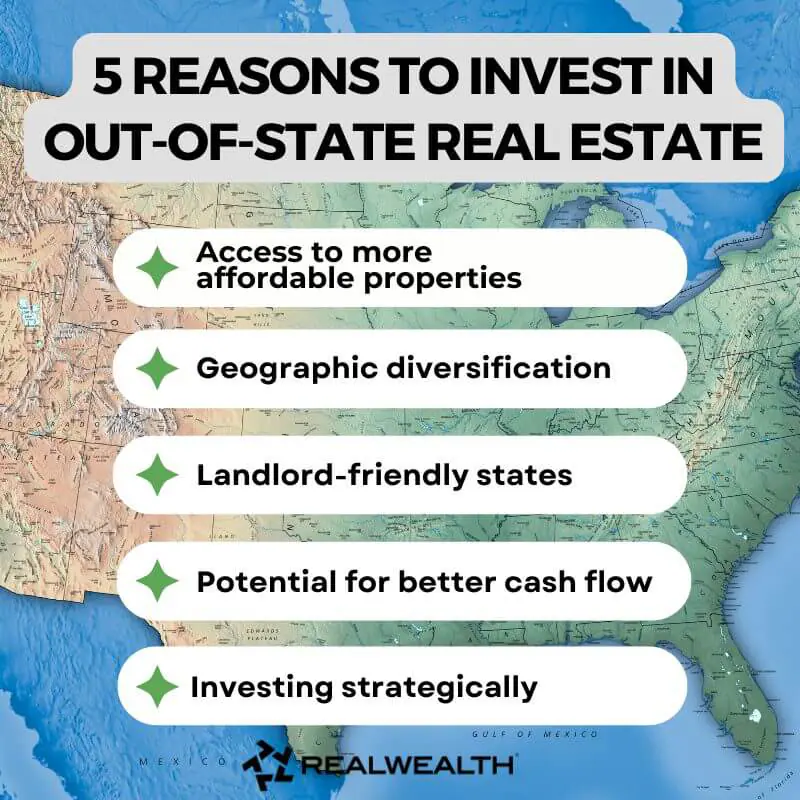
Many investors choose to buy rental properties in another state because they seek better returns, geographic diversification, and more affordable entry points. To help you figure out if buying rental property in another state is right for you, read Is Investing in an Out-of-State Rental Property Right for You?
The key factors to research are job growth, population trends, affordability, rent-to-value ratio, local landlord laws, and economic diversity. If you are ready to start analyzing markets, we’ve outlined helpful steps in How to Do a Real Estate Market Analysis Like an Expert.
Common risks include poor property management, rent defaults, unreliable contractors, high repair costs, tenant damage, and being unfamiliar with local regulations. The best way to mitigate them is to work with trusted, vetted teams who specialize in helping remote investors. Learn more about what to look out for in Five Types of Real Estate Investing Risks & How to Reduce Each.
Discuss the property management company’s operations and systems with key personnel. Ask about their local market experience and whether they also invest there. Research reviews from other investors. Find out the vacancy rate, management fees, rent collection process, maintenance response times and fees, and communication practices. At RealWealth, our vetting process typically takes around 90 days, although it may last longer. We look at every aspect of the business, including background checks, to ensure they meet our high standards. Learn 5 Tips on How to Manage Out-of-State Rental Property.
Key metrics include cash-on-cash return, cap rate, rent-to-value ratio, and long-term appreciation potential. If you are a RealWealth member, you’ll gain access to real estate pro formas and discounted tools, such as DealCheck, that can help you accurately analyze potential cash flow and ROI before making a purchase.
The answer depends on your comfort level and whether you have property management in place or if you are self-managing. Some investors with property management visit their investment property once or twice a year. Others may never set foot on their property. With technology at our fingertips, like video calls and digital photos, staying updated has become easier. However, this does require a level of trust with your local property management team.
RealWealth has been connecting investors with vetted turnkey real estate opportunities for over 20 years. We offer free education through weekly webinars, articles, and podcasts, and we thoroughly vet property teams and resources so you can invest remotely with confidence. Learn more about what sets us apart in Who Are the Best Turnkey Real Estate Companies?
Smart investors rely on a combination of economic data, local market research, and expert guidance to identify strong out-of-state opportunities. Understanding what makes a location attractive for rental property investing is essential before you commit capital. Start by reading our guide on How to Determine If a Real Estate Location is Good.
Comparing markets means looking at job growth, population trends, rent-to-price ratios, and landlord-tenant laws to find the best opportunities for your investment goals. We recommend using both comparative market analysis and neighborhood-level research to make informed decisions. Learn the process in How to Do a Comparative Market Analysis and How to Do a Neighborhood Analysis in Real Estate.
We highly recommend working with a CPA and tax specialist who is knowledgeable about real estate investing, its tax benefits, and understands the rules and regulations for both the state where you live and the state where your property is located. Typically, you’ll report rental income on your federal and state returns, if applicable, as some states have no income tax. Our list of investor resources includes CPAs experienced in multi-state real estate tax strategies to help you maximize deductions and manage compliance. Find a CPA.
Yes! Investors can complete 1031 exchanges and legally avoid paying capital gains taxes when buying like-kind properties in different states, provided both properties are in the U.S. RealWealth partners with qualified intermediaries who can help you defer taxes while upgrading into stronger out-of-state markets. Learn more and get help with a 1031 exchange.
Markets with strict tenant laws, high taxes, or slow job growth, such as California, New York, and Washington, can make investing in and managing properties more challenging. The markets RealWealth recommends focus on landlord-friendly, high-growth markets with strong fundamentals—such as Texas, Florida, and certain states in the Midwest, among others—where investors can find better cash flow and appreciation. Start researching where to invest out of state in the Best Places to Buy Rental Property.
The best way to build a team you can count on is to work with a turnkey real estate company, such as RealWealth, or a real estate network that already has established relationships with property managers, lenders, and contractors. RealWealth members gain access to trusted local teams in multiple markets, making it easier to invest remotely with confidence. Join RealWealth to find your next out-of-state turnkey rental property.