It’s safe to say every real estate investor wants to lower their tax bill, and where you invest can matter just as much as how you invest. There are currently 9 states with no income tax, which can mean more of your rental income stays in your pocket, especially if you live in one of them. Thirteen states also don’t tax retirement income, something to consider if you’re building a retirement-focused portfolio.
Quick Answer: Which States Skip State Income Tax?
As of 2026, there are nine states with no income tax: Alaska, Florida, Nevada, New Hampshire, South Dakota, Tennessee, Texas, Washington, and Wyoming. If you’re buying out-of-state investment properties, though, don’t stop there. Property taxes and insurance can cost you more than income tax would, and they’re very different from one state to the next.
It’s important to note that states without personal income tax typically make up that lost revenue through other taxes, like higher property or sales tax, which is worth factoring into your pro forma numbers as an investor, not just the headline “no income tax” appeal. Let’s go over these no-income-tax states in more detail, and where they stand out as real estate markets.
What States Have No Income Tax?
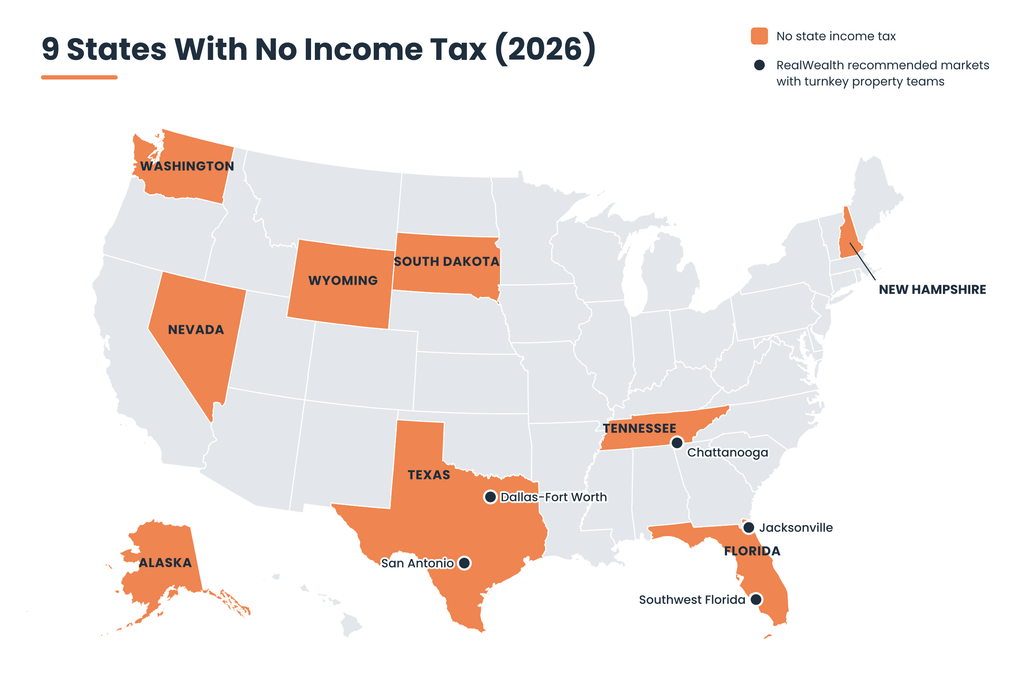
As of 2026, these nine states don’t charge a state income tax:
- Alaska
- Florida
- Nevada
- New Hampshire
- South Dakota
- Tennessee
- Texas
- Washington
- Wyoming
Tennessee and New Hampshire used to tax interest and dividend income, but not anymore. Tennessee’s tax ended in 2021 and New Hampshire’s in 2025, so both are now completely income-tax-free. Washington could be the next to change. It passed a tax on income over $1 million, set to start in 2028, but voters will decide whether to repeal it on November 3, 2026.
How Do States With No Income Tax Make Money?
They still have to pay for roads, schools, and everything else, so they need to find the money somewhere. Most of these states lean on property taxes, sales taxes, or both. Tennessee has one of the highest combined sales tax rates in the country, while Texas and New Hampshire rely heavily on property taxes. A few also rely on other sources, like oil revenue in Alaska and tourism in Nevada and Florida.
For real estate investors, this matters more than it might seem. Sales tax mostly affects the people living in the state. Property tax lands on you as the owner every year, so it’s one of the first numbers to check when you compare markets.
Does Buying a Rental in a No-Income-Tax State Lower Your Taxes?
It depends a lot on where you live.
If you live in one of these nine states and your rentals are there too, you won’t pay any state income tax on that rent.
If you live somewhere else, it’s a different picture. Buying a rental in Texas or Florida means you won’t owe those states anything on the rent, and you won’t have to file a second state tax return. But your home state will probably still tax that rental income, since most states tax residents on everything they earn.
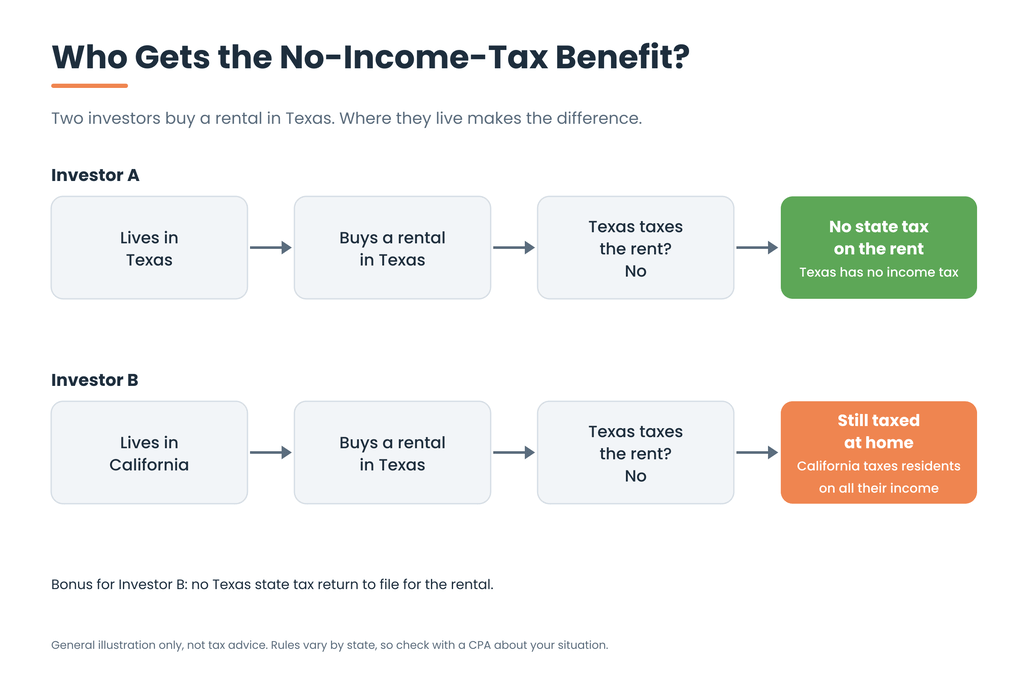
If you plan to move to one of these states later, say for retirement, owning rentals there can pay off once you become a resident because that rental income would no longer be subject to state income tax.
A CPA can tell you exactly how this plays out for your situation.
Which No-Income-Tax States Have the Lowest Property Taxes?
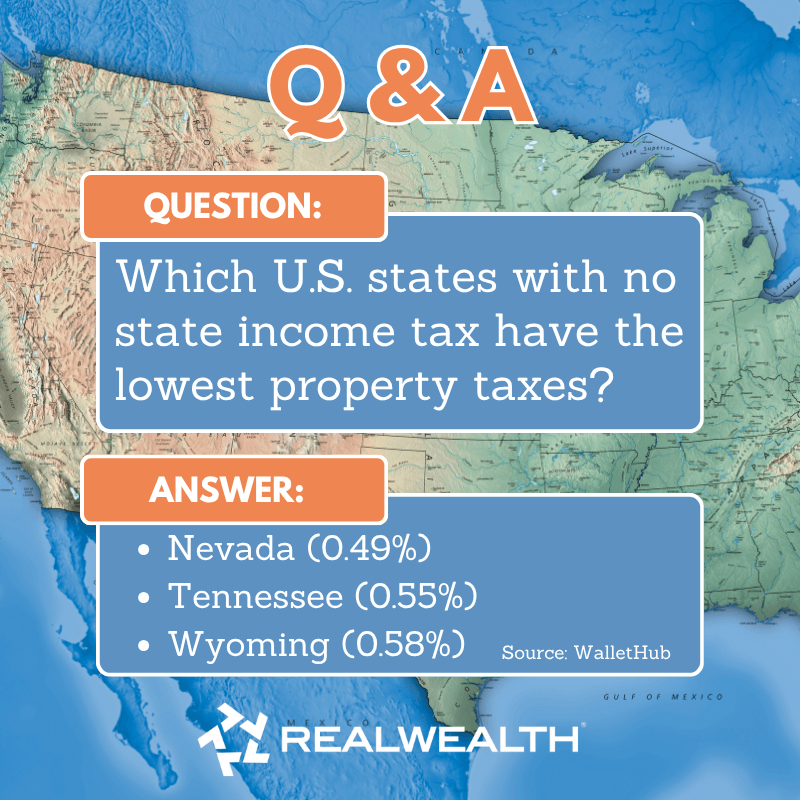
Nevada, Tennessee, and Wyoming have the lowest property tax rates of the nine, while New Hampshire and Texas have the highest. Here’s how all nine compare on the costs that hit a rental owner directly, sorted from lowest property tax rate to highest.
| State | Effective property tax rate | Avg. rental property insurance (statewide) | State transfer tax | Total state & local tax burden* | RealWealth property teams |
|---|---|---|---|---|---|
| Nevada | 0.49% | $739 | Varies by county | 8.37% | No |
| Tennessee | 0.55% | $1,017 | 0.37% (paid by buyer) | 6.21% | Chattanooga |
| Wyoming | 0.58% | $1,018 | None | 6.70% | No |
| Florida | 0.79% | $1,722 | 0.70% (paid by seller) | 6.27% | Jacksonville, Southwest Florida |
| Washington | 0.84% | $1,427 | 1.1% and up, plus local | 8.47% | No |
| South Dakota | 1.09% | $943 | 0.1% | 6.38% | No |
| Alaska | 1.14% | $1,891 | None | 4.92% | No |
| Texas | 1.58% | $1,842 | None | 7.69% | Dallas-Fort Worth, San Antonio |
| New Hampshire | 1.77% | $1,291 | 1.5% (split between buyer and seller) | 5.38% | No |
Property tax rates and total tax burden are from WalletHub. Insurance figures are statewide landlord insurance averages from Steadily, one of RealWealth’s insurance partners. Actual quotes vary by property, coverage, and location.
No-Income-Tax States With Turnkey Property Teams at RealWealth
Texas
Texas is the classic no-income-tax state. Your rental income isn’t taxed at the state level, and the ban on a personal income tax is written into the state constitution.
The trade-off is property taxes. Texas has one of the higher effective rates in the country at 1.58%, and that average includes homeowners who get a homestead exemption. Rental properties don’t qualify for it, so your bill as an investor can come in higher than the average suggests. Rental property insurance runs about $1,842 a year statewide, one of the highest among the nine states on this list.
So why do so many investors still buy here?
- Texas ranks #2 on our list of the most landlord-friendly states, with a 3-day notice to start an eviction for nonpayment and no rent control.
- There’s no state transfer tax when you buy or sell.
- Large metros like Dallas-Fort Worth and San Antonio have diverse economies that keep renters coming.
The big thing with Texas is running your numbers with the actual county tax rate, not a statewide average. RealWealth works with vetted property teams in Dallas-Fort Worth and San Antonio. If you’re new to this approach, our guide to turnkey real estate investing walks through how it works.
Florida
There’s no income tax in Florida, and property taxes are pretty reasonable at 0.79%. But if you’re buying a rental property, you won’t get the same breaks as Florida homeowners who live in their homes. No homestead exemption, and no 3% Save Our Homes cap on how fast your assessed value can rise. Rentals fall under a 10% yearly cap instead, which covers everything except school taxes.
That could change soon. Florida voters will decide in November 2026 whether to cut the cap for rentals to 5% starting in 2027.
Insurance is where Florida gets tricky. Landlord policies average about $1,722 a year statewide, but that number swings a lot depending on location, and coastal areas pay the most. Get an actual quote on the specific property before you commit.
When you sell, there’s a 0.70% documentary stamp tax, usually paid by the seller. If you finance, there’s also a smaller stamp tax on the mortgage.
On the plus side, Florida ranks #3 on our landlord-friendly list. Evictions for nonpayment start with a 3-day notice, and there’s no rent control. RealWealth works with vetted property teams in Jacksonville and Southwest Florida.
Tennessee
Of the three, Tennessee probably gives rental investors the simplest tax setup. The state doesn’t tax your paycheck, and it stopped taxing interest and dividends back in 2021. So whether your money comes from a job or your investments, Tennessee won’t take a cut at the state level.
Property taxes are low at 0.55%, and insurance averages about $1,017 a year statewide. That’s a lot easier on your cash flow than Texas or Florida.
The catches are pretty minor. Tennessee charges a 0.37% transfer tax at purchase, and the buyer typically pays it. Sales tax is among the highest in the nation, but it mostly hits residents, not your investment property’s bottom line.
RealWealth recommends a vetted turnkey property team in Chattanooga, a market we like for its landlord-friendly reputation and diverse employment base.
Not sure which of these three fits your plan?
Join RealWealth to see current properties in each market and connect with the vetted property teams behind them. Join RealWealth to get started.
Other States With No Income Tax
These six states also skip the income tax, but they’re less common picks for buy-and-hold investors. Here’s how each one stacks up for real estate investors. (Insurance figures are statewide averages.)
Nevada
Nevada has no income tax and the lowest property tax rate of the nine, at 0.49%. Insurance is cheap too, around $739 a year. On paper, that’s a great setup for a landlord.
The hesitation for some investors is the rental market itself. Nevada didn’t make our landlord-friendly list, and Las Vegas eviction filings climbed from 9.8% before the pandemic to 13.2% in 2024 as rents outpaced wages. Transfer taxes also vary by county, so check the rate where you’re buying.
Washington
Washington doesn’t tax wages, and property taxes are moderate at 0.84%. It does tax capital gains, but direct sales of real estate are exempt, so that one usually won’t hit a rental property sale. What you will pay when you sell is the real estate excise tax. It starts at 1.1% at the state level and goes up with the sale price, and many cities add up to another 0.5% on top.
Heads up: Washington passed a 9.9% tax on income over $1 million, set to start in 2028. It would also apply to Washington rental income earned by out-of-state owners. Voters will decide whether to repeal it on November 3, 2026, and the tax is also being challenged in court. For now, Washington still has no income tax for 2026 and 2027.
Prices are another hurdle. The state’s median home value is around $519,800, which makes cash flow harder to find.
New Hampshire
New Hampshire has no income tax and no general sales tax. Its tax on interest and dividends ended in 2025, so investment income is off the hook now too.
Where it gets you is property tax. At 1.77%, it’s the highest rate of the nine states on this list, and buyers and sellers each pay a 0.75% transfer tax. Insurance is reasonable at around $1,291 a year, but for most rentals, that property tax bill makes the numbers tough to work.
South Dakota
South Dakota keeps taxes low across the board, and its transfer tax is tiny at 0.1%. Property taxes are a little higher than you might expect at 1.09%, and insurance runs about $943 a year.
The bigger hurdle is size. Sioux Falls and Rapid City are the main rental markets, and there just isn’t as much inventory to choose from as in bigger states.
Wyoming
Wyoming is about as tax-light as it gets. No income tax, no transfer tax, a low 0.58% property tax rate, and insurance around $1,018 a year.
It’s also the least populated state in the country, so there are fewer renters and fewer properties to pick from. Cheyenne and Casper have rental demand, but it’s a small pool if you’re building a portfolio from out of state.
Alaska
Alaska has the lowest overall tax burden in the country. There’s no income tax, no statewide sales tax (some cities add their own), and no transfer tax. Property taxes are higher than you’d guess, though, at 1.14%.
For most investors, distance is the real issue. The cost of living is high, and managing a rental in Alaska from the lower 48 isn’t easy. If you’re still considering it, these tips on how to manage an out-of-state rental property are a good place to start.
Is a No-Income-Tax State Always the Better Deal for Rental Investors?
Not necessarily. When you own a rental, property taxes and insurance show up every year, whether you’ve got a tenant or not. In some states, those two costs can eat into your cash flow more than an income tax ever would. Alabama’s a good example.
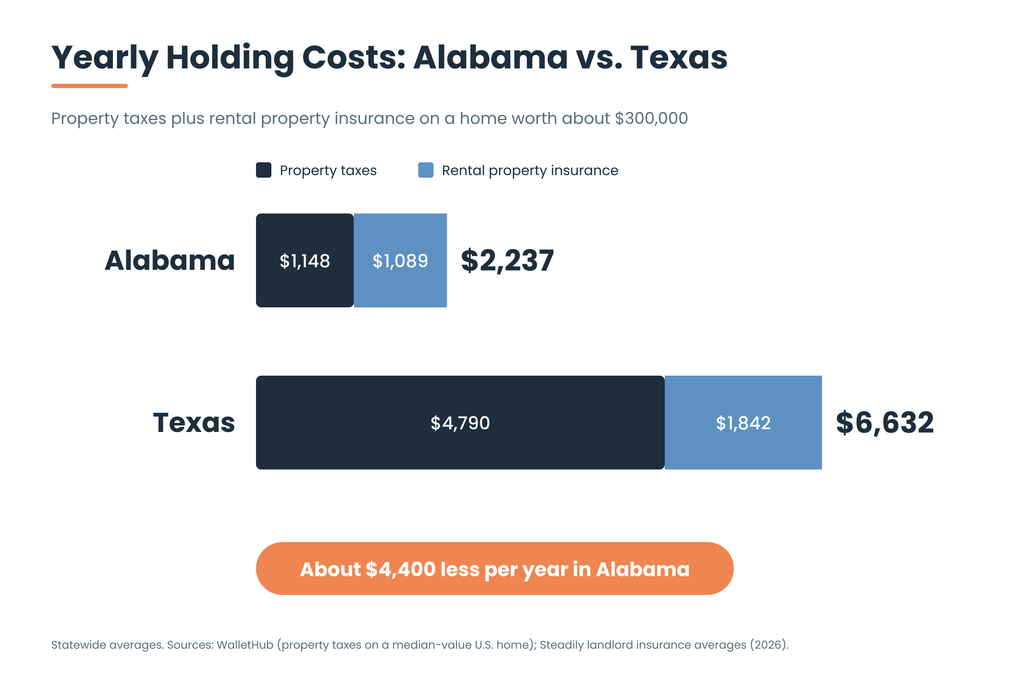
Say you’re comparing a $300,000 rental in Alabama with one in Texas. Texas has no state income tax, so it looks like the cheaper option on paper. But here’s roughly what you’d pay just to hold each one, based on statewide averages:
- Alabama: about $1,148 in property taxes and $1,089 for rental property insurance
- Texas: about $4,790 in property taxes and $1,842 for rental property insurance
That’s around $4,400 more a year in Texas, and you haven’t collected a dime in rent yet. Insurance also tends to run lower in inland markets like Birmingham and Huntsville than on the Gulf Coast.
But Doesn’t Alabama Have an Income Tax?
It does, with rates between 2% and 5%. The thing is, you only pay it on your net rental income, which is what’s left after expenses and depreciation. On a lot of rentals, that’s a pretty small number.
And if you already pay income tax where you live, you may be able to get a credit for what you pay Alabama. Your CPA can tell you how that shakes out for you.
Why Investors Keep Coming Back to Alabama
Alabama has the lowest property tax rate in the continental U.S., at 0.38% according to WalletHub, and one of the lowest typical tax bills, about $738 a year on a median-priced home. Homes are affordable too. The state’s median home value is about 36% below the national median, so your money stretches further.
Birmingham in particular is generally considered a stable market, without the big price swings you see in some high-growth cities.
What About Indiana?
Indiana is another one worth a look. It does have an income tax, but the state rate is a flat 2.95% for 2026, and counties add their own local income tax on top.
What really stands out for landlords is Indiana’s property tax cap. Outside of voter-approved levies, property taxes on a rental can’t go above 2% of its assessed value in a given year, so there’s a ceiling on what you’ll pay. A new deduction for rental properties is also phasing in through 2030, which should bring those bills down further.
What About Missouri?
Missouri has an income tax, but it did something no other state with an income tax has done. Starting in 2025, it stopped taxing capital gains for individuals, and that includes profits from selling real estate.
For a buy-and-hold investor, that matters most on the back end. When you eventually sell a rental, Missouri won’t take a cut of the gain, the way most states would. Your rental income is still taxed each year, so it’s a perk for when you sell, not while you own. How it applies depends on where you live and how the sale is set up, so check with your CPA. If you’d rather defer the gain entirely, a 1031 exchange is another option.
RealWealth works with vetted property teams in Birmingham, Huntsville, Indianapolis, Kansas City, and St. Louis, with property management already in place. Want to see what’s available and how these markets stack up against Texas, Florida, or Tennessee? Join RealWealth to browse current properties.
Which States Have No Income Tax and No Sales Tax?
Just two: Alaska and New Hampshire. Neither one has a state income tax or a statewide sales tax.
There’s some fine print, though. Alaska doesn’t have a state sales tax, but some cities and boroughs charge their own, so what you pay depends on where you are. New Hampshire doesn’t have a general sales tax either, but it does charge 8.5% on meals and short-term stays. If you’re thinking about a vacation rental there, your guests will pay that tax on stays under 185 days.
For a long-term rental, sales tax doesn’t move the needle much anyway. Property taxes matter a lot more, and both states run on the higher side, at 1.14% in Alaska and 1.77% in New Hampshire.
Delaware, Montana, and Oregon also skip the general sales tax, but all three have an income tax.
Which States Don’t Tax Retirement Income?
If you’re planning to retire in a state where you own rentals, or buy rentals where you plan to retire, this one’s worth knowing. Thirteen states don’t tax withdrawals from a 401(k), IRA, or pension.
Nine of them are the states on this page. With no income tax at all, there’s nothing to tax, retirement income included.
The other four do have an income tax, but they exempt most retirement income:
- Illinois
- Iowa, if you’re 55 or older
- Mississippi, for qualifying retirement income
- Pennsylvania, for qualifying retirement income
Here’s what investors tend to miss. In those four states, the break covers your retirement income, not your rental income. If you live there and own rentals, your net rental income still gets taxed like any other income. In the nine no-income-tax states, it doesn’t.
What About Military Retirement Pay?
Most states that tax income now exempt military retirement pay, either fully or in part, and the rules change often. For the current details in your state, check Military.com’s state-by-state guide.
Final Thoughts
No state income tax sounds great, and it can help. But when you’re running the numbers on a rental, it’s usually not what makes or breaks the deal. Property taxes, insurance, and how strong the local rental market is tend to matter a lot more for your cash flow.
That’s why Texas, Florida, and Tennessee look so different once you dig in, even though none of them tax your income. It’s also why states like Alabama, Indiana, and Missouri, which do have an income tax, can still come out ahead for a buy-and-hold investor.
So compare actual properties, not state headlines. RealWealth connects investors with vetted property teams that meet our REAL Income Property Standards™, with property management already in place, in markets like Dallas-Fort Worth, San Antonio, Jacksonville, Southwest Florida, Chattanooga, Birmingham, Huntsville, Kansas City, St. Louis, and Indianapolis.
Browse turnkey rental properties for sale, or join RealWealth to talk with an Investment Counselor about which market fits your goals.
This article is for general information only and isn’t tax advice. Tax rules change, so check with a CPA before making decisions based on your state’s tax laws.