


Sooner or later in your real estate investing career, you’ll find yourself having to decide which of several promising markets to purchase investment properties in. This is especially true with out-of-state real estate investing, where you can’t easily see the market or property first-hand. Each seller you talk to will tell you their market is the best and why you should invest there. As an investor, you need to know how to do a real estate market analysis so you can decide whether that market fits your goals and investment strategy.
To help you, I’ve broken down the steps for conducting a market analysis for real estate and the questions you need to ask to understand the attributes that make up a good market.
Quick Answer: How to Do a Real Estate Market Analysis
A real estate market analysis helps you evaluate potential investment markets using six key criteria:
- Numbers Check: Verify the rent-to-value ratio works for positive cash flow (aim for at least 0.6% monthly rent relative to purchase price)
- Property Management: Identify at least two professional property management companies in the market
- Economic Diversity: Ensure the local economy has multiple strong industries, not just one major employer
- Job Growth: Look for markets with new employers moving in and creating high-paying positions
- Population Growth: Target areas with growing populations that will increase housing demand
- Investor-Friendly Environment: Evaluate property taxes, eviction timelines, and local regulations
This systematic approach works for any market—whether local or out-of-state—and typically takes 10-15 minutes for an initial screening. Markets that pass your initial screen can then get a deeper analysis before you decide to invest.
Ready to invest with confidence? RealWealth members get a head start on their due diligence because we’ve already done the heavy lifting of analyzing top markets, vetting turnkey property teams, and connecting you with experienced professionals who pass our screening. Join RealWealth for free to access our network of vetted turnkey property providers in top U.S. markets.
Why Market Analysis Matters More for Out-of-State Investors
If you’re buying locally, you probably already have a sense of your market, as you can easily drive through neighborhoods, hear about new businesses opening, and talk to other local real estate investors. But when you decide to invest in out-of-state rental property, you need to be more intentional about your research because there isn’t a backlog of local knowledge.
That’s precisely why doing a thorough real estate market analysis becomes even more critical when you’re looking at markets outside your home state. The good news? The same systematic approach you’d use to evaluate any market works just as well (maybe even better) when you’re researching from a distance. You just need to know the right questions to ask.
Real Estate Market Analysis Steps
Step 1: Initial Screen
The goal of the initial screen in a real estate market analysis is to quickly eliminate markets that aren’t a good fit. Doing this will allow you to focus your time and energy on more promising markets. This step can take as little as 10 minutes once you’ve done a few. For this exercise, I chose three deal-breaker questions for my initial screen.
Question 1: Do the numbers work?
My first screen when doing a real estate market analysis is to verify if the numbers “work” in this market.
Some markets have a poor rent-to-value ratio, i.e., meaning the rents are low relative to the purchase price, so you’ll have negative cash flow. That doesn’t work for me. I want a market where the properties pay for themselves while I’m building equity.
To illustrate, compare the metrics for San Francisco, CA, vs. Port Charlotte, FL, near Ft Myers:
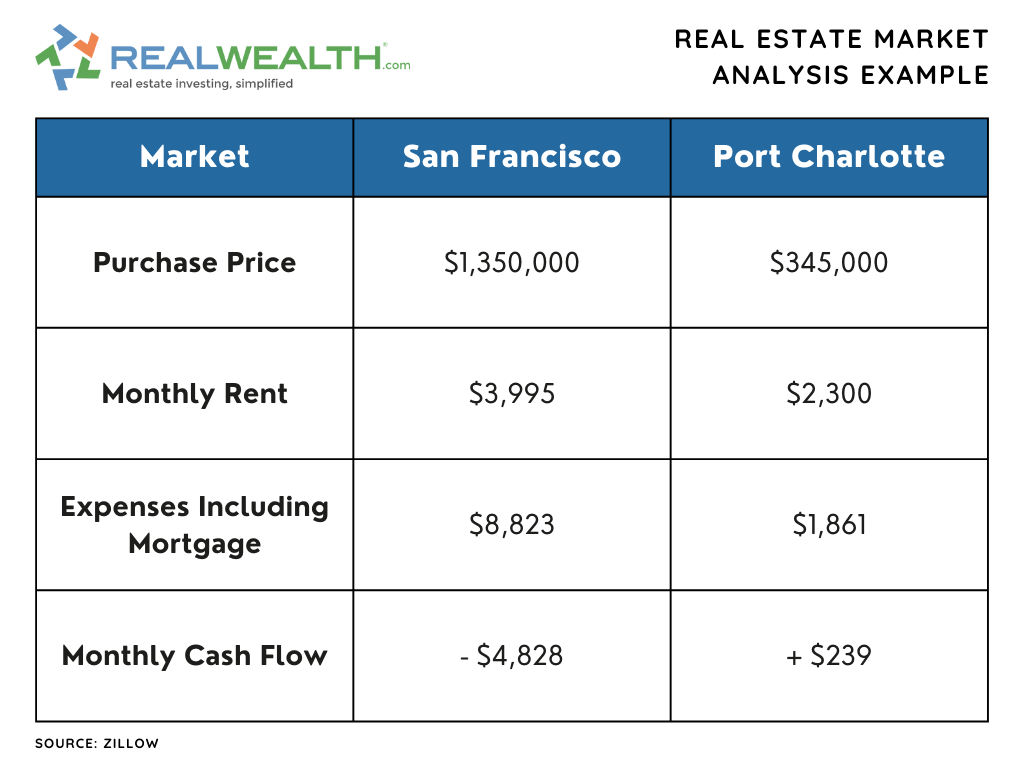
While this is an extreme example, it illustrates how the numbers don’t work for a city like San Francisco. The purchase price is so high relative to the rent that it has a negative cash flow of almost $5,000 per month.
The 1% Rule
The old rule of thumb was the “1% rule,” which states that, ideally, you’d want the monthly rent to equal 1.0% of the property’s purchase price, e.g., $1,000/month for a $100,000 property. That 1.0% ratio is very hard to achieve in today’s market, but at current interest rates, a property would need a rent ratio of at least 0.6 or higher to break even. The Port Charlotte property has a rent ratio of 0.67 ($2,300/$345,000).
(Also note that, for the same amount of money, you could buy four brand-new houses in Port Charlotte for the price of one 100-year-old house in San Francisco!)
For me, the numbers on the San Francisco property just don’t work. Imagine losing your day job and having that much negative cash flow! That said, a lot of people have made a lot of money in California real estate by accepting the negative cash flow and banking on price appreciation.
If you’re less risk-averse than I am, just remember that you’re getting a sure thing (negative cash flow) in exchange for a not-so-sure thing (future appreciation).
Also, if you’re looking at properties that have only $200/month in negative cash flow, you may decide you can live with that. You have to decide what numbers work for you or not.
Whoever is selling you the rental property should provide a proforma real estate statement itemizing rents and net cash flow after expenses. Be sure to ask for this information.
Investor tip: Always check the housing and rent prices in the same zip code you’re considering buying in by going to Zillow.com. This will help you confirm that the seller’s numbers are realistic. For more information about this process, read this article on how to analyze a real estate deal using a pro forma statement.
Question 2: Is There Good Property Management?
The most common reason real estate investments fail is poor property management, so I always recommend investors identify at least two good property managers in any given market. That way, if the first one doesn’t work out for whatever reason, you’ve already identified a backup.
The property management company should be a real company, not a mom-and-pop operation out of someone’s house. There should be a “deep bench” of managers, leasing agents, handymen, etc., so service won’t be interrupted if someone’s on vacation or if there’s personnel turnover.
Note: Requiring two good property management companies may effectively eliminate smaller metros. It’s hard enough to find one good property management company, but finding two such companies in a metro area with a population of less than 100,000 can be difficult.
This is one reason why many successful out-of-state investors focus on larger metros with established property management infrastructure. When you’re not local, you need professionals who can handle everything from tenant screening to emergency repairs—and you need backup options if things don’t work out. If you’re serious about investing in out-of-state rental properties, having solid property management isn’t just important; it’s the foundation of a successful investment. For more detailed guidance on this topic, check out our article on how to manage out-of-state rental property.
How to Find a Property Manager
- Your property provider should have a recommended property management company, so evaluate them to see if they’ll work for you. To find a second (backup) property manager, you can:
- Go to Yelp.com, search for “residential property management” and “city name,” and look at the ratings. Many will have negative ratings from disgruntled tenants, so focus on the ratings by landlords.
- Go to Meetup.com and search for real estate investor clubs/groups in the area where the property is located. Then, email the Meetup Group organizer and ask for recommendations.
2. If you can’t find at least one and preferably two suitable property management companies, then you should stop there and pass on that market.
Question 3: Is the Economy Diverse?
Not having a diverse economy is a deal-breaker for me personally, so I’m including it in this initial real estate market analysis screen. If it isn’t a deal-breaker for you, you could save this attribute for the next section.
My reasoning is that single-industry metros like Detroit or Las Vegas tend to get hit harder during recessions. When times are bad, the first thing consumers cut back on is discretionary spending, such as a new car or a trip to Vegas.
Worrying about whether my tenants will lose their jobs with every downturn in the economy is one more wild card I don’t want to deal with. I want to limit the number of variables outside my control.
How to Determine if the Economy is Diverse
You can determine how diverse a local economy is by going onto Google and searching for “city name” plus “top 20 employers” and looking at the number of jobs in each industry. For example, compare the results of Atlanta vs. Detroit:
Atlanta’s major employers span diverse industries: Delta Airlines, Home Depot, UPS, Coca-Cola, Emory University, the Centers for Disease Control and Prevention, SunTrust Bank, Georgia Tech, AT&T, Marriott, and countless hospitals.
By contrast, although it’s trying to become more diverse, the bulk of jobs in Detroit are still in the auto industry: Ford, Fiat-Chrysler (Stellantis), General Motors, Magna International (auto supplier), Quicken Loans, and health care.
With a diverse economy like Atlanta’s, if one sector struggles (e.g., Delta Airlines during the COVID-19 pandemic), other sectors can pick up the slack. That makes for a more resilient market with more stable rental occupancy and cash flow for investors.
Investor tip: When you’re evaluating markets from afar, economic diversity becomes even more critical. You won’t have the local pulse on layoffs or hiring trends, so investing in markets with multiple strong industries gives you a buffer. Many investors specifically target metros with diverse economies as part of their out-of-state real estate investing strategies because it reduces the risk of their rental market collapsing if one major employer shuts down.
Step 2: Real Estate Market Analysis Deep Dive
At this point, we’ve eliminated the markets that don’t meet our initial real estate market analysis screen without investing too much time. Now, we can dive deeper into the semi-finalists who passed our initial screen.
Question 4: Is There Job Growth?
New jobs in an area are a bullish sign for that area’s growth because someone has determined that the business climate there is promising enough to make the investment.
For example, Texas Instruments (TI) is currently building a new 300-millimeter semiconductor wafer fabrication plant in Sherman, Texas, with an estimated 3,000 TI jobs created, plus indirect jobs. Those high-paying jobs will pump lots of money into the local economy, including its real estate market.
This kind of major job creation is exactly what out-of-state investors should be looking for. Big employers moving into or investing in a market create ripple effects for housing demand, new businesses, and infrastructure improvements. All these can benefit rental property investors. Getting in before the market gets too hot is one of the smartest moves you can make as a remote investor.
How to Find Job Growth
The seller or property provider of the property you’re investing in will likely include information in their “pitch” if jobs are moving to the area and why it’s a good place to invest. You can check an area for job growth by:
- Checking the city’s Chamber of Commerce website for press releases about new jobs.
- Googling “what companies are expanding in “+ “city name.”
- Always make sure you locate where the new jobs are coming from on the map. Consider commuting distance and traffic patterns when determining where to invest.
Question 5: Is There Population Growth?
Though job growth usually results in population growth, the two are not always in sync, so they should be tracked separately.
For example, parts of Florida are popular destinations for retirees, so their population growth is greater than their job growth, since retirees don’t need jobs. In other places with high unemployment, like Detroit, a new Amazon warehouse might create jobs but not increase the population, because there are enough unemployed people there to absorb any new jobs.
A growing population is important because it signals increased demand for housing, which in turn likely drives rents and property values higher.
How to Determine population growth
Again, whoever is offering to sell you the property should have information on population growth. To do your own research, you can:
- Run a Google search
- To save you time, here’s a list of the top 40 fastest-growing metros in the US from 2023 to 2060. Note that The Villages, FL (the largest retirement community in the country) is #1.
Sometimes, you can find city-specific information by searching “city name” + “population growth forecasts.” Here’s the Jacksonville, Florida, housing market forecast:

Note that though the rate of growth is slowing (bottom graph), the metro is still expected to grow by 400,000 people in the next 15 years.
Investor Tip: In addition to the population growth rate, you should also consider the quality of population growth. Many retirees in Florida bring lots of capital with them, so it’s not just the number of bodies that matters but also the amount of money they can pump into the local economy. Retirees with money will sell their homes in New York, buy homes in Florida with all cash, and then spend money on restaurants, golf courses, and entertainment. Follow the money.
Question 6: Is the Market Investor Friendly?
Our last desirable attribute for a market is that it be investor-friendly, namely, one that makes it easy for real estate investors to do business.
Some markets have high property taxes (Houston), others require a city inspection every time a property is sold (St. Louis), and some markets have a time-consuming process for evicting non-paying tenants (San Francisco).
While these may not necessarily be deal-breakers for you, you should be aware of the business climate before investing. This is why I’m including this tip for your real estate market analysis.
Talking with other real estate investors
When you’re researching markets for remote investing, connecting with other investors who actually own properties there is invaluable. They’ll tell you about the quirks and challenges you’d never find on a city website.
- Look up Real Estate Investor Associations (REIAs) or real estate investing Meetup.com groups, and connect with investors who own properties in multiple cities. An investor in only one city knows that market well, but remember, what they think of as “normal” might be very abnormal when compared to other markets you’re considering.
Working with property managers
Don’t ask your property manager, “Is this city investor-friendly?” because they may not have anything to compare it to. Instead, ask very specific questions, such as:
- How long does it take to evict a non-paying tenant? What’s the process, and how much does it cost?
- Does the city require periodic inspections? How long does that take to schedule and complete?
- How often are property taxes reassessed?
Then compare those answers to the answers from other markets you’re considering and decide what market you’re most comfortable with. Learn more about the pros and cons of being a property manager.
That’s it!
This back-of-the-envelope market analysis for real estate may seem like a lot of work at first, but after you’ve done it a few times, you’ll find you can do your initial screening in about 10-15 minutes. The deeper dive could take a little longer.
Performing this analysis will give you the confidence you need to get out of “analysis paralysis” and start investing in real estate.
Applying Your Real Estate Market Analysis to Out-of-State Investing
Once you’ve completed your market analysis and identified promising locations, the next step is figuring out how to buy out-of-state real estate. The framework we’ve covered here, evaluating numbers, property management, economic diversity, job growth, population trends, and investor-friendliness, applies whether you’re buying three blocks from your house or three time zones away.
The main difference? When you’re investing remotely, you’ll rely more heavily on vetted professionals and turnkey solutions. This is exactly why many remote investors choose to work with RealWealth, as we have already done the heavy lifting by vetting turnkey property teams in top markets across the country, all with professional property management already in place. Instead of spending months researching markets, property providers, and property managers in unfamiliar markets, our members work with teams who have been thoroughly screened and have proven track records.
That’s the benefit of turnkey real estate investing with RealWealth. You can browse turnkey rental properties knowing that the infrastructure for success is already in place. It’s a particularly smart approach when you’re buying rental properties for passive income in markets you may never have visited.
For those who want to take an even more hands-off approach while still benefiting from real estate growth, real estate syndications for passive investors offer another avenue worth exploring. Either way, the market analysis skills you’ve learned here remain your foundation.
If you’re specifically interested in which markets are showing the strongest fundamentals right now, our guide to the best places to buy rental property can help narrow your focus. And if you want step-by-step guidance on the entire process, check out how to buy rental property and earn income while you sleep. In addition, RealWealth members have access to an unbiased investment counselor like me, who can help you narrow down a market based on your goals. Schedule a strategy session here.
Final Thoughts
Few markets will “check all the boxes” and provide the perfect place to invest. If there were such a market, it’d be too hard to get property there because all the Wall Street private equity funds would be snapping them up.
You’ll have to decide for yourself what criteria are your “deal breakers” and then use them on your initial screen.
The only non-negotiable, in my opinion, is property management. If you can’t find good property management, your investment is almost certain to fail. All the other criteria are up to you.
But knowing that the numbers work, that there’s good property management, a diverse economy, job and population growth, and an investor-friendly environment will help you pick the best markets for you.
And here’s the beauty of mastering this real estate market analysis process: it works everywhere. Whether you’re evaluating your hometown or researching markets halfway across the country, these fundamentals don’t change.
How RealWealth Helps You Invest in Real Estate
Want to invest in out-of-state real estate but aren’t sure which markets are best or who to trust? We help investors acquire professionally managed turnkey properties in the top markets nationwide! To get access to our recommended property providers, network of industry connections, and educational resources, all you need to do is become a RealWealth member. Membership is 100% free, yes, free! If you are ready to start investing in real estate, join 80,000+ investors today!
Frequently Asked Questions
RealWealth members get access to turnkey rental properties in carefully selected markets, complete with pro formas, projected ROI, and property management already in place. Once you connect with a turnkey property provider at RealWealth, they will send you their available inventory of off-market rentals, which may include single family homes, multi-family homes, and new construction homes. These listings are ideal for investors seeking passive income real estate opportunities in landlord-friendly states. Join RealWealth.
The best property management companies for out-of-state investors have strong local expertise, transparent processes and fees, and proven systems for tenant placement and maintenance. At RealWealth, we spend months vetting property management teams to ensure they are experienced and set up for success with our investor members. For tips on how to find a good property manager, read Why Property Management Is Important & How to Find A Good One.
When you join RealWealth, you’ll get access to a network of trusted real estate attorneys who specialize in working with real estate investors. These professionals understand the unique legal considerations associated with out-of-state ownership and can help ensure that your transactions are structured securely and efficiently. Members can connect with other recommended resources, including lenders, 1031 exchange facilitators, accountants, and additional real estate professionals.
Many investors choose to buy rental properties in another state because they seek better returns, geographic diversification, and more affordable entry points. To help you figure out if buying rental property in another state is right for you, read Is Investing in an Out-of-State Rental Property Right for You?
The key factors to research are job growth, population trends, affordability, rent-to-value ratio, local landlord laws, and economic diversity. If you are ready to start analyzing markets, we’ve outlined helpful steps in How to Do a Real Estate Market Analysis Like an Expert.
Common risks include poor property management, rent defaults, unreliable contractors, high repair costs, tenant damage, and being unfamiliar with local regulations. The best way to mitigate them is to work with trusted, vetted teams who specialize in helping remote investors. Learn more about what to look out for in Five Types of Real Estate Investing Risks & How to Reduce Each.
Discuss the property management company’s operations and systems with key personnel. Ask about their local market experience and whether they also invest there. Research reviews from other investors. Find out the vacancy rate, management fees, rent collection process, maintenance response times and fees, and communication practices. At RealWealth, our vetting process typically takes around 90 days, although it may last longer. We look at every aspect of the business, including background checks, to ensure they meet our high standards. Learn 5 Tips on How to Manage Out-of-State Rental Property.
Key metrics include cash-on-cash return, cap rate, rent-to-value ratio, and long-term appreciation potential. If you are a RealWealth member, you’ll gain access to real estate pro formas and discounted tools, such as DealCheck, that can help you accurately analyze potential cash flow and ROI before making a purchase.
The answer depends on your comfort level and whether you have property management in place or if you are self-managing. Some investors with property management visit their investment property once or twice a year. Others may never set foot on their property. With technology at our fingertips, like video calls and digital photos, staying updated has become easier. However, this does require a level of trust with your local property management team.
RealWealth has been connecting investors with vetted turnkey real estate opportunities for over 20 years. We offer free education through weekly webinars, articles, and podcasts, and we thoroughly vet property teams and resources so you can invest remotely with confidence. Learn more about what sets us apart in Who Are the Best Turnkey Real Estate Companies?
Smart investors rely on a combination of economic data, local market research, and expert guidance to identify strong out-of-state opportunities. Understanding what makes a location attractive for rental property investing is essential before you commit capital. Start by reading our guide on How to Determine If a Real Estate Location is Good.
Comparing markets means looking at job growth, population trends, rent-to-price ratios, and landlord-tenant laws to find the best opportunities for your investment goals. We recommend using both comparative market analysis and neighborhood-level research to make informed decisions. Learn the process in How to Do a Comparative Market Analysis and How to Do a Neighborhood Analysis in Real Estate.
We highly recommend working with a CPA and tax specialist who is knowledgeable about real estate investing, its tax benefits, and understands the rules and regulations for both the state where you live and the state where your property is located. Typically, you’ll report rental income on your federal and state returns, if applicable, as some states have no income tax. Our list of investor resources includes CPAs experienced in multi-state real estate tax strategies to help you maximize deductions and manage compliance. Find a CPA.
Yes! Investors can complete 1031 exchanges and legally avoid paying capital gains taxes when buying like-kind properties in different states, provided both properties are in the U.S. RealWealth partners with qualified intermediaries who can help you defer taxes while upgrading into stronger out-of-state markets. Learn more and get help with a 1031 exchange.
Markets with strict tenant laws, high taxes, or slow job growth, such as California, New York, and Washington, can make investing in and managing properties more challenging. The markets RealWealth recommends focus on landlord-friendly, high-growth markets with strong fundamentals—such as Texas, Florida, and certain states in the Midwest, among others—where investors can find better cash flow and appreciation. Start researching where to invest out of state in the Best Places to Buy Rental Property.
The best way to build a team you can count on is to work with a turnkey real estate company, such as RealWealth, or a real estate network that already has established relationships with property managers, lenders, and contractors. RealWealth members gain access to trusted local teams in multiple markets, making it easier to invest remotely with confidence. Join RealWealth to find your next out-of-state turnkey rental property.


