


You’ve built real equity in a rental property. That’s the good news. The not-so-good news? If you sell it, the IRS is going to want a significant cut, and depending on how long you’ve held it and how much it’s appreciated, that tax bill could easily run into the six figures. That’s where the 1031 exchange real estate strategy comes into play.
In this ultimate guide, we break down what you need to know about this tax-deferred exchange, so you can execute your transaction successfully.
Quick Answer: What is a 1031 exchange in real estate?
A 1031 real estate exchange lets you sell an investment property and roll the proceeds into a new one without paying capital gains tax right away. For example, you could sell a low-performing rental in California and swap into two cash-flowing properties in Texas or Florida, deferring what could be a six-figure tax bill. Download our guide for boosting your cash flow with a 1031 exchange.
Why real estate investors use 1031 exchanges:
- Boost cash flow and ROI by trading out of an underperforming property
- Trade up into bigger or more assets by consolidating equity
- Relocate capital into stronger, more landlord-friendly, higher-performing markets
- Build generational wealth, as heirs may receive a stepped-up basis, eliminating the deferred gain entirely
- Eliminate the headaches of a high-maintenance property or weak property management
- Click here to learn more
The four main types of 1031 exchanges:
- Delayed: Sell first, then buy (most common)
- Simultaneous: Sell and buy at the same time
- Reverse: Buy first, then sell
- Construction/Improvement: Use exchange funds to build or improve the replacement property
- Learn more about each type
Key 1031 real estate exchange timelines to know:
- Day 0: Your relinquished property closes, and the clock starts for your 1031 exchange (this includes weekends and holidays)
- Day 45: Deadline to identify replacement property in writing
- Day 180: Deadline to close on the replacement property
- Find 1031 exchange replacement properties
Key 1031 exchange real estate rules to know:
- You must use a Qualified Intermediary (QI); the sale proceeds can never touch your hands
- You have 45 days to identify replacement properties and 180 days to close
- The replacement property must be of equal or greater value to defer 100% of the gain
- Both properties must be held for investment or business use, not personal use
- Learn more about 1031 exchange rules or download the top 1031 exchange rules
Common 1031 exchange mistakes to avoid:
Choosing the wrong Qualified Intermediary is one of the most overlooked risks in this whole process; more on that below. RealWealth connects its investors with a trusted 1031 exchange facilitator our team has worked with for years. Here are some additional common mistakes:
- Hiring your QI after the sale closes; it must be before
- Missing the 45-day or 180-day deadlines; there are no extensions
- Taking any cash out of the proceeds (that’s taxable “boot”)
- Panic buying a weak replacement property just to meet the deadline
- Learn more common mistakes
Stressed about the 1031 exchange process? RealWealth connects its investors with 1031 exchange facilitators (a company we use ourselves!) and vetted property teams selling turnkey rental properties that meet our REAL Income Property Standards in high-growth markets.
To begin, join RealWealth, then schedule a complimentary strategy session with your investment counselor. They can connect you with a QI, discuss potential markets, and connect you with vetted property teams who have turnkey rental properties available now.
5 Reasons Why Investors Use the 1031 Exchange In Real Estate
A 1031 exchange isn’t usually a reaction to a property that’s falling apart. For investors who already hold meaningful equity, it’s a deliberate move, especially when there’s a low basis or favorable financing in place, making the decision less obvious than a simple sell-and-move-on.
Here are the top 5 reasons investors choose to exchange:
1. To Boost Cash Flow and ROI
Trade out of an underperforming property with stagnant rents and into one with more substantial income potential. Too much equity in one asset weakens returns.
2. Trade Up Into Bigger or More Assets
By consolidating equity into larger assets, you can benefit from economies of scale, higher gross rents, and long-term growth.
3. Relocate to Stronger Markets
Move capital into markets with stronger job growth, population increases, landlord-friendly laws, and better cash-flow dynamics.
4. Eliminate Headaches and Stress
Swap a high-maintenance home, unreliable tenants, or weak property management for a new or fully rehabbed home with professional management in place.
5. Create a Tax-Deferred Wealth Engine for Your Heirs
Grow significant wealth tax-free and ultimately pass properties to heirs with a stepped-up cost basis, potentially eliminating the deferred gain altogether.
Named after Section 1031 of the Internal Revenue Code, this strategy lets you sell one investment property, reinvest the proceeds into a like-kind replacement, and defer the capital gains tax you’d otherwise owe. You’re not eliminating the tax; you’re pushing it down the road while putting more of your money to work, and often into a stronger position than the one you left.
At RealWealth, we’ve guided investors through hundreds of these exchanges, helping them move out of low-growth, high-tax markets and into higher-performing markets in landlord-friendly states. This 1031 exchange real estate guide walks you through everything you need to know to do the same.
Get our free guide on “How to Boost Your Rental Property Cash Flow with a 1031 Exchange.”
What Is a 1031 Exchange, Exactly?
A 1031 exchange real estate transaction, also called a like-kind exchange or tax-deferred exchange. This strategy lets you sell one investment property, reinvest the proceeds into a like-kind replacement, and defer the capital gains tax you’d otherwise owe. You’re not eliminating the tax; you’re pushing it down the road while putting more of your money to work.
Here are the key points every investor needs to know upfront:
- Tax deferral, not elimination. You’re pushing the gain forward. When, or if, you sell the replacement property without another exchange, you’ll owe the deferred tax, unless you keep exchanging or pass the property to heirs (more on that below).
- Like-kind is broad for real estate. Almost any U.S. investment real estate qualifies as “like-kind.” A single-family rental for a duplex, raw land for a commercial building, one state for another.
- You must use a Qualified Intermediary (QI). A neutral third party must hold your sale proceeds. If the money ever touches your hands, the IRS treats the sale as taxable immediately. Most investors don’t realize the QI industry itself isn’t regulated at the federal level, so who you choose matters. RealWealth investors work with a trusted 1031 exchange facilitator our team has relied on for years.
- Strict deadlines apply. You have 45 days to identify replacement properties and 180 days to close. Weekends and holidays count. If you miss either window, you lose the deferral.
- Reinvest everything to defer 100% of the gain. You must reinvest all net proceeds and replace with equal or greater debt. Take anything out, cash or reduced debt, and that portion gets taxed.
A 1031 exchange isn’t just a tax play; it is one of the most powerful tools for repositioning your portfolio. Done right, you can exit a tired market, acquire better cash-flowing properties, and diversify into better growth markets and properties. All of this can happen without you legally handing a big chunk of your profits to the IRS.
The Real Reason to Do a 1031 Exchange In Real Estate (It’s Not Just Taxes)
Yes, deferring taxes is the headline. But the real estate investors who get the most out of a 1031 real estate exchange treat it as a strategic upgrade, not just a way to avoid a tax bill.
The 4 Types of 1031 Exchanges
Before we go much further in this 1031 exchange real estate guide, you need to know which exchange structure fits your situation. For a detailed breakdown, see our article on 4 Types of 1031 Exchanges Real Estate Investors Should Know About. Here’s the summary:
- Delayed Exchange: By far the most common 1031 exchange. You sell your relinquished property first, then identify and close on the replacement within the required deadlines. This is the structure most rental property investors use.
- Simultaneous Exchange: You sell and buy at essentially the same time. Rare in practice because the timing is very difficult to coordinate.
- Reverse Exchange: You acquire the replacement property before selling your current one. This one is more complex and more expensive, but useful when you find the right property and can’t risk losing it.
- Construction/Improvement Exchange: You use exchange funds to build or improve a property, which then counts as your replacement. Good for investors who want to buy and upgrade rather than buy as-is.
For most rental property investors moving from one market to another, especially when using the turnkey property teams in RealWealth’s vetted network, the delayed exchange is the practical path.
Key Definitions
Relinquished Property: The investment property you’re selling.
Replacement Property: The property (or properties) you’re buying with the proceeds.
Like-Kind: For real estate, this is broadly defined. Almost any U.S. investment real estate qualifies. What doesn’t: stocks, bonds, personal residences, or property held primarily for sale.
Qualified Intermediary (QI): This is a neutral third party that holds your sale proceeds, prepares exchange documentation, and ensures the funds never reach you directly. See our full guide on What is a Qualified Intermediary for a 1031 Exchange for everything you need to know about finding and working with a QI.
Because QIs aren’t a federally regulated profession, vetting who holds your money is one of the most important decisions in the entire process. Connect directly with a trusted 1031 exchange facilitator.
Boot: Any non-qualifying value you receive in the exchange, leftover cash, reduced debt, or non-like-kind property. Boot is taxable. To defer 100% of the gain, avoid it.
1031 Exchange Rules: What You Must Know
One misstep can cost you the entire tax deferral. It’s essential to begin the process by getting familiar with the rules. Our full article on 1031 Exchange Rules Every Investor Needs to Know covers these in depth, but for the purpose of this 1031 real estate guide, here’s what matters most:
Rules You Can’t Ignore
- The same taxpayer who sells the relinquished property must acquire the replacement. You can’t sell personally and have an LLC buy the replacement unless specific conditions are met.
- The property must be held for investment or business use, not as inventory or a personal residence.
- You must replace the debt with an equal or greater value. If your new property carries less debt than the one you sold, the difference is treated as boot.
- Engage your QI before the sale closes, not after. This is one of the most common (and costly) mistakes investors make.
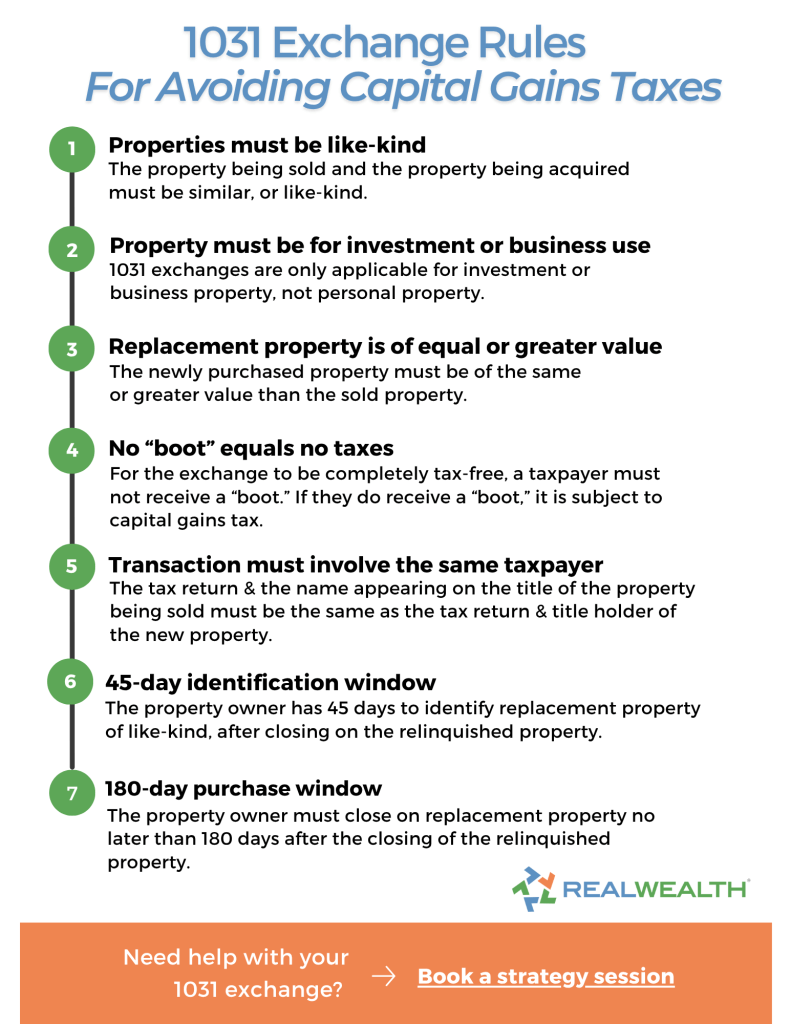
Get our free PDF about the top 1031 exchange rules to follow to avoid paying capital gains taxes.
The 1031 Exchange Timeline
The clock starts the day your relinquished property closes. From that point, two hard deadlines control everything. For a full step-by-step walkthrough, see our 1031 Exchange Timeline: 8 Steps To Avoid Paying Capital Gains.
At a Glance: 1031 Exchange Timeline
| Step | Action | Deadline |
|---|---|---|
| Pre-sale Planning | Decide on the exchange, research replacement markets, and engage your QI | 60-90 days before sale of your rental property |
| List Relinquished Property | Include 1031 language in the sales contract | At the listing stage |
| Engage QI | Must happen before the sale closes | Prior to closing |
| Day 0: Sale Closes | Proceeds go to QI; the clock starts | Sale closing date |
| Day 1-45: Identification Window | Identify replacement property(ies) in writing to your QI | By Day 45 |
| Day 46-180: Exchange Period | Close on at least one identified replacement property | By Day 180 |
| Post-Closing | File IRS Form 8824 and maintain all documentation | With your tax return for the year of sale |
Two things worth noting about these deadlines:
Weekends and holidays count. There are no extensions (except in declared federal disaster situations). Miss Day 45 or Day 180, and the IRS treats it as a taxable sale. Full stop.
This is why having your replacement property options lined up before your sale closes isn’t just a good idea; it’s essential.
How to Choose the Right Replacement Property
Many investors get so focused on meeting the tax deadline that they end up buying the wrong property just to complete the exchange. That’s a mistake that follows you for years.
The 1031 exchange is a chance to upgrade your portfolio, not just shuffle it. Our full guide How To Identify 1031 Exchange Replacement Properties To Boost Cash Flow walks through property selection in detail. Here’s what to focus on:
1) Market Fundamentals First
Strong replacement markets share a few characteristics:
RealWealth works with vetted turnkey property teams that pass our 7-step vetting process in markets such as Birmingham, AL, Cincinnati, OH, Cleveland, OH, Dallas, TX, Jacksonville, FL, Columbus, GA, and more. All of which were specifically selected for their strong fundamentals and investor-friendly conditions.
To learn more about the turnkey teams we recommend and view 1031 exchange replacment replacement properties available now, join RealWealth for free.
2) Cash Flow Over Convenience
If you’re trading out of a low-cash-flow property, your replacement should generate higher cash flow. Run the numbers carefully:
3) One Property or Multiple?
You can sell one property and exchange it for two or more. This is worth considering if:
- You want to diversify across markets or property types
- You want to reduce the risk that one vacancy wipes out all your cash flow
- The math works out better with two smaller properties than one large one
You can identify up to three properties without restriction (the “3-property rule”), or identify more if they meet specific value thresholds.
4) Have Backup Options Ready
You must identify replacement properties by Day 45. Having only one option lined up is risky if the deal falls through. Having two or three qualified candidates ready gives you flexibility without scrambling and added stress.
Does It Matter Which States Are Involved?
Yes, especially if you’re moving from a high-tax state like California.
The federal 1031 rules apply nationwide, so you can sell in one state and buy in any eligible U.S. state. That’s a big opportunity for investors in high-cost, high-tax, or heavily regulated markets. Our article on the 1031 Exchange from California to Another State dives into this specific scenario.
A few things to know about cross-state exchanges:
- California requires ongoing reporting. If you do a 1031 exchange out of California, you must file Form FTB 3840 annually until the deferred gain is recognized.
- State tax rules vary. Your CPA should be aware of tax rules in both your origin state and your replacement state.
- Landlord-tenant laws, vacancy rates, and property taxes differ significantly by state. You’re not just picking a property; you’re picking a regulatory environment that will affect your returns for years.
Moving from a high-tax, high-regulation state into a landlord-friendly market is one of the biggest advantages a 1031 exchange can unlock. If that’s your situation, it’s worth talking through with an investment counselor before you list. Become a RealWealth investor for free and get the guidance and connections you need for a successful tax-deferred exchange.
Common 1031 Exchange Mistakes (and How to Avoid Them)
These 1031 exchange real estate mistakes are more common than you’d think, and some of them are unrecoverable.
At a Glance: Common 1031 Exchange Mistakes
| Mistake | Why It Happens | How to Avoid It |
|---|---|---|
| Hiring the QI after the Sale Closes | Treating the exchange as an afterthought | Engage your QI before listing your property |
| Missing the 45-day or 180-Day Deadlines | Poor preparation, unrealistic timeline | Map out all dates in advance with a buffer built in |
| Touching the Sale Proceeds | Thinking you can hold the funds temporarily | Proceeds must go directly to QI escrow, never to you |
| Not Replacing Debt or Reinvesting Full Equity | Trying to take cash out or reduce debt load | Understand the equal-or-greater debt rule before structuring the deal |
| Buying a Weak Replacement Property | Panic buying to meet the deadline | Start researching replacement options before you list the relinquished property |
| Ignoring State Tax Rules | Focusing only on federal requirements | Get state-specific tax advice for both your origin and destination states |
When a 1031 Exchange Might Not Be the Right Move
As powerful as it is, a 1031 tax exchange isn’t always the best option. Consider skipping it if:
In those situations, a straightforward sale may be the better call. But at least now you know the alternative and can make the decision with clear eyes.
How RealWealth Helps You Execute a 1031 Exchange Real Estate Strategy Successfully
When you’re working against a 45-day identification deadline, having the right team in place isn’t optional. At RealWealth, we’ve built the infrastructure to help investors move quickly and strategically.
As a free RealWealth investor, you get access to:
If you’re thinking about a 1031 exchange, even if the sale is still months away, the time to start is now. Becoming a RealWealth investor is 100% free, and once you’ve joined, you can schedule a complimentary strategy session with your investment counselor and start building your replacement property shortlist before the clock starts. Become a RealWealth investor today!
Real Investors, Real Results
RealWealth investors have used 1031 exchanges to reposition out of underperforming properties and into stronger, more strategic portfolios:
- Ann exchanged out of a San Diego short-term rental and rebuilt her portfolio to a value of $957,900, achieving an ROE of 9.8% on her original $930K in equity. Read Ann’s full story.
- DR started with the same $930K in equity and grew a portfolio worth $1,118,710 through a multi-property exchange. Read DR’s full story.
- Ed traded a self-managed rental in Cambridge for a $624,900 duplex with professional property management already in place, moving from hands-on landlord to hands-off investor. Read Ed’s full story.
See more RealWealth investor success stories.
Note: Equity and portfolio figures reflect data provided at the time of each investor’s exchange. Individual results vary based on market conditions, financing terms, and property performance.
Top Frequently Asked 1031 Exchange Questions
1. What qualifies as “like-kind” property in a 1031 exchange?
The good news here is that the IRS is fairly broad in its approach to real estate. A single-family rental, a multi-family, raw land, and a commercial building all qualify as like-kind to each other. So if you’re selling a rental house and want to buy a small apartment building instead, that works. What doesn’t qualify: stocks, bonds, personal residences, or anything you’re holding to flip rather than rent. The main thing the IRS cares about is that both properties are held for investment or business purposes.
2. Can you do a 1031 exchange from one state to another?
Absolutely, and honestly, this is one of the best uses of the strategy. Federal 1031 rules let you sell in any state and buy in any other. So if you’re in California and tired of high taxes and tight landlord laws, you can exchange right out of that market and into something like Texas, Florida, or Alabama without triggering a taxable event. Just know that California still requires you to file a form annually until the deferred gain is recognized. Your CPA should handle that, but it’s worth knowing upfront. Our article on the 1031 Exchange from California to Another State walks through the details.
3. Can I 1031 exchange into a syndication or fund?
Generally, no, not directly. A 1031 exchange requires “like-kind” real property, and a typical real estate syndication or real estate fund investment is a security interest (an LP or LLC membership interest), not direct ownership of real property, so it doesn’t qualify on its own.
4. How many times can I do a 1031 exchange?
As many times as you want, there’s no federal limit. A lot of long-term investors use what’s called a “swap till you drop” strategy, where they keep exchanging into new properties throughout their lifetime and never pay the deferred tax at all. When you pass the property to your heirs, they receive a stepped-up basis, which essentially wipes out the accumulated gain. It’s one of the most powerful wealth-building and estate planning combinations available to real estate investors.
5. What happens if I miss the 45-day or 180-day deadline?
You lose the deferral; a full stop. The IRS treats it as a regular taxable sale, and you’ll owe capital gains tax for that year, just as if you’d never attempted the exchange. There are no extensions for missing the deadline (with very limited exceptions for presidentially declared federal disasters). This is exactly why we encourage investors to start researching replacement properties before they even list the relinquished one. The 45 days go faster than you think.
6. What is “boot” in a 1031 exchange?
Boot is anything you receive in an exchange that doesn’t qualify for deferral, such as leftover cash, a reduction in debt, or non-like-kind property. Here’s a simple example: if you sell a property for $500,000 and reinvest only $450,000 into the replacement, the $50,000 difference is boot and is taxable. To defer 100% of your gain, you need to reinvest all your net proceeds and carry equal or greater debt on the replacement property. Your QI can help you structure the deal to avoid boot before it becomes a problem.
7. How do I find a Qualified Intermediary for a 1031 exchange?
As an investor, it is important to know that the QI industry isn’t federally regulated, so anyone can set up shop as a QI. That makes who you choose an important decision, not a formality. A QI needs to be engaged before closing so the proceeds go directly to them, never to you, and it’s worth being careful that whoever holds your funds isn’t investing them in risky ways while you’re between purchases. RealWealth investors work with a trusted 1031 exchange facilitator (a professional we use ourselves). Join RealWealth for free here or read our full guide on What is a Qualified Intermediary to understand exactly what to look for and what questions to ask.
8. How can RealWealth help me with a 1031 exchange?
Finding the right replacement property under deadline pressure is where most exchanges break down, and that’s exactly where RealWealth comes in. As an investor, you get access to vetted turnkey property teams in landlord-friendly markets across the country, a network of screened QIs and tax professionals, and investment counselors who’ve walked investors through this process many times. We help you build your shortlist of replacement properties before the clock starts, so you’re not scrambling when Day 45 arrives. Schedule a complimentary strategy session to talk through your specific situation.
Additional 1031 Exchange Resources
Everything you need to go deeper:
- 1031 Exchange Rules Every Investor Needs to Know
- 1031 Exchange Timeline: 8 Steps To Avoid Paying Capital Gains
- What is a Qualified Intermediary For a 1031 Exchange
- How To Identify 1031 Exchange Replacement Properties To Boost Cash Flow
- 4 Types of 1031 Exchanges Real Estate Investors Should Know About
- 1031 Exchange from California to Another State
- How I Doubled My Portfolio with a 1031 Exchange
- 1031 Exchange Masterclass Webinar
- 1031 Exchange Properties for Sale In Top U.S. Markets
- How to Calculate Capital Gains Tax on Investment Property
Looking for a trusted 1031 exchange facilitator?
RealWealth is 100% free to join and includes access to our list of investor resources, such as 1031 exchange facilitators (whom we use ourselves), CPAs, lenders, and more. Join 90,000+ registered investors today to get access to our list of trusted real estate professionals.
The Bottom Line
The big takeaway from this 1031 exchange real estate guide is that this strategy is one of the most powerful tools in a real estate investor’s playbook. It lets you defer capital gains tax, exit underperforming markets, upgrade your cash flow, and build wealth without writing a big check to the IRS every time you make a smart move.
But it only works if you plan ahead. The 45-day and 180-day deadlines wait for no one. The replacement property you buy in a rush to meet the deadline is the one you’ll regret. And the QI you hire after the sale closes, or the wrong QI hired at all, is a risk you don’t need to take.
The investors who get the most out of 1031 exchanges start planning months before the sale with their replacement market research done, their QI lined up, and their team ready to move.
That’s exactly what RealWealth is built to help you do. Join RealWealth for free today and get access to vetted replacement properties, experienced investment counselors, and all the resources you need to execute your exchange with confidence.


