When many people think of real estate investing, they picture buying a rental property, finding tenants, and fielding midnight maintenance calls. And for some investors, that’s exactly what they want. But for a growing number of people or investors who’ve maxed out direct ownership, there’s a better way to put real estate to work—through real estate investment funds.
When you invest in a real estate investment fund, you participate in institutional-quality deals without the landlord headaches. Your capital is pooled with other investors and deployed across multiple properties by an experienced management team. If structured well, it generates income and appreciation while you focus on everything else in your life.
This comprehensive guide covers how a real estate investment fund works, what types exist, how to evaluate them, what fees and risks to expect, and how to take your first step as a fund investor. If you’re already familiar with real estate syndications, you’ll find funds follow a similar passive structure, with some important differences worth understanding.
Quick Answer: What are Real Estate Investment Funds?
Real estate investment funds pool capital from multiple investors to purchase, develop, or manage a portfolio of properties, giving you exposure to real estate without buying or managing anything yourself. Instead of concentrating $50,000–$100,000 in a single property or deal, your capital is spread across multiple assets, markets, and sometimes asset classes, managed by a professional team. Most private real estate funds require accredited investor status, hold periods of 3–7 years, and minimum investments of $50,000+, and offer tax advantages that aren’t available with stocks or REITs.
Top Benefits of Investing in a Real Estate Investment Fund
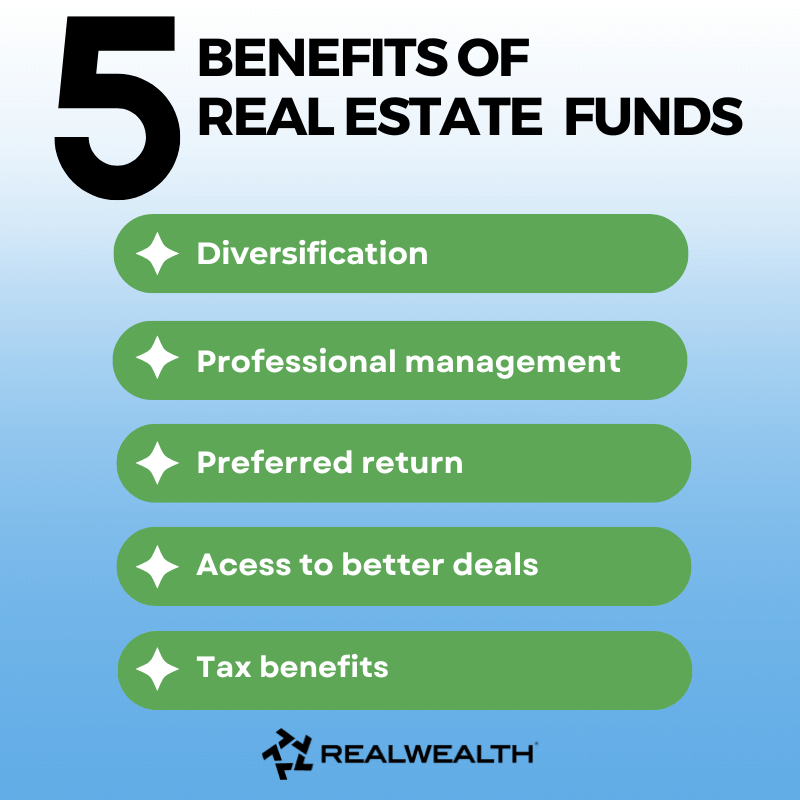
Real estate investors are drawn to fund investing because of the benefits, such as:
- Truly passive income: You have no late-night tenant calls, property management to deal with, or maintenance decisions to make.
- Built-in diversification: Your capital is spread across multiple properties and real estate markets from day one.
- Tax advantages: Depreciation and cost segregation can significantly offset taxable income.
- Access to institutional deals: Invest in apartment complexes, build-to-rent communities, and development projects you couldn’t pursue alone.
- Time freedom: A professional team handles operations while you focus on your life.
Top Risks of Investing in Real Estate Funds
Real estate fund investing can be a powerful wealth-building tool, but every investor needs to weigh these risks first:
- Illiquidity: Your capital is typically committed for 3–7 years with limited ability to exit early.
- Manager dependency: Performance depends heavily on the fund sponsor’s expertise, integrity, and execution.
- Market risk: Economic shifts, rising interest rates, or changes in local demand can affect returns.
- No guarantees: Projected returns and cash flow distributions are targets, not promises.
- High minimums: Private funds typically require $50,000+ upfront, limiting accessibility for some investors.
How to Get Started with Real Estate Investment Funds
Learning how to invest in real estate funds doesn’t have to be overwhelming. Start by:
- Confirming your investor status: Knowing whether you qualify as an accredited investor narrows your options and helps you focus on the right opportunities.
- Educating yourself on real estate investment fund structures: Understanding the difference between REITs, private funds, and real estate syndications helps you choose the right fit for your goals.
- Vetting the sponsor before the deal: The fund manager matters more than any single property. Look for track record, transparency, and aligned incentives. Learn about our vetting process.
Ready to learn more? Join RealWealth for free to access current fund opportunities, educational resources, and connect with the RealWealth Developments Director, Paul DiVincenzo, to figure out if passive fund investing belongs in your portfolio.
What Are Real Estate Investment Funds?
A real estate fund is a pooled investment in which multiple investors contribute capital, which a professional manager deploys across a portfolio of properties. Think of it like a mutual fund, but instead of stocks, the underlying assets are real estate.
Here’s how the basic real estate investment fund structure works:
- You invest capital into the real estate fund alongside other investors
- A fund manager (called a General Partner (GP) or Sponsor) selects properties, executes the business plan, and handles all operations
- You receive returns through regular distributions and a share of profits at exit
- Your liability is limited to the amount you invested
The key difference from buying a property directly is that you’re not picking the specific assets, negotiating with tenants, or managing contractors. You’re hiring a team to do that, benefiting from their expertise and deal flow.
What you gain: Professional management, built-in diversification, access to deals you couldn’t pursue alone, and your time back.
What you delegate: Day-to-day decisions, individual property selection, and operational control.
That trade-off is exactly why real estate investment funds appeal to investors seeking real estate exposure without the active management.
Why Invest in Real Estate Funds?
Real estate fund investing solves a problem that keeps many investors from scaling: as you can only do so much yourself.
Whether it’s capital, time, or expertise, direct ownership has limits. Funds remove several of them at once.
- Professional management: Experienced operators handle acquisitions, asset management, and dispositions on your behalf
- Portfolio diversification: Your capital is spread across multiple properties, markets, and sometimes asset classes from day one
- Access to institutional-quality deals: Apartment complexes, build-to-rent communities, storage facilities, and development projects that are out of reach for individual buyers
- Passive income: Regular distributions without managing a single tenant
- Tax advantages: Depreciation, cost segregation, can be used with an SDIRA and IRA (not available with stocks or bonds)
- Scalability: Easier to grow your real estate portfolio without multiplying your workload
Why Investors Choose RealWealth Developments Funds
When you invest in a single real estate syndication deal, your capital is concentrated in one property, one market, and one business plan. If that deal underperforms, there’s no buffer.
A real estate investment fund changes that equation. Your capital is deployed across multiple properties, sometimes across multiple asset types, which means the performance of any single asset has less impact on your overall return. Funds also allow continuous capital deployment: as new opportunities arise, the fund manager can move quickly without requiring you to evaluate and commit to each individual deal. That saves you significant time in due diligence while keeping your capital working.
RealWealth Developments (RWD) structures its fund offerings with this in mind. With a target of:
- 16-22% internal rate of return (IRR)
- 1.85X equity multiplier
We focus on Tier 2 and Tier 3 markets across the South, Midwest, and Mountain West, markets with strong population and job growth, where deals still pencil. Every project goes through a rigorous 9-step vetting process before investor capital is deployed.
Are Real Estate Funds a Good Investment?
That depends on three things: the fund, the manager, and your goals.
Done well, real estate investment funds have historically delivered returns that compare favorably to stocks, with less day-to-day volatility and the added benefit of tangible asset backing. But not all funds are created equal, and the wrong manager or structure can cost you.
Real estate funds tend to work best for investors who:
- Are accredited investors with capital to deploy beyond their primary residence or direct properties
- Want passive exposure to real estate without active management responsibilities
- Have a 3-7 year time horizon and don’t need immediate liquidity
- Are looking to diversify beyond stocks, bonds, or direct property ownership
- Value professional due diligence and don’t have the time or network to source deals themselves
That said, investing in real estate funds isn’t for everyone. If you need quick access to your capital, want full control over individual property decisions, or don’t yet qualify as an accredited investor, a different strategy may be a better starting point.
For a head-to-head look at how funds compare to other options, see the comparison section below.
Types of Real Estate Investment Funds
Not all real estate funds are built the same. Here’s a breakdown of the main structures you’ll encounter:
Real Estate Investment Trusts (REITs)
- Publicly traded on stock exchanges.
- Accessible to all investors, highly liquid, low minimums ($500-$5,000).
The trade-off: less control, tied to market volatility, and typically lower returns than private alternatives.
Private Real Estate Investment Funds
- Not publicly traded.
- Accredited investors only, higher minimums ($25,000-$100,000+), but generally stronger return potential.
- Capital is locked up for the fund’s hold period (typically 3-7 years).
This is where RealWealth Developments operates.
Real Estate Development Funds
- Focus on ground-up construction, building properties rather than buying existing ones. Higher risk, higher return potential.
RealWealth Developments’ build-to-rent and land development projects fall into this category.
Risk/Return Chart: Core, Core-Plus, Value-Add, and Opportunistic Funds
| Fund Type | Risk Level | Target Return | Strategy |
|---|---|---|---|
| Core | Low | 6-9% IRR | Stabilized, income-producing assets |
| Core-Plus | Low-Moderate | 9-13% IRR | Minor improvements to stabilized assets |
| Value-Add | Moderate | 9-13% IRR | Improve underperforming assets |
| Opportunistic | High | 18%+ IRR | Development, distressed assets |
Open-End vs. Closed-End Funds
- Open-end funds allow ongoing contributions and redemptions.
- Closed-end funds raise capital once, deploy it, and distribute proceeds at exit.
- Most private real estate funds are closed-end.
How to Invest in Real Estate Funds: Step-by-Step
Step 1: Determine Your Investor Status
Most private real estate funds require accredited investor status. To qualify, you need:
- Annual income of $200,000+ ($300,000 for couples) for the past two years, with expectation of the same going forward, OR
- Net worth of $1,000,000+ (excluding your primary residence)
Non-accredited investors can access REITs and some crowdfunding platforms, but options are more limited.
Step 2: Define Your Goals
Know what you want before you start shopping for a real estate investment fund. It sounds obvious, but skipping this step is how investors end up in the wrong fund for their situation. Think through:
- Income vs. appreciation: Do you want regular distributions or a bigger payout at exit?
- Risk tolerance: Core vs. value-add vs. opportunistic?
- Time horizon: How long can your capital be tied up?
- Capital allocation: What percentage of your portfolio makes sense for real estate funds?
Step 3: Research and Compare Funds
Key metrics to evaluate:
- Target IRR and equity multiple: What returns is the real estate fund projecting, and what’s the basis for those projections?
- Hold period: When do you get your money back?
- Preferred return: Do investors get paid before the sponsor takes profits?
- Track record: Has this manager performed across market cycles, not just during a bull market?
- Fee structure: Management fees, acquisition fees, performance fees (more on this below)
Step 4: Conduct Due Diligence
- Review the Private Placement Memorandum (PPM) carefully
- Check the fund manager’s background (SEC, BBB, references)
- Understand the governance structure and your rights as a limited partner
- Ask for investor references from previous deals
For a deep dive on evaluating syndication deals, this guide on underwriting real estate syndications applies equally to fund investments.
Step 5: Complete the Investment Process
- Review and sign subscription documents
- Understand capital call schedules (when and how your money is drawn down)
- Decide whether to invest personally or through a self-directed IRA
- Wire funds per the fund’s instructions
Step 6: Monitor Your Investment
- Expect quarterly reporting from a well-run fund
- Track distributions against projections
- Attend investor update calls when available
- Evaluate the real estate fund’s performance against its stated business plan
Real Estate Investment Funds vs. Other Options
| Feature | Funds | REITs | Direct Ownership | Syndications |
|---|---|---|---|---|
| Liquidity | Low (3-7 year lock) | High (publicly traded) | Low | Low (deal-specific) |
| Minimum Investment | $25K-$100K+ | $500 or less-$5K+ | $50K-$300K+ | $50K typical |
| Diversification | High (portfolio) | High | None | None (one deal) |
| Control | Low | Very low | Full | Low |
| Return Potential | High | Moderate | Moderate-High | High |
| Accreditation Required | Usually yes | No | No | Usually yes |
| Management Burden | None | None | Full | None |
Funds vs. Syndications is the comparison most relevant to RealWealth Development investors.
The core difference: a real estate syndication is a deal with one property and one exit timeline. A real estate investment fund deploys capital across multiple real estate deals, which reduces concentration risk and removes the need to evaluate each acquisition individually. Both are passive, but funds are more diversified. Learn more about syndications here.
Fees in Real Estate Investment Funds
Every real estate investment fund deal has its own size and type, so fees for things like loans, construction management, development, and management vary widely.
Questions to ask any fund manager:
- What fees are charged, and at what stage are they charged?
- How are performance fees structured: is there a preferred return first?
- What does the waterfall look like? (How profits flow from the fund to investors to the sponsor)
For a deeper look at how preferred returns and waterfall structures work, this article breaks it down clearly.
REITs report fees as an expense ratio, typically 0.5-1.5% for publicly traded REITs, and higher for non-traded REITs.
Tax Considerations for Real Estate Fund Investors
Taxes look very different depending on which type of fund you invest in. Here’s what to expect.
Private real estate investment funds (LPs/Members):
- You’ll receive a K-1 each year reporting your share of income, losses, and deductions
- Depreciation pass-through can offset taxable income, a major advantage over stocks
- Cost segregation may accelerate those deductions further
- Capital gains at exit may qualify for favorable long-term rates
REITs:
- Distributions reported on 1099-DIV
- Qualified dividends receive preferential tax treatment
- No direct depreciation pass-through
Self-directed IRAs:
- Investing through a self-directed IRA (SDIRA) can defer or eliminate taxes depending on account type (traditional vs. Roth)
- Additional rules apply, so work with a qualified custodian and tax advisor
One important note: K-1s from private funds often arrive late in tax season (March-April), which can require filing extensions. Plan for this.
Work with a CPA experienced in real estate fund investing. RealWealth investors have access to vetted CPA resources through the Investor Resources tab. Please consult with a CPA before investing in any real estate deal.
How to Evaluate Real Estate Investment Funds
Not every real estate investment fund that promises strong returns delivers them. Before committing capital, run every fund through these filters.
1. Manager track record
This is the single most important factor. Ask for actual performance data, not just projections:
- How many funds has this team managed to completion?
- What were the real returns, compared to what was originally projected?
- How did they handle the 2008 downturn?
2. Investment strategy clarity
A good fund manager can explain their strategy in plain language. If they can’t, that’s a problem. You want to know:
- What asset types does the real estate fund target, and why?
- Which markets, and what’s the data behind that selection?
- What’s the exit strategy, and are there backup options if the first plan doesn’t work?
3. Fee structure and alignment
Fees are normal. Fee structures that benefit the sponsor even when investors lose money are not. Check:
- Does the sponsor co-invest their own capital? (They should.)
- Is there a preferred return that investors receive before the sponsor takes profits?
- Do performance fees only kick in after investors are made whole?
4. Governance and investor protections
You won’t control individual property decisions, but you should have clearly defined rights:
- What can limited partners vote on?
- How often do investors receive performance reports?
- What’s the process if the fund needs to make a major unplanned decision?
5. Communication
How a manager communicates during the diligence process tells you a lot about how they’ll communicate when things get hard. Are they responsive? Proactive? Or do you have to chase them?
6. Red flags to watch for
Why Investors Choose RealWealth Developments
RealWealth Developments was built out of RealWealth’s 20+ year commitment to investor education and transparency. Here’s what sets us apart:
1. Rigorous deal vetting
Every RWD fund investment goes through a 9-step vetting process. We select markets based on population growth, job growth, landlord-friendly laws, and strong fundamentals. We evaluate developers for track record, local expertise, and financial strength.
2. Aligned interests
RealWealth principals co-invest personal capital in every deal. Preferred returns are structured to protect investors first, before RealWealth Developments takes any profit share. This isn’t just PPM language; it reflects how the team approaches every deal.
3. Target returns that make sense
RealWealth Developments targets 16-22% IRR with a 1.85X equity multiple. Minimum investments are $50,000 for accredited investors through 506(c) offerings.
Deal types in the RealWealth Development portfolio:
- Multifamily (value-add apartment complexes)
- Build-to-rent communities (ground-up SFR developments)
- Single-family rental portfolios
- Single-family home developments (sell at retail)
- Land development (entitlement and sale to homebuilders)
- Self-storage (recession-resistant cash flow)
4. Education-first approach
No pressure. No cold calls. RealWealth Development investors have access to detailed offering documents, due diligence materials, and direct conversations with Paul DiVincenzo, RWD’s Syndications Director, before making any commitment.
5. Quarterly reporting and transparency
Investors receive detailed quarterly updates on fund performance. The team communicates proactively, including during challenges. That transparency is central to how RealWealth has retained the trust of 90,000+ registered investors for over two decades.
Getting Started with Real Estate Fund Investing
Whether you’re new to passive investing or looking to add a real estate investment fund to an existing portfolio, here’s how to take your first step.
For new investors, start here:
- Confirm your accredited investor status
- Define your goals: income, appreciation, or both?
- Decide how much capital you’re allocating to this asset class
- View the current offerings at RealWealth Developments
For investors ready to explore real estate funds:
Step 1: Join RealWealth
Becoming a RealWealth investor is free. Join here and navigate to the open syndication offerings page to see what is currently available.
Step 2: Connect with Paul, RealWealth Developments Director
Step 3: Review due diligence materials.
Request the PPM, operating agreement, and pro formas for any offering you’re evaluating. Read them carefully. Ask questions about anything unclear.
Step 4: Invest at your comfort level.
There’s no pressure to move fast. Take the time you need to feel confident. RealWealth’s job is to educate and empower, not to push you into a deal before you’re ready.
The Bottom Line
Real estate investment funds give you a way to build a portfolio of income-producing properties without the time, expertise, or capital required for direct ownership. Whether you start with a publicly traded REIT or move into a real estate fund through an operator like RealWealth Developments, the mechanics are the same: professional management, pooled capital, and passive returns.
The key is finding a fund manager with a proven track record, transparent communication, and interests that align with yours, not just someone chasing fees.
If you’re ready to learn more, join RealWealth for free. You’ll get access to our complete educational library, vetted fund opportunities through RealWealth Developments, and a team of investment counselors who can help you figure out whether passive fund investing belongs in your portfolio.
Or, if you’re ready to talk specifics, schedule a complimentary consultation with the team today.