If you’ve been researching out-of-state rental properties, RealWealth and Roofstock have probably both come up. On the surface, they seem to solve the same problem by helping investors find and buy out-of-state rental properties without having to source deals themselves. But the way each company is built, how each one makes money, and what that means for your experience as an investor are fundamentally different.
To be fully transparent, this comparison is written by RealWealth. We believe it is important to tell you this up front, because we think the honest move is to give you a genuinely fair look at both models, including where Roofstock does some things well, so you can make the right call for your strategy.
Please note that fees, fund availability, and third-party ratings referenced in this article reflect information available as of the publication date of this article in July 2026 and may have changed since publication. We encourage you to verify current details directly with Roofstock before making any decisions.
By the end of this RealWealth vs Roofstock comparison, you’ll have a clear picture of what each model actually is, what independent investors have experienced with both, and which one is built around your interests as an investor.
| Features | RealWealth | Roofstock |
|---|---|---|
| Best for | Vetted, off-market access + syndications | Self-directed investors |
| Fees | No transaction fees (referral-based) | Buyer fee (0.5% or $500 min) |
| Inventory | Off-market, renovated and new construction properties to REAL Income Standards, vetted teams | Open marketplace |
| Syndications | Yes, RealWealth is the sponsor | Institutional only |
| Post-closing support | Ongoing investment counselor | Primarily transaction-focused |
Quick Answer: What Is the Difference Between RealWealth and Roofstock?
When comparing RealWealth vs. Roofstock, you’ll find two very different approaches to real estate investing. One is an online marketplace where you browse and buy independently, and there are real estate fund opportunities to institutional investors. The other is an independent matchmaker that vets property teams, helps guide your strategy, and sponsors its own real estate syndications and funds for accredited investors.
RealWealth has two arms: RealWealth Realty is the turnkey real estate investing side of the business that connects investors with vetted teams selling off-market properties (SFR, MFR, rehabbed, new build) across 15+ markets, and RealWealth Developments is the syndication side that sponsors its own real estate syndications and funds for accredited investors.
Becoming a RealWealth investor is free, and properties are never marked up. RealWealth earns referral fees from turnkey property teams and affiliate relationships with investor-related service providers, such as lenders, asset protection specialists, and 1031 exchange facilitators.
Roofstock is an online marketplace where sellers list single-family rental properties for sale. Buyers browse, underwrite deals using Roofstock’s data tools, and purchase independently. Roofstock charges buyers a marketplace fee of 0.5% of the purchase price or $500, whichever is higher. Roofstock does offer a sponsored SFR fund, but at the time of posting this article, it is available only to large-scale institutional investors, not individual accredited investors.
Below you’ll find more information about both companies, including how they work, how each one makes money, what real investors have said about both on independent platforms, and which company best suits your investment strategy.
Join RealWealth for free to see both turnkey properties and open real estate syndication and fund opportunities for yourself.
Two Companies, Two Very Different Business Approaches
RealWealth and Roofstock both connect investors to single-family rental properties without requiring them to source deals themselves. That’s where the similarity ends.
Roofstock
Roofstock is a technology-driven online marketplace. Think of it as the eBay of rental real estate. Sellers, including institutional investors, individual landlords, and homeowners, list properties on Roofstock’s platform. Buyers browse, analyze the data, and purchase. Roofstock facilitates the transaction and earns fees from both sides. They don’t own, renovate, or manage the properties. Roofstock’s primary role centers on facilitating the transaction itself, rather than providing ongoing support after closing.
RealWealth
RealWealth Realty works differently on the turnkey side. We don’t list properties from sellers who pay to be part of our network. We spend months independently vetting local turnkey property teams, connect investors with those teams, and earn a referral fee from the team, not from marking up your purchase price. You pay the same price as if you went directly to that team yourself. And because we’re not the seller, we have no financial incentive to push one property over another. Our aim is simply to connect you with the best turnkey property teams selling properties in growth markets.
RealWealth Developments operates differently on the syndication side. We don’t refer accredited investors to someone else’s fund. RealWealth Developments creates, underwrites, and operates its own real estate syndications and funds. We are the general partner, and our returns are tied to deal performance, not deal volume. Roofstock’s fund equivalent is entirely walled off from individual investors, available only to large-scale institutional asset managers.
That structural difference, across both turnkey properties and passive investing opportunities, shapes every interaction you’ll have with each company and every dollar you’ll spend.
For the purposes of this article, we’ll compare RealWealth Realty’s turnkey investing model against Roofstock’s marketplace, and RealWealth Developments’ syndication offerings against Roofstock’s institutional SFR fund, since both companies offer fund-level real estate exposure, but for very different investor types.
What RealWealth Actually Is
RealWealth was founded in 2003 by Rich and Kathy Fettke and has helped 90,000+ registered investors build wealth passively ever since. RealWealth Realty operates as an independent matchmaker, vetting local turnkey property teams across 15+ markets, connecting investors with those teams, and earning a referral fee from the team rather than marking up your purchase price. RealWealth Developments syndications and funds offer opportunities for investors to pool capital together to acquire larger properties and real estate assets.
RealWealth Highlights:
- 90,000+ registered investors
- $1.4B+ in assets acquired by RealWealth referrals
- 8,000+ rental properties acquired by investors through RealWealth Realty
- 23+ years of systematic vetting
- 10+ year relationships with our top turnkey property teams
- $150M equity raised by RealWealth Developments
- $132 million assets under management by RealWealth Developments
- 16-22% target IRR at RealWealth Developments
- 95%+ deal rejection rate at RealWealth Developments
When investors research RealWealth alongside Roofstock, they often find RealWealth positioned as the beginner-friendly option while Roofstock is credited as the more sophisticated, data-driven platform for experienced self-directed investors. That framing misses what RealWealth actually does and why the distinction matters for your returns.
Here’s how the full model works:
Turnkey rental properties Through RealWealth Realty
- Turnkey rental properties across 15+ researched markets through RealWealth Realty
- All turnkey inventory is off-market, which means you’re not browsing the MLS or competing with retail buyers
- Teams offer single-family and small multi-family (2-4 units) across cash flow and growth markets
- New construction is available through select vetted property teams
- Properties are never marked up, which means you pay the same price as going direct
- Throughout the year, select property teams may offer buyer concessions across all property types. These may include below-market interest rates through preferred lenders, rate buydowns, and reduced property management fees, depending on what each team is offering at the time
- Every market was selected based on job growth, population trends, landlord-friendly laws, and long-term appreciation fundamentals
Real estate syndications & funds through RealWealth Developments
- RealWealth isn’t just a referral to someone else’s real estate syndication or fund; we are the sponsor
- RealWealth Developments creates, underwrites, and operates its own deals
- Investors invest alongside RealWealth as the general partner
- Available for accredited investors looking for 100% passive, institutional-style real estate exposure
Joining RealWealth & strategy sessions with Investment Counselors is free
- Becoming a RealWealth investor is free; it always has been
- Every RealWealth investor gets access to complimentary strategy sessions with experienced investment counselors
- Counselors are not on transaction-based pay; their job is to help you figure out the right path, not close a deal
For investors who want to go deeper on market cycles, economic trends, and real estate investing strategies, RealWealth co-founder Kathy Fettke hosts The RealWealth Show, the first podcast about real estate investing and Real Estate News for Investors.
If you want to see what turnkey properties are available in top markets, or view open real estate syndication and fund opportunities, become a RealWealth investor. It takes less than five minutes.
How RealWealth Realty Vets Property Teams (7-Step process)
This is the part most comparison articles skip entirely, because most companies don’t have a structured process for vetting turnkey property teams and property management teams. RealWealth Realty does, and to our knowledge our REAL Income Property Standards™ are the only named, enforced turnkey rental property standard of its kind in the space.
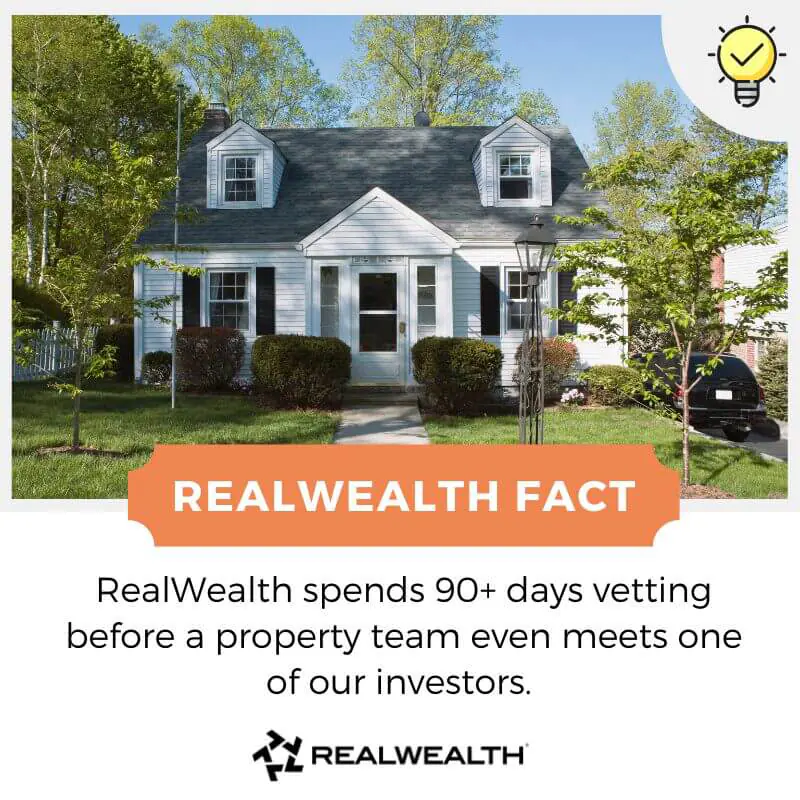
Before a turnkey property team is ever introduced to a RealWealth investor, they go through a 90+ day vetting process that includes:
Step 1. Market Selection
We conduct extensive research on top-performing markets by evaluating local economic conditions, job growth trends, population growth, affordability metrics, and landlord-friendly regulations. If the market doesn’t pass, no team in it gets considered.
Step 2. In-Person Site Visits
Our team conducts on-site visits to each market to inspect rehabs and new construction projects firsthand, meet property teams and tour their operations, evaluate neighborhoods and property conditions, verify construction quality and standards, and assess property management operations.
Step 3. Company Background & Reference Checks
We conduct thorough due diligence on every turnkey property team in our network, including historical performance and a portfolio review, comprehensive background verification of owners and key personnel, reference checks with past clients and industry partners, and evaluation of property management operations and systems.
Step 4. Inventory Analysis
Our team physically spends time in each market and inspects everything the turnkey property teams do, including on-site evaluation of construction quality and standards for both rehabs and new-build projects. Every team must adhere to our REAL Income Property Standards™, which set the quality standards that RealWealth and our investors expect.
Step 5. REAL Income Property Standards™
All property teams in our network are held to our proprietary REAL Income Property Standards™, a named, structured framework covering four areas: Renovated or Built to standard (with specific minimum requirements for roof, HVAC, plumbing, hot water tank, foundation, electrical, flooring, kitchen, bathroom, and interior paint); Examined through inspections and due diligence; Appraised at or below market value; and Licensed property management that meets national industry standards. To our knowledge, no other turnkey real estate company, including the ones in this comparison, has an equivalent named, enforced standard.
Step 6. Contract Review
We conduct a comprehensive review of all contracts to ensure specific contingencies, such as appraisal and inspection contingencies, are included. This is not a legal review, but an additional layer of oversight before any investor moves forward.
Step 7. Investor Feedback Loop
Vetting doesn’t stop at approval. We monitor and report on issues experienced by our investors through a documented process, use that feedback to refine our referral list, and require continued positive feedback for teams to remain in our network. We also maintain transparency regarding new property teams that are still in the evaluation phase.
If a property team stops performing or communicating, they are removed. We can do that because we’re independent. We have no operational ties to the turnkey teams we recommend, so there are substantially fewer financial conflicts when deciding whether to continue recommending a turnkey provider.
How RealWealth Developments Vets Syndications & Funds (9-Step Process)
Step 1: Initial Screening
- Market analysis and opportunity identification
- Preliminary financial review, including initial underwriting
- Asset class evaluation (multifamily, build-to-rent, self-storage, industrial, land development)
Step 2: Background Checks
- Comprehensive background verification of sponsors/operators
- Legal and compliance review
Step 3: Track Record Analysis
- Review of the sponsor’s or project team’s historical performance
- Evaluation of past deals through different market cycles
- Investor reference checks
Step 4: Full Underwriting
- Conservative, data-driven financial analysis
- Risk-adjusted return projections
- Stress testing under various scenarios
Step 5: Third-Party Validation
- Independent appraisals
- Third-party financial verification
- External market research validation
Step 6: Site Visits
- Physical inspection of properties or development sites
- Market and neighborhood evaluation
- Meet with local teams and operators
Step 7: Deal Structure Review
- Profit split analysis
- Fee structure evaluation
- Investor protection mechanisms
- Preferred return verification
Step 8: Sponsor or Project Team Alignment Assessment
- Verification of sponsor co-investment (“skin in the game”)
- Management team capability evaluation
- Communication and transparency standards
Step 9: Legal Documentation Review
- Private Placement Memorandum (PPM) analysis
- Operating agreements
- Investor protections and rights
For a full breakdown of our vetting standards for RealWealth Realty and RealWealth Developments, see our vetting process page.
How Roofstock Works
Roofstock was founded in 2015 and has processed over $5 billion in real estate transactions. It operates as an online marketplace where sellers list single-family rental properties, and buyers purchase them through Roofstock’s platform. Roofstock does not own, renovate, or manage the properties it lists.
Here’s how their model works:
The business structure:
- Sellers, including institutional investors, individual landlords, and homeowners, list properties directly on Roofstock’s platform
- Roofstock charges buyers a marketplace fee of 0.5% of the purchase price or $500, whichever is higher
- Roofstock charges sellers a listing fee of $2,500 or 3% of the sale price, whichever is greater
- ‘Roofstock Certified’ inspections are conducted by local third-party contractors, not Roofstock itself.
- Roofstock’s own site describes verifying rent payment history ‘with the seller,’ rather than through independent records (It’s not clear on Roofstock’s website what its full pre-listing verification process includes beyond the inspection.)
- Roofstock connects buyers with a network of third-party local property management companies but does not manage properties directly
- Roofstock’s Terms and Conditions explicitly state that buyers agreed to rely on third-party data at their own risk; Roofstock cannot be sued if an inspector misses a major issue
- Roofstock has an A+ BBB rating but is not BBB accredited
- For institutional investors, Roofstock offers a sponsored SFR fund and asset management services; these are not available to individual retail or accredited investors
What they do well:
- Large volume of listings across multiple markets is useful for investors who want to browse many options simultaneously
- Tenant-occupied properties available, meaning some properties generate rental income from day one
- Data and analytics tools including cap rate estimates, neighborhood scores, inspection reports, and floor plans for every listing
- 30-day money-back guarantee on eligible Certified properties (terms apply, requires cooperation with relisting)
- Self-directed model suited to experienced investors who prefer to underwrite deals themselves
What independent investors have flagged:
- Roofstock listings don’t always account for real costs. One investor on Reddit found deals that looked cash-flow positive on paper turned out negative once he ran his own numbers, since Roofstock’s data can leave out or downplay vacancy, maintenance, and other expenses
- “Roofstock Certified” inspections conducted by local third-party contractors, not Roofstock itself. Several investors posting on BiggerPockets and Reddit reported significant issues discovered post-closing that inspections missed or downplayed
- Inventory quality concerns. One Reddit user described Roofstock’s listings as ‘a dumping ground for regretted purchases,’ pointing to overpriced properties needing significant work, vacant homes in high-vacancy markets, and listings with nonpaying tenants already in place.
- Post-closing support described as minimal. Multiple investors on Reddit reported agents lost motivation to help after the transaction closed
- Property management quality varies widely. Roofstock connects buyers with local managers but has no operational control over them once the transaction closes (Reddit)
- No consistent property condition standard. What you get depends on what the seller disclosed and what a local inspector happens to catch, and investors report real gaps between the two (BiggerPockets, Reddit)
- Multiple buyers report significant issues discovered post-closing that inspections missed or downplayed, including one investor on BiggerPockets who shared that quoted rent ran well above actual market rent, and another on Reddit that involved a string of undisclosed repair issues
Real estate outcomes vary with any company, and these patterns don’t reflect every Roofstock investor’s experience. Results vary significantly by market, property type, and the specific property. The concerns noted above are worth understanding clearly before committing.
What Real Investors Have Said
Independent investor reviews exist for both companies, though neither has the volume you’d find with some larger operators. Here’s what investors have actually said on independent platforms, on both sides.
RealWealth Reviews: What investors have said
BiggerPockets forum discussion by Kyle N. (8-property investor, verified):
- After closing on two Alabama properties, his property manager became unresponsive for months. His RealWealth adviser intervened, the local team proactively switched management companies, and the situation was resolved without Kyle paying a dime or fighting for it.
- On a post-close sewer issue: “They definitely had my back. Had I gone alone, I would have been replacing the sewer line and fixing the tub myself, and never gotten reimbursed rent.”
- Credited RealWealth specifically for finding a property team he would never have found independently.
Yelp discussion by Michael D. (multiple properties in Florida, Ohio, and Texas):
- Attended a live RealWealth event in Tampa, expecting a hard sell and hidden fees. Got the opposite — a free two-day event with no sales pitch, just education and property tours.
- “Every single team we’ve worked with has been professional, transparent, and a pleasure to do business with. All our properties have appreciated nicely and continue to perform well, and we’ve always felt supported by RealWealth before, during, and long after the purchase.”
Yelp discussion by Antonio C. (Ohio properties purchased 12 years ago):
- Bought two rental properties in Ohio through RealWealth over 12 years ago. Both appreciated and generated healthy cash flow.
- “One of my best decisions was to buy through RWN (RealWealth, formerly known as RealWealth Network) instead of directly from the provider. This gives you much more leverage when issues arise, and when you own a real asset, issues do come up.”
RealWealth investor success stories
- Malcolm and Merry success story (RealWealth investors since 2017): Started with one $100K property, now own 12
- Claudia and Julian Fraser success story (RealWealth investors since 2012): Turned one failing California beach house into 7 cash-flowing properties with a 1031 exchange
- Robby and Athena success story (RealWealth investors since 2023): Started investing at 21, targeting 20 properties
You can read more investor experiences on our real estate investing success stories page.
One honest note: A BiggerPockets reviewer had a negative experience with a specific Ohio property team, in which properties were marked up roughly 30% above local market value with poor follow-up after closing. His complaint was directed at the property team, not RealWealth’s model. That kind of situation is exactly why our ongoing monitoring and removal process exists.
A second honest note: Not every investor’s experience with RealWealth’s recommended teams has been positive. On Yelp, one investor described serious issues with a Baltimore property management team, including billing errors and a lack of accountability during a management transition. Another long-term investor reported disappointing returns across multiple markets and, over time, frustrations with property team relationships.
In both cases, the underlying complaints were about specific third-party teams, not RealWealth’s model. The Baltimore team is no longer part of our network. For other markets, our team relationships and standards evolve over time, and investor feedback is the primary driver of those changes. No vetting system eliminates all risk, and we think investors deserve to know that upfront.
Roofstock Reviews: What investors have said
BiggerPockets forum discussion by JC Wu Jacksonville property):
“Buying properties from Roofstock is like buying properties without a buyer’s agent. Their ‘one stop for all’ business model is inherently flawed, and the water is too deep for newbie buyers. The increased efficiency is achieved at the cost of buyers’ best interests.”
- Lost $30,000+ on a Roofstock-certified property after discovering an undisclosed permitting issue post-closing that was not flagged in the inspection report
- Market rent quoted by Roofstock was $1,025/month; actual market rent was $900-965/month
- Describes Roofstock’s Terms and Conditions as protecting sellers and Roofstock from liability far more than a typical MLS transaction
“This is a 1-star review for newbie buyers; 3-star review for seasoned buyers who know what to watch out for when evaluating deals; 5-star review for sellers, especially those who want to evade scrutinization from shrewd local brokers.”
“Can’t be lazy with this stuff is what I learned. Everyone is out to get your money if you get lazy with this. Bought a house with them and is a 30k repair nightmare.”
- Claims Roofstock denied the 30-day money-back guarantee despite finding the inspection report inaccurate
- Engaged a lawyer after the guarantee was not honored
Reddit discussion by deanipple (first Roofstock property):
“I’ll take responsibility for most of my issues because I trusted the Roofstock inspection report to be accurate. In actuality, it was more so misleading at best and fraudulent at worst.”
- Closed August 31; immediately hit with gas meter issues ($700-800), furnace control board failure ($940), severe drain clog ($350), full bathroom plumbing replacement ($3,000), missing attic insulation ($2,400-2,800), and external plumbing access issues ($2,100)
- Previous owner was a house flipper who cut corners with no paper trail
Reddit discussion by Impressive-Leg7119 (2018-2020 buyer):
“I wanted to share a cautionary experience for those relying on data from turnkey providers, including RoofStock. Back in 2018-2020, I purchased three properties through RoofStock and was generally happy. However, when I recently browsed their listings, I was shocked at how much the data quality had declined. I usually use their numbers to shortlist properties before doing final due diligence — but this time, the discrepancies were massive. Properties that initially appeared cash-flow positive turned out to be cash-flow negative after verifying the actual numbers.”
Real estate outcomes vary with any company, and these patterns don’t reflect every Roofstock investor’s experience. Roofstock has processed over $5 billion in transactions, and many buyers report smooth closing experiences. The concerns raised above center on post-closing surprises, inspection accuracy, and data quality. Regardless of which platform you use, it’s worth verifying all data independently.
The Difference Between a Transaction and a Strategy
Roofstock’s Transaction Model
Roofstock is built for investors who already know what they’re doing. If you can read a cap rate, verify rent comps against local data, evaluate a neighborhood independently, underwrite a deal from scratch, and manage a property manager relationship without any support, Roofstock gives you the inventory and the tools to do that at scale.
RealWealth’s Strategy Model & REAL Income Property Standards
RealWealth Realty exists so you don’t have to become a full-time real estate analyst to invest well. The market selection, the 90+ day vetting process, the REAL Income Property Standards™, the investment counselor who knows your goals, all of that work happens before you ever look at a property. By the time a RealWealth Realty investor is reviewing a deal, the foundational due diligence has already been done independently on their behalf.
That includes something Roofstock doesn’t offer at all: named, enforced property condition standards. In the turnkey space, ‘certified’ can mean almost anything. RealWealth Realty’s REAL Income Property Standards™ set specific minimums for roof, HVAC, plumbing, electrical, and structural integrity before any team enters our network. Roofstock has no equivalent. What you get depends on what the seller disclosed and what a third-party contractor caught.
That’s not hand-holding. That’s the difference between browsing a marketplace where you perform much more of your own due diligence and building a strategy with a company that has already vetted every team and market and created turnkey rental property standards before you ever look at a real estate deal.
And for accredited investors who want to go further, RealWealth Developments sponsors its own real estate syndications and funds. Roofstock’s fund equivalent requires institutional scale. It was never built for individual investors.
RealWealth Realty & RealWealth Developments work differently on both sides of what we do:
On the turnkey investing side through RealWealth Realty:
- We earn a referral fee from turnkey property teams, not from marking up your purchase price
- Investment counselors are not on transaction-based pay
- Your relationship with your investment counselor doesn’t end at closing; RealWealth Realty investors have access to ongoing support
- We have no inventory to push and no financial incentive to favor one property or market over another
- Because we’re independent from the teams we recommend, we can remove underperforming teams without any operational disruption to our business
On the real estate syndication side, through RealWealth Developments:
- RealWealth Developments is the general partner and sponsor of its own real estate syndications and real estate funds
- Our returns come from deal performance, not deal volume
- When a RealWealth syndication succeeds, we succeed alongside our investors
- Accredited investors can participate starting at $50,000, unlike Roofstock’s institutional-only offerings
One model connects you to a transaction. The other helps you build a strategy and becomes a support system for your long-term real estate investing success.
Want to see how the model works firsthand? Join RealWealth for free to access current turnkey properties, view open real estate syndication and fund opportunities, and connect with an investment counselor. No obligation, no transaction pressure.
RealWealth Realty vs. Roofstock: Side-by-Side Comparison
| Features | RealWealth Realty | Roofstock |
|---|---|---|
| Business model | Independent matchmaker connecting investors to vetted turnkey property teams, real estate syndications and real estate funds | Online marketplace where individual sellers list rental properties for sale |
| Founded | 2003 (as RealWealth Network) | 2015 |
| Cost to investor | Free to become a RealWealth investor, no transaction fees | 0.5% of purchase price or $500, whichever is higher |
| How they make money | Referral fees from property teams; no property markups; affiliate relationships with vetted investor service providers, including lenders, attorneys, and 1031 exchange facilitators | Buyer fee (0.5% or $500 min); seller listing fee ($2,500 or 3% of sale price); institutional asset management fees |
| Property markups | None. Properties are never marked up. You pay the same price as if you went directly to the property team. RealWealth Realty earns nothing from your purchase price or repair bills | No markup by Roofstock, sellers set their own prices; no independent verification of market value |
| Inventory type | All off-market; mix of SFR, multifamily, new construction, and rehabbed properties held to REAL Income Property Standards™ | Open marketplace; mix of tenant-occupied and vacant SFR from individual sellers and institutions |
| New construction | Yes, through vetted property teams | Available through select listings |
| Financing incentives | Yes, buyer concessions are sometimes available across all property types through select teams; they vary by team | No platform-level financing incentives; buyers arrange their own |
| Markets | 15+ researched markets based on economic fundamentals | Multiple markets nationwide (open marketplace) |
| Property standards | REAL Income Property Standards™, proprietary, named, enforced, verified in person | “Roofstock Certified” inspection by third-party contractors; no named property standard |
| Vetting process | 7-step independent vetting with 90+ day process, in-person market visits, quarterly audits, and ongoing monitoring | Seller-listed inventory; inspection reports by third-party contractors |
| Removal process | Yes, underperforming teams are removed | N/A — open marketplace; sellers list independently |
| Syndications / Fund Access | Yes, RealWealth Developments is the GP and sponsor; accredited investors from $50,000 | Institutional SFR fund only, not accessible to individual retail or accredited investors |
| Investment counselors & post-closing support | Yes, investment counselors available as long as you are a RealWealth investor; | Minimal, as their platform is designed to facilitate the transaction, not provide ongoing support |
| Public review presence | Reviews on Yelp, BiggerPockets, and Trustpilot | Reviews on BiggerPockets and Reddit |
| Years in business | 23 years | 11 years |
| Investors | 90,000+ registered investors | $5B+ in transactions processed |
| Best for | Investors who want vetted guidance, off-market access, multiple market options, and a full path from first rental to real estate syndication | Self-directed, experienced investors who want to browse a large inventory of listed rental properties and underwrite deals independently |
What RealWealth Offers That Roofstock Doesn’t
1. No Transaction Fees, ever
Roofstock charges buyers 0.5% of the purchase price or $500 minimum on every transaction. RealWealth Realty charges nothing to join or to access vetted properties and investment counselors.
2. Proprietary REAL Income Property Standards™
Every team in our network must meet a named, enforced standard for property condition covering roof age and condition, HVAC systems, plumbing, electrical, and structural integrity, verified in person. Roofstock’s “Certified” label uses third-party local inspectors. Multiple investors report significant issues that were missed or downplayed. To our knowledge, no other turnkey real estate company has an equivalent named and enforced standard like RealWealth.
This matters in the turnkey space specifically because there are no industry-wide property condition standards. Any company can call a property ‘turnkey’ or ‘certified’ without meeting a single named requirement. A Roofstock Certified property could have a roof nearing end of life, an aging HVAC system, or deferred maintenance the third-party inspector missed — and multiple investors have found exactly that post-closing. RealWealth Realty’s REAL Income Property Standards™ exist to close that gap, setting specific minimums that every property team must meet before presenting a single property to an investor.
3. Fully off-market inventory
Every property available through RealWealth Realty comes through vetted team relationships, not an open marketplace where sellers list their own properties. You’re not competing with retail buyers or sorting through listings that local investors have already passed on.
4. Buyer concessions across all property types
Throughout the year, select property teams in our network may offer buyer concessions that can include below-market interest rates through preferred lenders, rate buydowns, and reduced property management fees across all property types. What’s available depends on what each team is offering at the time.
5. Post-closing support that doesn’t disappear
Roofstock’s model primarily centers on facilitating the transaction, whereas RealWealth Realty investors have access to their investment counselor as long as they are a RealWealth investor. That’s not as an upsell; it is part of the RealWealth model. When a property team underperforms, we have the means to stop recommending them to our investors. When a situation needs escalating, we escalate.
6. A removal process with fewer conflicts of interest
When a property team stops performing, we remove them. We can do that cleanly because we have no operational ties to the teams we recommend. Roofstock has no equivalent. Sellers list their own properties and buyers are largely responsible for managing the investment independently after closing.
7. Geographic diversification across 15+ markets
Roofstock lists properties across many markets but offers no market selection guidance or economic research. RealWealth Realty’s 15+ markets were selected based on job growth, population trends, landlord-friendly laws, and long-term appreciation fundamentals.
8. Real estate syndication opportunities where we’re the sponsor, not a middleman
Roofstock does offer a sponsored SFR fund, but it is built exclusively for large-scale institutional asset managers. It is not accessible to individual accredited investors. RealWealth Developments is different in every respect: it sponsors its own real estate syndications and funds for accredited individual investors, with minimums typically starting at $50,000. Investors participate alongside RealWealth Developments as the general partner, meaning our returns are tied to deal performance, not deal volume. For an accredited investor who wants institutional-style passive real estate exposure through a company they already trust for turnkey rentals, there is no equivalent at Roofstock. Explore current open syndication offerings available to investors.
9. Twenty-three years of independent vetting versus 11 years as a marketplace
Both companies operate in the real estate investing space. The difference is that RealWealth Realty’s track record is built on vetting and monitoring independent teams across multiple markets, while Roofstock’s track record is built on processing transactions in an open marketplace. One produces an independent check on quality. The other transfers the due diligence responsibility to the buyer.
10. Nationally recognized thought leadership & media authority
RealWealth co-founder Kathy Fettke co-hosts BiggerPockets’ “On the Market,” one of the largest real estate podcasts in the world, and hosts The RealWealth Show, the first podcast about real estate investing. She has been featured on CNN, CNBC, NPR, and Fox Business, and is the author of the best-selling book “Retire Rich with Rentals.” Co-founder Rich Fettke is the author of “The Wise Investor” and co-authored “Scaling Smart” with Kathy, and was featured on CNN discussing real estate market trends in 2025.
What Roofstock Does Well
This section exists because a fair comparison requires one.
1. Large inventory volume for self-directed investors
Roofstock lists thousands of properties across multiple markets. For experienced investors who know exactly what they’re looking for and want maximum browsing options, that volume is a genuine advantage.
2. Tenant-occupied properties with immediate cash flow
Some Roofstock listings come with tenants already in place, meaning buyers start earning rental income from day one without having to go through a leasing process first.
3. Data and analytics tools
Roofstock provides cap rate estimates, neighborhood scores, inspection reports, floor plans, and market data for every listing. For investors who prefer to do their own underwriting from a rich data set, these tools are more detailed than what most turnkey platforms provide.
4. Established transaction infrastructure
Roofstock has processed over $5 billion in transactions and has the legal, title, and closing infrastructure to handle large transaction volumes efficiently.
RealWealth vs. Roofstock: Which is right For You?
Choose RealWealth Realty if you:
- Want a vetted, off-market path to investment without paying a premium for someone else’s inventory or a markup on every repair
- Value knowing exactly how the turnkey real estate company you’re working with makes money, and that it isn’t from your purchase price or your maintenance bills
- Want access to multiple vetted property teams across 15+ markets, not one company’s pipeline in select cities
- Want every property you consider to meet a named, enforced property standard — RealWealth’s REAL Income Property Standards™. To our knowledge, no other turnkey real estate company in this comparison has an equivalent
- Want to take advantage of buyer concessions available across all property types through select teams, depending on what each team is currently offering
- Are building toward a diversified portfolio that includes both rental properties and passive real estate syndication opportunities
- Want an investment counselor whose job is your strategy, not your transaction
- You are an accredited investor interested in participating in institutional-style real estate deals where RealWealth Developments is the sponsor
Choose Roofstock if you:
- Are an experienced, self-directed investor who prefers to independently underwrite deals from a large inventory of listed properties
- Want to browse thousands of listings across many markets simultaneously and make your own selections without advisory input
- Are comfortable conducting your own due diligence on property condition, rent comps, and market fundamentals independently of any platform guidance
- Want tenant-occupied properties with immediate cash flow potential and are comfortable managing the property manager relationship yourself
- Are not interested in real estate syndications or an ongoing advisory relationship
Where Roofstock May Be a Better Choice
If you’re the kind of investor who already knows how to read a cap rate, verify rent comps against local data, and evaluate a neighborhood without anyone’s help, Roofstock’s marketplace gives you real advantages.
You get access to a large volume of listings across many markets at once, so you can compare options side by side instead of waiting on one company’s pipeline. If you already have contractors and a property manager you trust, or you’re comfortable finding new ones yourself, Roofstock’s self-directed model won’t slow you down with a vetting process you don’t feel like you need.
And if immediate cash flow matters more, Roofstock’s tenant-occupied listings mean some properties are already generating rent on day one. For an investor who wants maximum inventory, values speed, and prefers to run their own numbers rather than lean on someone else’s, that’s a real fit, not a consolation prize.
Can You Use Both?
Yes! Some investors start out fully self-directed, then come to us to add more doors to their portfolio or diversify with syndications or funds, and others start with us and then move to a marketplace like Roofstock. Leah Collich, RealWealth’s Realty Director, started on her own first. She began investing in real estate in 2010. Seven years later, she became a RealWealth investor to expand her portfolio while living overseas. With access to our vetted teams and their available turnkey properties, complete with property management in place, she expanded into five new markets.
The Bottom Line
Two companies, same investor audience, fundamentally different models. Roofstock is an online marketplace that gives self-directed investors access to a large volume of listed rental properties, data tools, and a streamlined transaction process. For experienced investors who prefer to underwrite deals independently and want maximum inventory to browse, that model can work.
RealWealth Realty and RealWealth Developments are built for the investor who wants a strategy, not just a transaction. Off-market inventory across 15+ researched markets, proprietary REAL Income Property Standards™ that every team must meet, a vetting process with a named structure and a removal mechanism, no transaction fees, buyer concessions available through select teams, investment counselors who are paid to give you good advice rather than close your deal. And, real estate syndication opportunities through RealWealth Developments where we’re the sponsor, not an institutional-only fund, and not a middleman.
The right company isn’t the one with the most listings or the most sophisticated data tools. It’s the one whose interests are aligned with yours from the first conversation to the last closing.
Join RealWealth for free to access current properties, open real estate syndication and fund offerings, and a complimentary strategy session with an investment counselor. It takes less than five minutes, and there’s no obligation to buy anything.