

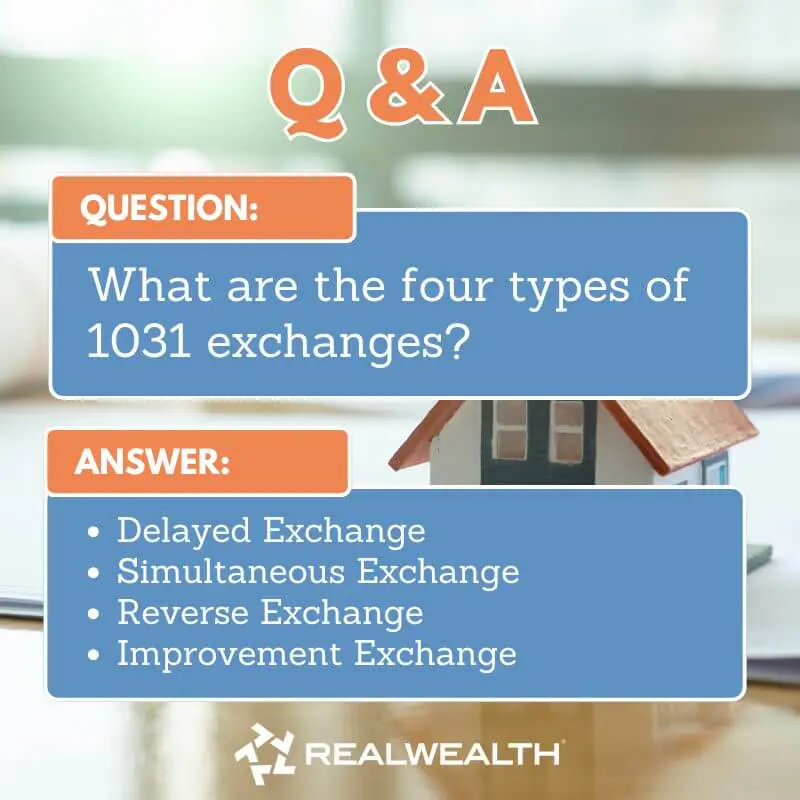
Did you know that investors can choose from four main types of 1031 exchanges? These include simultaneous, delayed, reverse, and construction or improvement exchange. Understanding these different types of 1031 exchange structures is essential for any investor considering a 1031 exchange strategy to defer capital gains taxes. Below, we break down these exchange types and why an investor may decide to use them.
Quick Answer: What Are the 4 Types of 1031 Exchanges?
The four types of 1031 exchanges are: Delayed Exchange (most common), Simultaneous Exchange, Reverse Exchange, and Construction/Improvement Exchange. Each type has different timelines and requirements depending on whether you buy before or after selling your property.
What is the most common type of 1031 exchange?
The Delayed Exchange accounts for over 90% of all 1031 exchanges because it gives investors 45 days to identify and 180 days to close on replacement properties.
What’s the main difference between types?
The primary difference is timing:
- Delayed: Sell first, buy later (45/180-day timeline)
- Simultaneous: Buy and sell on the same day
- Reverse: Buy first, sell later (all-cash required)
- Construction: Use exchange funds to improve replacement property
Which type should you choose?
Most investors use delayed exchanges for flexibility. Choose reverse if you found your dream property first. Use construction exchanges when the replacement property needs improvements.
Need help choosing the right exchange type? Connect with a vetted Qualified Intermediary and find replacement properties available now →
What are the Four Different Types of 1031 Exchange Structures?

1. Delayed Exchange
The Most Common 1031 Exchange Type
The delayed like-kind exchange is the most common type of 1031 exchange chosen by investors today. This type of 1031 exchange occurs when the Exchangor relinquishes the original property before acquiring the replacement property.
In other words, the property the Exchangor owns (which is called the “relinquished” property) is transferred first, and the property the Exchangor wishes to exchange it for (the “replacement” property) is acquired second.
The Exchangor is responsible for marketing their property, securing a buyer, and executing a sale and purchase agreement before initiating the delayed exchange. Once this has occurred, the Exchangor must hire a third-party exchange intermediary, also called a qualified intermediary (QI), to begin the sale of the relinquished property and hold the proceeds from the sale in a binding trust for up to 180 days while the seller acquires a like-kind property.
Investor tip: Choosing the right qualified intermediary is crucial for a successful delayed exchange, as they’ll handle all funds and ensure IRS compliance. Unfortunately, the industry is poorly regulated. So if you choose an exchange facilitator on your own, be sure to vet them thoroughly. If you’d like to save time, let us introduce you to the trusted 1031 exchange facilitator we’ve recommended for over a decade. We even use them on our own 1031 exchanges!
Using this strategy, an investor has a maximum of 45 days to identify the replacement property and 180 days to complete the sale of their property. In addition to the numerous tax benefits, this extended timeframe is one of the reasons that the delayed exchange is so popular.
Learn more about the specific 1031 exchange timeline and deadlines you’ll need to follow for a delayed exchange.
2. Simultaneous 1031 Exchange
The second type of 1031 exchange is called a simultaneous exchange. This type of exchange occurs when the replacement property and relinquished property close on the same day. As the name suggests, these closings occur simultaneously.
It is important to note that the exchange must occur simultaneously; any delay, even a short one, caused by wiring funds to an escrow company, can result in disqualification of the exchange and the immediate application of full taxes.
There are three primary ways that a simultaneous exchange can occur.
- Swap or complete a two-party trade, whereby the two parties exchange or “swap” deeds.
- A three-party exchange in which an “accommodating party” facilitates the transaction simultaneously for the exchanger.
- Simultaneous exchange with a qualified intermediary who structures the entire exchange.
Working with an experienced 1031 exchange facilitator ensures proper timing and compliance, as even minor delays can disqualify the exchange and trigger immediate tax liability.
3. Reverse Exchange
A reverse 1031 exchange, also known as a forward exchange, occurs when you acquire a replacement property through an exchange accommodation titleholder before you exchange the property you currently own. In theory, this type of exchange is very simple: you buy first and you exchange later.
What makes reverse exchanges tricky is that they require all cash. Additionally, many banks won’t offer loans for reverse exchanges. Taxpayers must also decide which of their investment properties will be acquired and which will be “parked.” Failure to close on the relinquished property during the established 180-day period that the acquired property is parked will result in a forfeiture of the exchange.
This type of 1031 exchange follows many of the same rules as the delayed exchange. However, there are a few key differences to note:
- Taxpayers have 45 days to identify what property is going to be sold as “the relinquished property.”
- After the initial 45 days, taxpayers have 135 days to complete the sale of the identified property and close out the reverse 1031 exchange with the purchase of the replacement property
4. Construction or Improvement Exchange
The final type of 1031 exchange we will highlight is the construction exchange. This type of exchange allows taxpayers to make improvements on the replacement property using the exchange equity. In layman’s terms, the taxpayer can use their tax-deferred dollars to enhance the replacement property while it is placed in the hands of a qualified intermediary for the remainder of the 180-day period. When identifying replacement properties, consider which ones might benefit from improvements to increase value or cash flow.
It is important to note that the taxpayer must also meet three requirements if they want to defer all of the gains (from the sale of the relinquished property) and instead use it as part of the construction or improvement exchange.
- The entire exchange equity must be spent on completed improvements or as a down payment by the 180th day.
- The taxpayer must receive “substantially the same property” that they identified by the 45th day.
- The replacement property must be equal to or greater in value when it is deeded back to the taxpayer. Improvements must be made before the taxpayer can take the title back from the qualified intermediary.
How to Choose the Right Type of 1031 Exchange
For help understanding all the 1031 exchange rules that apply to each exchange type, consult with your tax advisor and Qualified Intermediary before beginning the process. Here are some basics to help you understand which type of 1031 exchange might be right for your situation.
Choose a Delayed Exchange if:
- You want maximum flexibility with 45/180-day windows
- You need time to research and identify replacement properties
- You’re exchanging from one property to multiple properties
- You want to boost cash flow by diversifying into multiple markets
Choose a Simultaneous Exchange if:
- You’ve already found your ideal replacement property
- Both parties are ready to close immediately
- You want to minimize holding period and risks
Choose a Reverse Exchange if:
- You found your dream property and must act fast
- You have all-cash available to purchase first
- You’re in a competitive market where properties sell quickly
Choose a Construction/Improvement Exchange if:
- The replacement property needs renovations or improvements
- You want to use tax-deferred dollars for construction
- You can complete improvements within the 180-day window
At a Glance Comparison Chart: Types of 1031 Exchanges

Need Help With A 1031 Exchange?
Join RealWealth and get access to our list of 1031 exchange facilitators and connect with turnkey property teams selling single family and multi-family turnkey investment properties, with property management in place, in top U.S. markets.
Frequently Asked Questions
A 1031 exchange lets real estate investors defer paying capital gains taxes when they sell an investment property and purchase a “like-kind” replacement property with the proceeds. You must use a Qualified Intermediary (QI) who holds the funds, identify replacement properties within a 45-day window, and close within 180 days. Learn the complete rules and step-by-step process →
There are seven primary IRS rules that all 1031 exchanges must follow:
1. Like-Kind Property – Both properties must be investment real estate
2. Investment Property Only – No primary residences or personal use
3. Equal or Greater Value – Replacement property must be worth same or more
4. No Boot – In order for the exchange to be completely tax-free, you must not receive a “boot.”
5. Same Taxpayer – Title must be in the same name as the taxpayer on the relinquished property.
6. 45-Day Identification – Identify up to 3 properties within 45 days (no extensions)
7. 180-Day Purchase – Close on replacement within 180 days (no extensions)
You have 45 calendar days from the closing of the rental property you are selling to identify up to three replacement properties and a total of 180 days to close. These IRS deadlines are very strict with no extensions, so proper planning is critical. See the complete 8-step timeline and avoid missing deadlines →
Start early, and do so long before you put your property on the market. Planning early reduces the anxiety of the 45-day identification window, helps you connect with the best QIs, lenders, property teams, and find the best 1031 exchange replacement properties so you can meet all of your deadlines and not end up stressed out and settling for mediocre deals. RealWealth can help streamline the process for you, by connecting you with trusted 1031 exchange qualified intermediaries and property teams who have turnkey rental properties for sale now.
The IRS mandates two critical deadlines. The identification period is a 45-day window to identify potential replacement properties. The exchange period is the acquisition of the replacement property, which must be completed within 180 days of the sale of the relinquished property. Learn more about 1031 exchange timelines and mistakes to avoid →
There are four main types of 1031 exchanges in real estate: Delayed Exchange (most common, where you sell first and then buy), Simultaneous Exchange (where you close both properties on the same day), Reverse Exchange (where you buy first and then sell), and Construction Exchange (where you make improvements using exchange funds). Each has different requirements and timelines. Compare all four types and choose the right one →
Yes, a 1031 exchange qualified intermediary is required by law for 1031 exchanges. The QI holds the sale proceeds, prepares documents, coordinates closings, and ensures IRS compliance. If you touch the funds at any time without a QI, you’re disqualified and will owe capital gains taxes. Learn what a QI does, costs, and how to find one →
To find 1031 exchange investment property, focus on markets with population growth, job growth, affordability, low property taxes, and landlord-friendly laws. Start your search before selling and consider multiple properties in two to three markets, so if one of the rental properties falls through, you have a backup plan. Get the 12 rules for identifying cash-flowing replacement properties →
While all RealWealth property teams have ample inventory for 1031 exchange replacement properties, some of the most popular locations have been Dallas-Fort Worth, Alabama (including Birmingham and Huntsville), San Antonio, Jacksonville, Tennessee, and Cleveland. These markets offer strong cash flow, appreciation potential, affordability, and landlord-friendly laws with available turnkey rental property inventory. Explore available properties in top markets now →
Yes! As long as the properties meet the “like kind” requirement and you can replace the full value of the relinquished property or properties, you can defer all capital gains taxes with a 1031 exchange.
Yes, you can exchange a California investment property for an out-of-state 1031 exchange investment property, provided you follow the rules. However, California requires annual Form FTB 3840 filings to track deferred gains until you sell or pass away (please consult with your tax advisor or CPA). Many investors exchange their high-equity California rental properties to dramatically increase cash flow in landlord-friendly states. Learn about California-specific requirements and why investors leave →
Buy properties in appreciating markets, hold for 4-6 years while they generate cash flow and appreciate, then exchange them for multiple properties in growth markets. RealWealth’s investment counselor Joe Torre turned two properties into five, then plans to turn two into four again—doubling his portfolio every four to six years. Read the complete portfolio doubling case study and strategy →
Yes, RealWealth offers a free 1031 Exchange Masterclass webinar covering all the critical rules, timelines, qualified intermediaries, partial exchanges, and real investor case studies. The webinar features a live Q&A session with 1031 exchange professionals and is ideal for both new and experienced real estate investors. Watch the free 1031 exchange masterclass now →
RealWealth connects its members with property teams that sell off-market, turnkey rental properties in top U.S. markets. These turnkey teams sell single-family and multi-family properties that are fully rehabbed or newly built, and come with property management in place. Free membership includes one-on-one strategy sessions and ongoing support from investment counselors who specialize in helping real estate investors find replacement properties within the 45-day deadline. Get help finding properties fast →
RealWealth specializes in connecting investors with vetted turnkey property teams in landlord-friendly states across the U.S. Our network includes trusted providers in top markets like Texas, Alabama, Tennessee, and Ohio—all offering professionally managed, 1031-eligible properties with strong cash flow and appreciation potential. Connect with vetted property teams now →
Before you begin your search, it’s critical that you know that the 1031 exchange intermediary industry is not well-regulated. Be very careful with whom you use and be sure that they will not invest your money in risky ways while you are in between purchases.
You could start by getting referrals from escrow officers, researching online reviews, and checking credentials. Look for a 1031 exchange facilitator with thousands of successful exchanges and experience with your specific exchange type (delayed, reverse, or construction). Learn how to find and vet a qualified intermediary →
To save time, become a RealWealth member (100% free). We have worked with the same reputable 1031 exchange facilitator for over a decade. We know they are great, because we use them too! Let us introduce you →
Start your search before selling. Focus on markets with strong cash flow and appreciation. Target properties in areas with population growth and job growth. Choose landlord-friendly states with low property taxes. Work with property teams that have immediate inventory to avoid missing your 45-day identification deadline. Get the 12 strategies for finding cash-flowing properties →
You can start by viewing sample investment properties here. But the best way to find qualified properties is to become a RealWealth member. After you join, schedule a strategy session with your investment counselor, who can help you identify a market that matches your goals and connect you with a property team that has 1031 exchange replacement properties for sale now. Depending on the market you choose, these turnkey properties may include single-family rentals ($120,000-$350,000), duplexes ($200,000-$600,000), and fourplexes ($500,000-$985,000) in markets such as Texas, Alabama, Ohio, and Tennessee. Properties range from rehabbed turnkey to new construction, with options for cash flow, appreciation, or hybrid strategies. View property types and examples by market →
A quick internet search will help you find 1031 exchange services. Whomever you choose, be sure to vet them thoroughly. Investors choose to work with RealWealth because we connect them to trusted 1031 exchange facilitators (whom we use ourselves) and vetted property teams. These teams have off-market turnkey properties in growth markets and have property management in place. In addition, we offer personalized strategy sessions with investment counselors who understand the stress of the timeline crunch. RealWealth membership is 100% free and provides access to educational content and a network of trusted professionals, including qualified intermediaries, attorneys, and CPAs. Explore services and get started free →
The key is to find a property of like kind. Based on what you are selling, your options may include single-family rentals for steady cash flow, duplexes and multi-family properties for higher returns, new construction in growth markets for appreciation, and rehabbed turnkey properties for immediate rental income. You can choose from markets offering various price points ($120,000-$985,000+) and investment strategies based on your goals. See available options in top markets →
RealWealth members get free access to a comprehensive directory of vetted professionals, including 1031 exchange qualified intermediaries, turnkey property teams, real estate attorneys, CPAs, lenders, and more—all experienced in real estate investing strategies. This network helps streamline your exchange process and ensures you’re working with trusted experts. Access the professional directory free →
If you don’t identify a replacement property within 45 days or close within 180 days, your entire exchange fails, and you’ll owe capital gains taxes on the full sale amount. Other risks include settling for an underperforming property due to time pressure, overpaying in competitive markets, or selecting a property in the wrong market that fails to meet your investment goals. Learn the complete timeline and avoid these risks →
Membership to RealWealth is free and gives you access to vetted Qualified Intermediaries (we’ve used them ourselves), off-market turnkey rental properties in landlord-friendly states, one-on-one strategy sessions with experienced investment counselors, educational webinars, and market research to help you complete your exchange successfully and meet critical deadlines so you avoid paying capital gains taxes. Get expert help with your 1031 exchange →
Membership to RealWealth is free and gives you access to vetted Qualified Intermediaries (we’ve used them ourselves), off-market turnkey rental properties in landlord-friendly states, one-on-one strategy sessions with experienced investment counselors, educational webinars, and market research to help you complete your exchange successfully and meet critical deadlines so you avoid paying capital gains taxes. Get expert help with your 1031 exchange →


