If you’re looking to build wealth through real estate but don’t want the headaches of being a landlord, real estate syndications can be an attractive option. You invest, professionals handle everything, and you receive your share of the profits. Sounds simple, right?
The catch is that choosing the wrong real estate syndication company can be costly. Not all companies vet deals the same way or communicate with the same transparency. Some are in it for the long haul with their investors, while others are more transactional.
We’ve put together this comparison guide to help you understand the key features of the top real estate syndication companies, so you can choose the one that best suits your investment preferences and style.
Complete transparency: RealWealth Developments is our own syndication arm. That said, we’ve done our best to present accurate, fair information about each company so you can make the right choice for your situation.
Quick Answer: Best Real Estate Syndication Companies Compared
A real estate syndication lets you pool your money with other investors to access larger commercial properties—the kind that would be way beyond your budget on your own. Think apartment complexes, self-storage facilities, and major residential developments. In this guide, we’re comparing the top real estate syndication companies: RealWealth Developments, MC Companies, The Real Estate Guys, Ashcroft Capital, Spartan Investment Group, BAM Capital, and Gatsby Investment.
RealWealth Developments, co-founded by Rich and Kathy Fettke back in 2003, maintains a strict vetting process, focuses on building long-term relationships with investors, and, thanks to 25+ years of relationship building, offers opportunities investors can’t find elsewhere. Plus, you also get direct access to Kathy, Rich, and the syndication team, not just a customer service rep.
Other companies, such as MC Companies, appeal to investors with a luxury multifamily rental focus. The Real Estate Guys focuses heavily on real estate syndication education, and its offerings extend beyond syndications to include collectibles, precious metals, and fine art. Ashcroft Capital and BAM Capital both focus on added-value multifamily opportunities. Spartan Investment Group focuses on self-storage facilities and RV parks. Gatsby Investment offers investors syndication opportunities in the LA market.
Below, we break down what makes each real estate syndication company unique, who they’re best suited for, and how they make money. Plus, tips for choosing the best syndication partner for you.
- Learn more about real estate syndications.
- Get tips for choosing the right real estate syndication company for you.
- Join RealWealth to learn more about our current real estate syndications and real estate funds. Membership is 100% free, and it takes less than five minutes to sign up.
Best Real Estate Syndication Companies: Who’s Who
Whether you’re brand new to real estate syndications or you’ve been investing for years, knowing what each of the top real estate syndication companies actually does can make all the difference. Here’s the rundown on the companies that have earned strong reputations in this space.
1. RealWealth Developments
Rich and Kathy Fettke started RealWealth back in 2003. What began as a way to create financial security after a family health crisis has grown into helping over 82,000 members build wealth through turnkey real estate and syndication opportunities. RealWealth Developments is the real estate syndication side of the business, focusing on larger commercial projects, land development, built-to-rent multifamily, and rental property funds.
Key Features:
- Education before everything: Free webinars, two podcasts (The RealWealth Show and Real Estate News for Investors), articles, and one-on-one coaching sessions, to help you understand real estate investing strategies.
- Actual people answering your questions: You can talk directly to Kathy Fettke, RealWealth Co-Founder, and Paul DiVincenzo, RealWealth Developments Director, and the team, not a call center.
- Seriously rigorous vetting: Background checks, site visits, detective-level research on sponsors and markets. They reject 95%+ of deals that come across their desk.
- Access to deals others don’t see: A 25-year network means they get first crack at off-market opportunities before they’re shopped around.
- Realistic numbers: They target 16% IRR with 1.85X equity multiplier—achievable returns, not pie-in-the-sky projections.
- Real transparency: Quarterly updates through their investor portal that share what’s going well AND what’s challenging.
- Different types of projects: Single-family rental funds, built-to-rent, multifamily, land deals, single family home developments, and commercial properties.
- Long-term partnership approach: They’re building relationships, not just doing one-off deals.
- Only accepts accredited investors.
Where They Invest: Growth secondary markets across the South, Midwest, and Mountain West, where jobs, population, and infrastructure are expanding.
Best For: Investors who want to really understand what they’re investing in, prefer conservative projections, and want a long-term relationship with their sponsor.
Free membership to RealWealth gives you access to all educational and investor resources.
2. MC Companies
Ken McElroy is the CEO of MC Companies, bringing over 36 years of senior-level experience in multifamily and commercial real estate. He founded McElroy Management in 1998, which merged with Ross McCallister in 2001 to create MC Companies. If your investing focus is high-end multifamily neighborhoods, MC Companies is one of the best real estate syndication companies. They have over $1.2 billion in assets under management, with a portfolio of 6,500 units.
Key Features:
- Everything handled in-house: land buying, construction, property management
- Ken McElroy’s name recognition and educational content
- Strong media presence through books and podcasts
- Focus on institutional-quality high-end rental communities
- Accepts accredited investors only
Where They Invest: Arizona, Nevada, and Texas
Best For: Accredited investors interested in brand-new rental communities with a well-known sponsor
3. The Real Estate Guys™
Robert Helms and Russell Gray have been podcasting about real estate for years, building a huge following along the way. If you want to deep dive into all things syndication-related, they are one of the top real estate syndication companies that provide in-depth education about this investing strategy. Through their investor registry deal desks, members get access to a variety of investment offerings (precious metals, oil and gas, lending funds), including syndications.
Key Features:
- Education-first approach
- Real estate syndication seminars and events
- Accepts accredited investors only
- Access to a variety of investment opportunities
Where They Invest: A variety of markets through the deal desk; investors are informed of current offerings.
Best For: Investors who value community and education alongside their investments.
4. Ashcroft Capital
Frank Roessler and Joe Fairless, who you may know from the “Best Ever Real Estate” podcast, are co-founders of Ashcroft Capital. Founded in 2015, the company is a fully integrated multifamily real estate syndication company with over $2.9 billion in assets and 14,000+ units across the Sunbelt. They handle everything in-house, including acquisitions, property management (through Birchstone Residential), and construction management. They’ve completed 62+ acquisitions since inception and focus on value-add apartment buildings: they buy properties that need upgrades, renovate them, and either refinance or sell for a profit.
Key Features:
- Fully integrated platform controlling every aspect of the investment
- In-house property management (Birchstone Residential) and construction teams
- Conservative underwriting focused on capital preservation
- Known for transparent communication with investors
- A proprietary procurement process that cuts costs by about 35%
- Accepts accredited investors only
Where They Invest: Strong Sunbelt presence in Texas, Florida, Georgia, and North Carolina
Best For: Apartment syndication investors who appreciate transparent sponsors with strong personal brands.
5. Spartan Investment Group
Founded in 2014 by neighbors Scott Lewis and Ryan Gibson, Spartan Investment Group draws on military and aviation backgrounds that have shaped its core fundamentals: conservatism, due diligence, and a checklist-driven process. They started in residential real estate, moved to commercial development, and eventually settled on self-storage using straightforward criteria—easy to manage, easy to maintain, easy to evict. As one of the best real estate syndication companies in the self-storage space, Spartan has raised over $200 million in private equity and paid out more than $15M in returns to investors.
Key Features:
- Self-storage facilities and RV parks (alternative to traditional apartments)
- Residential land development
- Veteran-owned and operated
- Significant scale with 140+ team members
- Multi-state presence
- Only accepts accredited investors
Where They Invest: 11 states, WA, OR, TX, KY, WI, AR, to name a few.
Best For: Investors interested in self-storage and land development with a veteran-owned sponsor.
6. BAM Capital
Founded by Ivan Barratt, multifamily real estate syndication company BAM Capital focuses on the Midwest and Class A, A-, and B++ apartment buildings. They handle everything in-house, meaning they control the entire process. They prefer properties built within the last 20 years that have cash flow and room to improve with value-added upgrades. Current numbers include 29 properties with $232M in distributions.
Key Features:
- Strong Midwest focus, with areas experiencing job and population growth
- Everything is managed in-house with strategic cost reductions through more efficient management
- Target higher-quality apartment buildings with value-add opportunities
- Emphasis on cash-flowing properties
- Full control from purchase to sale
- Accredited investors only
Where They Invest: Midwest markets with strong apartment fundamentals.
Best For: Investors wanting quality Midwest apartments with an all-in-one sponsor.
7. Gatsby Investment
Gatsby Investment is one of the top real estate syndication companies for the Los Angeles market. They specialize in value-add projects and new-build construction, with a focus on multifamily. They handle everything from property scouting and evaluation to acquisition, financing, design, permitting, construction management, and sales. They are a tech-forward company with a process that modernizes how real estate syndications work.
Key Features:
- Tech-forward platform and processes
- Small to medium-sized projects
- Focused on value-add and ground-up projects
- Professional oversight of the entire deal lifecycle
- Accredited investors only (minimum investment of $10,000)
- Proprietary software and automation systems
- Accepts investing through trusts
Where They Invest: Los Angeles area.
Best For: Tech-savvy investors who want a modern, streamlined investing experience.
What Makes the Best Real Estate Syndication Companies Stand Out
Each of these real estate syndication companies brings something different to the table. Your choice really depends on what matters most to you—education and hand-holding, specific asset types, regional focus, technology, or brand recognition.
The key is figuring out which sponsor’s approach aligns with your goals and investment style. Don’t rush it.
How to Choose the Best Real Estate Syndication Company for You
When you’re evaluating different syndication real estate companies, here’s what you should be looking at:
1. Get Clear on What You Want
Are you investing for monthly cash flow, long-term growth, tax benefits, or all three? How long can you keep your money invested—5 years? 7 years? 10 years? Different real estate syndication companies and deal structures serve different goals.
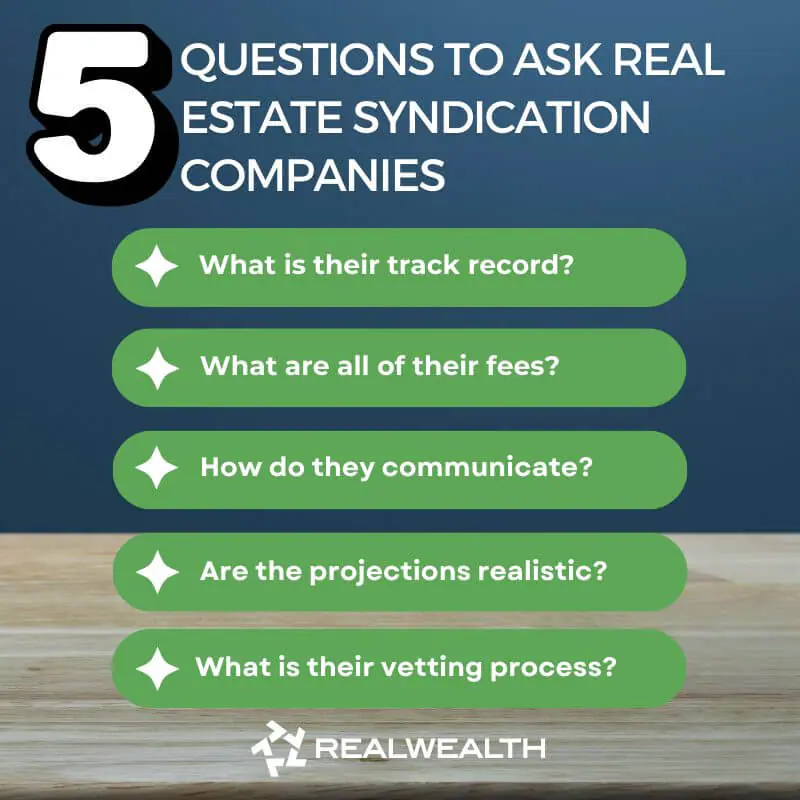
2. Understand Their Track Record
Don’t just ask how many deals they’ve done. Ask:
- Were they the sponsor of the deal(s)?
- Did they hit their projected returns or fall short?
- What happened with syndication and funds that went sideways?
- How long have they been doing this, and how many market cycles have they seen?
3. Understand All the Fees
Real estate syndication company fees can add up. Look for:
- Acquisition fees (when they buy the property)
- Asset management fees (annual fees while they own it)
- Property management fees
- Development Fees / Construction Management
- Disposition fees (when they sell)
Make sure the fees make sense and don’t eat up all the returns.
4. How Do They Communicate?
This matters more than you think.
- Do they send detailed quarterly updates?
- Do they only reach out when raising money?
- Can you actually speak with someone if you have questions?
- Are they honest when things don’t go as planned?
5. Look at Their Projections
Be wary of real estate syndication sponsors projecting IRR higher than 25%+ in today’s market. Those are red flags. The best real estate syndication companies will show you realistic scenarios, including what happens if things go wrong. Ask yourself: are these projections based on today’s market or a market that may not exist?
6. How Thorough Is Their Due Diligence?
What’s their vetting process? Do they:
- Visit properties in person?
- Run background checks on partners?
- Get third-party inspections and appraisals?
- Verify market data themselves?
- What percentage of deals they look at do they actually move forward with?
If a real estate syndication company is doing a new deal every month, they’re probably not saying no enough.
7. Education and Support
Does the real estate syndication company actually teach you anything, or do they just send pitch decks? Can you ask dumb questions without feeling judged? Do they provide ongoing education about markets and strategies?
8. Are Your Interests Aligned?
Look for:
- What is the distribution process (preferred returns)? Do investors get paid before the sponsor?
- Is the profit split fair, or is it tilted heavily toward the sponsor?
- Do they seem focused on long-term wealth building or just raising capital to make fees?
9. Check Investor Requirements
Some deals are only for accredited investors (generally, $200K+ in income or $1M+ in net worth). Others use Regulation A+ or Regulation D structures that allow non-accredited investors. Make sure you qualify for what you’re interested in.
10. Trust Your Gut
After all the analysis and thorough review of the private placement memorandum, how do you feel about this sponsor? Do they answer questions directly or dodge them? Do they pressure you to invest quickly? Does their communication style work for you? Do you trust them with your money?
You’re not just investing in a property. You’re investing in a relationship that could last 5-10 years. Make sure it’s a real estate syndication company and sponsor you actually want to work with.
Why People Choose RealWealth Developments
We know we’re biased, but here are some reasons why our investor members choose RealWealth Developments as their top real estate syndication company.
1. They Want to Understand What They Were Doing
Many investors come to us after feeling lost or pressured elsewhere. They want someone to explain things clearly without the sales pitch.
2. They Want Conservative Underwriting vs Overpromising
When a syndication sponsor projects 25% IRR on a straightforward apartment renovation, something’s off. Our investors appreciate that we stress-test deals, build in contingencies for delays and cost overruns, and aim for returns that are actually achievable. We’d rather under-promise and over-deliver. Our conservative underwriting is key to success.
3. They Want Access to Better Deals
Our 25-year network gives us the first look at investing opportunities that never make it to crowdfunding platforms or other syndicators. The best deals go to trusted relationships first. After 25 years, we’ve built a lot of those relationships.
4. They Value Transparency
Our investors get detailed quarterly updates through our InvestNext platform. We share what’s going well AND what’s challenging. No sugarcoating. If there’s a construction delay, we’ll tell you. If we’re ahead of schedule, we’ll let you know that, too.
5. They Want to Talk to Real People
At RealWealth Developments, you have direct access to our entire team through email, phone, or by scheduling a one-on-one call. Our team is available during business hours, Monday through Friday, and after business hours during the week and on some weekends. Try getting that from a crowdfunding platform.
6. They Appreciate the Long-Term Focus
We’re not chasing the next hot market or the trendiest asset class. We invest based on fundamentals: where are jobs growing, where are people moving, where is infrastructure being built. Boring? Maybe. Effective? We think so.
7. They Want Due Diligence They Can Trust
Our rejection rate of 95%+ means we’re incredibly picky. We’ve walked away from real estate syndication deals because they didn’t meet our standards for investor protection. That’s rare in this industry.
8. They Like That We’ve Been Doing This for 25 Years
We’ve been through multiple real estate cycles—the good, the bad, and the 2008 crisis. That experience matters when markets get turbulent. We’re not learning on the job with your money. Our job during these difficult times is to strategically mitigate investor risk.
9. They Want to Be Part of Something Bigger
RealWealth Foundation donates 10% of profits to charities that change lives. So far, we’ve donated over $870,305. When you invest with us, you’re part of that impact.
10. They Value Community
With a community of 82,000 members and growing, you’re not alone. You can connect with other investors, attend property tours, join webinars, and learn from people who’ve been where you are.
If this sounds like what you’re looking for—education first, conservative projections, transparent communication, long-term partnership—we’d love to talk with you.
Join RealWealth today to view our current real estate syndication and fund opportunities, and schedule a call with me, Paul DiVincenzo, RealWealth Development Director. No pressure, no sales pitch. Just an honest conversation about whether real estate syndications make sense for your situation.
Final Thoughts on Choosing Among Top Real Estate Syndication Companies
Choosing a real estate syndication sponsor is a big deal. You’re trusting them with your money for 3 to 7 years, maybe 10. The sponsor’s track record, communication style, and whether their interests align with yours will make or break your experience.
Every business that made the top real estate syndication companies guide has its strengths. Some focus on specific property types and regions, and some use technology to streamline the process. What matters is finding the right fit for YOU.
Do your homework. Ask tough questions. Take your time. Choose a partner whose values align with yours.
At RealWealth Developments, we’ve built our business on education, transparency, and putting investor interests first. It’s worked for 25 years, through multiple market cycles and thousands of successful investments. If that resonates with you, we’d love to connect.
Ready to explore syndication opportunities with a team that’s been at this for 25 years? Join RealWealth for free—you’ll get access to our current deals, all our educational resources, and an honest conversation with our investment team about what makes sense for your situation.
Disclaimer: This is educational content, not investment advice. Real estate syndications involve risk, including loss of your investment. Past performance doesn’t predict future results. Make decisions based on your own situation, goals, and risk tolerance. Talk to qualified advisors before investing.
Frequently Asked Questions About Real Estate Syndications
A real estate syndication is a partnership in which multiple investors pool their capital together to purchase a property or project that would be too expensive for them to buy individually. With this investing strategy, you are a passive investor: you contribute funds and receive a share of the returns, while the sponsor (such as RealWealth Developments) handles all operations, including acquisition, management, and eventual sale. Depending on the deal type, investors may receive distributions from cash flow, a lump-sum payment upon sale, or a combination of both. A real estate syndication strategy allows you to invest in institutional-quality real estate without active management responsibilities while benefiting from tax advantages and appreciation potential. Get the full breakdown of how syndications work→
We put together a free webinar that walks you through the whole thing. You’ll see examples of real syndications, learn what makes a good sponsor versus a sketchy one, and understand how the money flows. Watch our free real estate syndication webinar→
For 506(c) offerings, which RealWealth Developments specializes in, you need to be an accredited investor. For a 506(b) deal, you do not have to be an accredited investor. According to the SEC, an accredited investor must have at least $200K in annual income (or $300K if married) or a net worth of at least $1 million, excluding your primary residence. Why? They’re trying to protect people from jumping into investments they don’t understand. Learn exactly what it takes to qualify as an accredited investor→
A Private Placement Memorandum (PPM) is a comprehensive legal document that outlines the details of a real estate syndication investment. This includes the business plan, financial projections, fee structure, distribution waterfall, and potential risks. The PPM is required by securities law and must be reviewed before investing, as it contains critical information about how your capital will be used, when you can expect returns, and what risks to consider. While it may seem lengthy and technical, reading the PPM carefully ensures you fully understand what you’re investing in and helps you make an informed decision. Here’s how to read and understand a PPM→
Your preferred return, which varies by deal structure, is typically between 6% and 12% (and has been higher on some RealWealth Development Deals). It is the amount you receive before the sponsor receives any proceeds beyond their fees. A waterfall structure determines how profits are split between the sponsor and investors throughout the life of the deal. Many real estate syndications use tiered waterfalls, where the split might start at 70/30 (investor/sponsor), but once the sponsor hits a particular IRR hurdle, it shifts to 50/50, meaning sponsors take a larger share of profits as performance improves. At RealWealth Developments, we keep the profit split consistent throughout the entire investment without any hurdles, so investors maintain their full percentage of returns from day one through exit, which maximizes your share of the upside. Learn how preferred returns and waterfalls protect your investment→
Underwriting is just fancy talk for “did they do the math right?” Looking at their assumptions is key to underwriting. For example, are they projecting rent increases of 10% a year in a market that’s only been increasing by 3%? That’s a red flag. Conservative sponsors might show you lower returns, but those numbers are way more likely to happen. Ask yourself: if rent growth slows or vacancies rise, does this deal still work? Get our complete guide to evaluating syndication underwriting→
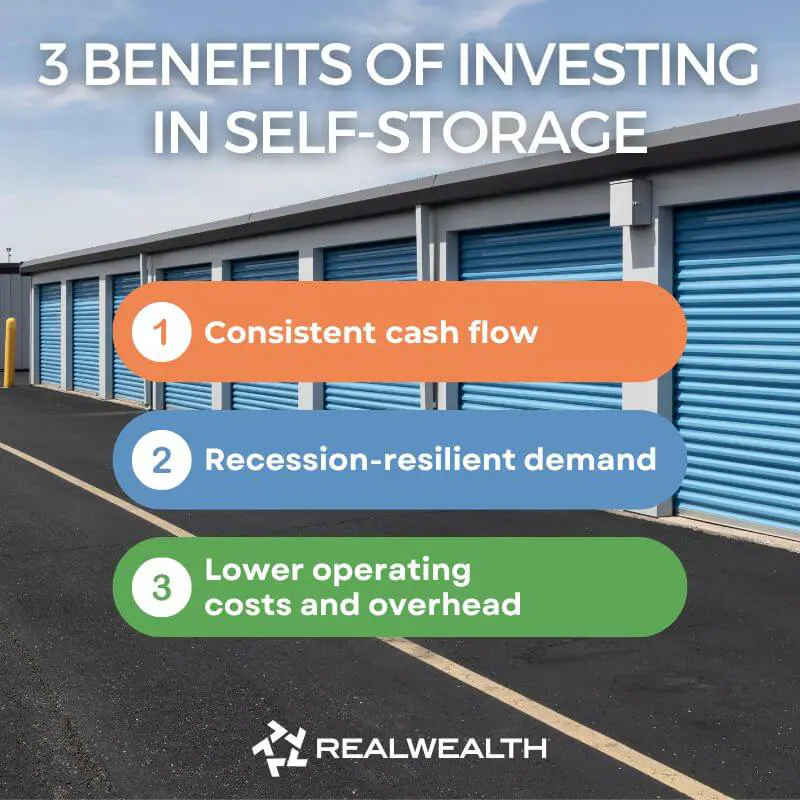
Yes! In fact, storage syndications have become really popular because the business is simpler than apartment syndications: kitchens aren’t breaking, no midnight plumbing emergencies, no tenants trashing units. Someone stops paying? You cut the lock and auction off their stuff. The deals work like apartment syndications. You invest, they improve the facility, you get quarterly checks, and everyone cashes out when it sells. Here’s everything you need to know about self-storage syndications→
Good question, as people often mix these up. When you invest in a real estate syndication, you’re working directly with the company that found the property and will manage it. They’re all-in on that deal. Crowdfunding platforms are more like a middleman. Typically, different sponsors post their deals on a website. The platform takes a fee, but they are not typically involved in the management of the investment. Direct real estate syndications mean better access to the sponsor. Platforms typically offer more options to browse through, and you may not need to be an accredited investor to invest. See our detailed comparison of syndications vs crowdfunding→
REITs are like buying stock in a real estate company. You can buy and sell shares instantly, but you have no idea which specific buildings you own. Syndications are the opposite. You pick a specific property, project, or fund, you know exactly where your money’s going, but you’re typically locked in for 3-7 years. REITs are available to anyone. Most syndications require you to be an accredited investor, which means meeting certain income or net worth requirements.
Depends on what you’re looking for. Want apartments? Self-storage? A specific region or market? Something else? Some companies are great if you’re new and need lots of hand-holding. Others assume you know what you’re doing and just give you the numbers. Learn more about the major players in the real estate syndication space→
When evaluating real estate syndication sponsors, you’ll want to 1) review their past performance, but also 2) ensure you distinguish between deals where they were the lead sponsor and deals where they were a passive partner. At RealWealth Developments, we now serve as the sponsor for our current deals, giving us complete control over operations, underwriting, and asset management. This is a key difference from our earlier investments, where we participated as silent partners. Thirdly, you’ll want to evaluate the sponsor’s experience, deal structure (including investor protections), and alignment of interests with you as an investor.
Fees in real estate syndications vary significantly based on the deal type and structure. Standard fees may include acquisition, asset management, disposition, loan, and construction management or development fees. All these fees should be clearly laid out in the private placement memorandum. If you’re adding up all the fees and they’re eating half your returns, that’s a problem.
Start with the private placement memorandum (PPM), which is the primary document that covers the deal in full, including all risks. Then read the operating agreement, which outlines your rights as an investor and how decisions are made. You’ll also want to review and complete the subscription agreement before signing. That’s your legal commitment to invest, and you can’t just back out once you’ve signed. Request the property’s financial projections and the sponsor’s underwriting to see their assumptions. If you don’t understand something in any of these documents, ask questions or have a lawyer review them.
Your money is typically locked up for 3 to 7 years, so you can’t withdraw it if you need it. The property may not perform as projected. Construction could get delayed. The market could tank. The sponsor might not be as experienced as they claimed. Worst case? You could lose the invested capital. This is why doing your homework on the deal’s underwriting is so important.
You can with a self-directed IRA or solo 401(k), but not with your regular employer 401(k). You’ll need to work with a special custodian who handles alternative investments, and any money you make has to stay in your retirement account until you’re old enough to withdraw it. Not every syndication company accepts funds from retirement accounts, so ask about this upfront if it matters to you.
Join as a free member—takes less than five minutes and costs nothing. You’ll get access to our current deals, all the details on each project, and the actual offering documents so you can do your homework. You can schedule a free call with our investment team to ask questions without any sales pressure. We also offer extensive educational content on syndications, regular webinars that walk through how everything works, and real investors you can talk to about their experience.