Self-storage has become one of the most sought-after asset classes in real estate syndications. As a result, many investors are exploring how to invest in self-storage as a means to diversify their real estate portfolios. It’s easy to see why syndicators are interested in self-storage units. With their recession-resilient performance and relatively simple operational model, they are primed to capitalize on stability, scalability, and strong return potential.
In this article, we explore why self-storage is such an attractive option for syndicators and passive investors alike and the benefits that distinguish it from other real estate investment opportunities.
Quick Answer: How to Invest in Self-Storage Syndications
Learning how to invest in self-storage syndications opens the door to one of real estate’s most resilient asset classes. Unlike apartment buildings where you’re dealing with broken appliances and tenant complaints, self-storage facilities are simpler to operate and maintain strong demand across economic cycles. When you invest in a self-storage syndication, you pool capital with other investors while a sponsor handles acquisition, operations, and eventual sale, giving you passive exposure to commercial real estate without the headaches of active management.
Why Investors Choose Self-Storage Syndications
- Lower operating costs: No kitchen breakdowns, no plumbing emergencies, minimal staff needed
- Recession-resilient demand; People need storage during moves, downsizing, and economic uncertainty
- Strong cash flow potential: Monthly rent collected in advance creates a predictable income
- Tax advantages: Depreciation, cost segregation, and bonus depreciation reduce taxable income
- Tech-enabled operations: Digital leasing, contactless access, and automation make facilities scalable
- Multiple exit opportunities: REITs and institutional buyers actively acquire stabilized properties
Ground-Up Development Advantage
Investing in storage units through new development offers even greater upside. Purpose-built facilities can create instant equity, optimize unit mix for local demand, and integrate modern automation from day one, leading to faster lease-up and higher rents than older properties.
The self-storage sector remains largely dominated by small, independent operators, creating opportunities for professional sponsors to acquire underperforming facilities, improve operations, and generate strong returns. With the right sponsor, investing in self-storage syndications can be a smart addition to any diversified real estate portfolio.
Explore our real estate syndication opportunities or join RealWealth for free to access detailed deal analysis and connect with our syndications team.
7 Benefits of Investing in Self-Storage Syndications
If you are curious about investing in self-storage syndications, here are seven benefits that set this asset class apart from other real estate investment opportunities.
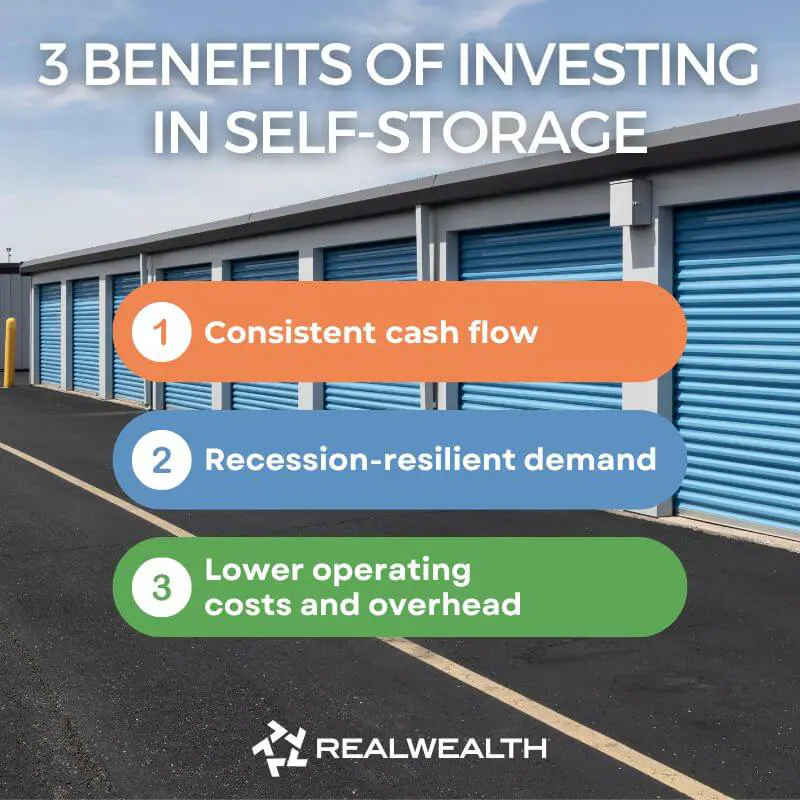
1. Lower Operating Costs and Overhead
Compared with other commercial real estate (CRE) asset classes, such as multifamily and office buildings, self-storage facilities are much simpler to operate. Tenants do not make maintenance calls about broken appliances, plumbing issues, or HVAC repairs. The units themselves are relatively low-maintenance, and the turnover process is straightforward.
In addition, many modern self-storage properties operate with minimal staff or are even fully automated. Features such as online reservations, self-service kiosks, and digital gate access reduce the need for full-time on-site personnel, thereby lowering operating expenses. An investment with lower overhead costs translates to higher net operating income (NOI), a critical metric for driving investor returns.
2. Recession-Resilient Demand
When learning how to invest in self-storage, one of its most appealing aspects is its ability to perform well across economic cycles. In good times, lifestyle changes such as moving, downsizing, marriage, and home renovations drive demand for storage. Businesses also use storage units for inventory, equipment, and file retention.
During downturns, demand tends to remain strong—or even increase—as people downsize, relocate for work, or deal with financial distress. This countercyclical demand pattern makes self-storage more recession-resistant than many other asset classes. Looking back at the historical performance of self-storage units during the 2008 financial crisis and the COVID-19 pandemic, occupancy and revenue proved more stable than office or retail real estate.
3. Ground-Up Development: High Reward Potential and Strategic Design Advantages
Ground-up self-storage development offers a compelling blend of elevated return potential and long-term operational advantages. Unlike projects that require retrofitting existing structures, new construction allows sponsors to build purposefully, tailoring the facility to market needs from the ground up.
This approach offers several key benefits:
- Enhanced equity creation: Projects built for $8M can appraise at $11–12M upon stabilization, offering instant equity gains.
- Strategic site selection: Developers can target high-demand areas with optimal visibility and access.
- Optimized layout and unit mix: Facilities are designed based on real-time market research and demographic trends.
- Modern systems and automation: Seamless integration of digital leasing platforms, access control, and surveillance from day one.
- Reduced operating costs: New materials and energy-efficient systems minimize maintenance and utility expenses.
- Premium positioning: Purpose-built assets often lease up faster and command higher rents than older, retrofitted properties.
4. Consistent Cash Flow and Tax Advantages
If you’re considering passive income opportunities, learning how to invest in self-storage can be a valuable tactic. Self-storage typically generates reliable cash flow. Rental income is collected monthly, and because tenants usually pay in advance, cash flow tends to be predictable.
Another benefit of investing in self-storage is that it offers the same tax advantages as other real estate types, including:
- Depreciation
- Cost segregation
- Bonus depreciation
All of which can significantly reduce taxable income. Many investors are pleasantly surprised by the size of the paper losses on their K-1 forms, even as they receive regular distributions.
5. Smaller Players = Greater Opportunity
Unlike multifamily housing, which institutional investors increasingly dominate, small, independent operators own around 70% of the self-storage market. With smaller, independent players running the game, syndicators have opportunities to acquire underperforming properties at favorable prices. In addition, syndicators can quickly add value and improve returns by bringing professional management and operational efficiency.
6. Strong Exit Potential
As institutional interest in investing in storage units continues to grow, so do the exit opportunities. REITs, private equity firms, and larger operators actively acquire stabilized, well-managed self-storage facilities to grow their real estate portfolios. This creates multiple exit strategies for real estate syndicators:
- Sell to institutional buyers at a premium
- Refinance and hold for cash flow
- Bundle multiple properties into a portfolio sale
A well-timed exit can lead to substantial equity payouts.
Of course, whether that exit actually delivers depends on how conservatively the deal was underwritten from the start. See how to evaluate a syndication’s underwriting.
7. Tech-Enabled Management and Scalability
The self-storage sector has fully embraced technology, and the tenant experience and operational efficiency are improved with features like:
- Online leasing
- Digital access control
- Contactless move-ins
This model allows real estate syndicators to expand their portfolios across markets without requiring large on-site teams, making it easier to grow and manage operations. Additionally, automation, such as the ones noted above, enhances data collection and performance tracking, which is valuable for asset management and investor reporting.
Final Thoughts
Self-storage offers real estate investors the best of both worlds: stability and simplicity on the operations side and strong potential for cash flow and appreciation on the investment side.
As more investors seek alternatives to traditional real estate and stock market volatility, it’s no surprise that learning how to invest in self-storage syndications is gaining popularity. With the right sponsor, self-storage can be a smart and rewarding addition to any diversified investment portfolio.
Looking for more ways to invest? Learn more about our real estate syndications.