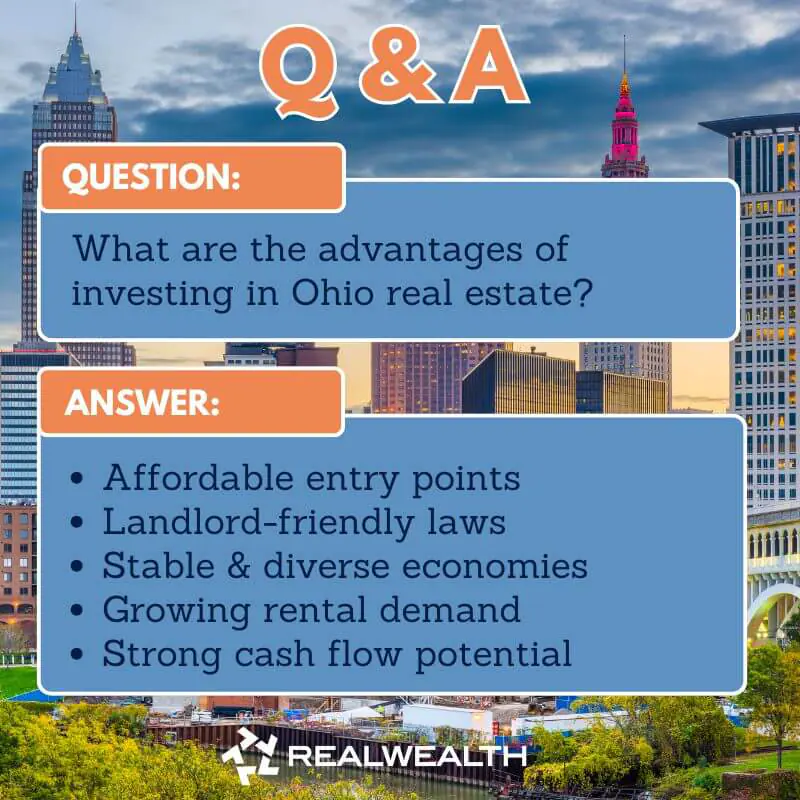
While coastal markets face housing oversupply and price corrections, Ohio continues to produce opportunities for cash-flow properties. Prices are affordable, inventory is tight, and the Midwest is outperforming the national average on rent growth. Ohio housing market predictions for 2026 and 2027 point to one of the most reliable investment setups in the country.
In this article, we cover predictions for 2026 and 2027, including statewide trends and a detailed look at three markets in RealWealth’s network with active turnkey real estate teams in Cleveland, Cincinnati, and Dayton. Here’s what the data shows:
- Home prices are rising steadily. Zillow puts the typical Ohio home value at $218,865, up 3.5% over the past year, well below the national average and still among the most affordable in the country.
- Inventory is tight across key markets. Ohio’s supply-constrained metros continue to see strong buyer competition, with homes moving fast in Cincinnati and Cleveland.
- Rental demand is strong and growing. Midwest markets are posting above-average rent growth as the national apartment supply wave crests and single-family rentals outperform.
- Economy diversifying. From Intel’s semiconductor investment in Central Ohio to defense and aerospace in Dayton, major capital is flowing into the state.
Our Ohio housing market predictions are based on data from Redfin, Zillow, Ohio REALTORS, NAR, and Fannie Mae. These are informed forecasts, not guarantees. Local conditions always matter more than statewide averages.
Want to see what Ohio investing looks like in practice? Explore rental properties for sale in Ohio’s top markets.
Quick Answer: What Are The Ohio Housing Market Predictions For 2026 And 2027?
Ohio’s housing market is affordable, supply-constrained, and generating strong rental returns in its top metros. Here’s what investors need to know:
- Home prices are up 3.5% year-over-year statewide, with forecasts of 2-4% appreciation in 2026 across key markets.
- Rental demand is strong, with Midwest markets posting above-average rent growth amid declining national new apartment supply.
- Inventory remains tight in Cleveland, Cincinnati, and Dayton, keeping competition healthy and vacancy low.
- Major investment continues flowing in, from Intel’s semiconductor plant to defense expansion in Dayton, supporting long-term housing demand.
In addition to overall Ohio housing market predictions, we’ll cover three key Ohio markets in this article:
- Cleveland: One of the most affordable major metros in the country, with strong rental demand and a diversifying economy.
- Cincinnati: A competitive market with nine Fortune 500 companies and consistently strong rent growth.
- Dayton: An underrated Midwest market anchored by Wright-Patterson Air Force Base with entry prices well below the national average.
Read on for the full breakdown of Ohio housing market predictions by market.
Real investors, real results. See how Robby and Athena built wealth before 30 and are on a path to 20 properties through RealWealth’s recommended turnkey property network.
Ready to invest? Join RealWealth for free to connect with vetted turnkey property teams in Cleveland, Cincinnati, and Dayton.
Ohio Housing Market Predictions & Trends Influencing Growth
Before we get into Ohio housing market predictions for each city, let’s look at the statewide trends shaping the market. Ohio remains one of the most affordable states to buy a home in the country. That affordability is now being backed by something it hasn’t always had: people actually moving in.
Population growth and migration patterns
Ohio’s population story has quietly changed. For most of the past two decades, the state was losing residents. That trend reversed. According to the U.S. Census Bureau, Ohio had a net domestic migration of 11,926 people in 2025, a dramatic turnaround from a loss of more than 32,000 in 2021. The Ohio Department of Development reported the highest number of people moving into the state in 25 years, with Ohio ranking 10th nationally for migration rate. The state’s population grew 0.3% from 2024 to 2025, reaching approximately 11.8 million.
The growth isn’t uniform. Franklin County, home to Columbus, continues to lead the state. The 25-44-year-old population, the demographic that drives both housing demand and rental formation, has stabilized or increased in three-quarters of Ohio counties. That’s a meaningful shift for a state that was watching its working-age population shrink. Rural counties continue to decline, but for investors focused on Cleveland, Cincinnati, and Dayton, the migration picture is improving.
Robby and Athena built wealth in Ohio before the age of 30 and are on a path to 20 properties. Read their story to see how they did it through the turnkey property teams in RealWealth’s network.
Employment and economic indicators
Ohio’s economy is in solid shape heading into 2026. JobsOhio reports the state earned its highest possible credit ratings — AAA/Aaa/AAA — from all three major rating agencies for the first time in state history, citing economic diversification and job creation. The state’s labor force participation rate is the highest it’s been in a decade, with more than 273,000 job openings as of April 2025.
In 2025, JobsOhio completed 311 projects with $12.1 billion in capital investment. Major wins include Anduril’s commitment to create 4,000+ jobs and invest at least $910.5 million near Rickenbacker International Airport in Columbus, First Quality Tissue’s nearly $1 billion manufacturing investment in Defiance County, and Intel’s ongoing semiconductor development in New Albany. Ohio has ranked number one in infrastructure nationally for three consecutive years, and number two for cost of doing business. For real estate investors, that kind of economic momentum creates jobs, pulls in workers, and drives housing demand.
Ohio’s unemployment rate was 4.5% in November 2025, slightly above the national average but tracking in the right direction. The state’s working-age population is growing, and major capital investment is creating jobs across multiple sectors, such as advanced manufacturing, logistics, technology, aerospace, and healthcare.
Real estate development and construction trends
Ohio produced approximately 30,000 new privately owned housing units in 2024, a 24% increase from 2019, according to the Ohio Housing Finance Agency’s FY 2026 Housing Needs Assessment. Most of that growth came from multifamily, up 80% from 2019, while single-family new construction grew just 11%. The gap between housing supply and housing demand remains wide. The Greater Columbus region alone needs 14,000 to 19,000 new homes annually, but has been adding only a fraction of that. Statewide, there is a shortage of over 202,000 rental homes affordable to very low-income Ohioans.
That supply constraint is a tailwind for investors. Tight inventory keeps competition for existing rental properties healthy, supports rent growth, and limits downward pressure on home values. Zillow puts the typical Ohio home value at $218,865, up 3.5% over the past year. This is a steady, affordable appreciation that works for buy-and-hold investors. Learn how to find off-market properties.
Government policies and regulations affecting real estate
Ohio’s policy landscape is broadly favorable for real estate investors. The state’s existing landlord-friendly environment, combined with the absence of statewide rent control under House Bill 430, provides property owners with consistent operating conditions across markets. The Ohio Housing Finance Agency continues to fund affordable housing development, with the state approving substantial tax credits for multifamily rehabilitation and construction. Those programs expand the overall rental housing stock but don’t meaningfully affect single-family rental investors.
On the economic development side, JobsOhio’s 2026 outlook signals continued investment in advanced manufacturing, energy, aerospace and defense, life sciences, and AI-enabled growth. The project pipeline heading into 2026 is described as strong, with site inventory and workforce strategies aligned with demand. More jobs mean more workers need housing, and Ohio’s affordable price points make it one of the more accessible entry markets in the Midwest for investors looking to capitalize on that dynamic.
Cleveland, Ohio Housing Market Predictions

Cleveland doesn’t get the same attention as Columbus or Cincinnati, but it’s been quietly putting up some of the best numbers in Ohio. Redfin named Cleveland one of six “hot” markets to watch in 2026, with five of them in the Midwest or Great Lakes region. The combination of extreme affordability, steady rent growth, and a diversifying economy is what keeps putting Cleveland on those lists.
The economy here runs deeper than most people expect. The Cleveland Clinic is one of the largest employers in the state. Sherwin-Williams opened a new $600 million headquarters downtown. Case Western Reserve University, Progressive Insurance, and Goodyear all help anchor the employment base. Healthcare and tech are both growing, drawing younger professionals into a city that costs a fraction of what coastal markets do.
Cleveland Real Estate Market Forecast for 2026 & 2027
1. Affordable entry with steady appreciation
Redfin puts the median sale price in Cleveland at $125,000 in January 2026, up 5% year-over-year. Zillow shows the typical home value at $104,666. Those numbers aren’t a typo. Cleveland’s median sale price is 60% below the national average, making it one of the most affordable entry points among major U.S. metros.
That affordability isn’t a sign of weakness; it’s a key feature. Properties are still moving, multiple offers are still happening on well-priced properties, and Zillow projects appreciation of around 2.8% by September 2026. For investors, the low entry price combined with a steady upward appreciation trajectory means strong cash-on-cash returns from day one.
2. Rent growth outpacing the national average
RentCafe puts the average Cleveland apartment rent at $1,575, up 3.15% over the past year. Single-family rents are tracking higher. Cleveland ranked third nationally for the highest percentage increase in rent over the past year, with single-family home rents jumping 9.4% year-over-year. Rents in Cleveland are still 25% below the national median, which means tenants can afford them, and that affordability keeps vacancy low.

Image Source: Yardi Matrix
Fifty-nine percent of Cleveland households rent. The tenant base is broad, stable, and not going anywhere. Major investments, such as the Cleveland Clinic’s Innovation District expansion and Sherwin-Williams’ new headquarters, are creating jobs that attract workers who need housing. For investors focused on single-family rentals, Cleveland’s combination of low entry prices, rising rents, and a deep pool of renters is hard to beat in the current market. Learn more about how to make money from rental properties.
Read how Malcolm and Merry built cash flow and equity in Ohio through turnkey property teams in RealWealth’s network.
Cincinnati, Ohio Housing Market Predictions 2026-2027

Cincinnati is one of those markets that keeps outperforming expectations. Much of that has to do with its diverse and resilient economy, with several Fortune 500 companies that call the metro home, including Kroger, Procter & Gamble, and GE Aerospace. The University of Cincinnati, Xavier University, and Cincinnati Children’s Hospital anchor the education and healthcare sectors. The tech industry has been growing steadily, with Cincinnati ranking among the top 30 U.S. cities for tech talent growth. And yet home prices are still well below the national average. That’s the setup investors are looking at here.
According to the Allied Van Lines 2025 U.S. Migration Report, most new Cincinnati residents arrived from Phoenix, Chicago, Seattle, Philadelphia, Boston, as well as a mix of Sun Belt refugees and major coastal markets drawn to Cincinnati’s affordability. That inbound pattern from larger, more expensive metros supports both housing and rental demand as new arrivals settle in.
Cincinnati Real Estate Market Forecast for 2026 & 2027
1. Strong appreciation in one of Ohio’s most competitive markets
As of February 2026, Redfin reports that Cincinnati’s median sale price is $276,000, up 10.7% from last year, making it one of the strongest appreciation rates in any Ohio market. Houzeo predicts 2-4% appreciation in 2026, which is supported by just 2.93 months of inventory. Homes are selling at 98.3% of the asking price.
For investors, entry prices still make sense. Single-family homes average around $236,000, and lower-priced homes in RealWealth’s recommended turnkey property team network continue to favor investors in most neighborhoods. Learn how to buy your first rental property.
2. One of the most sought-after rental markets in the country
Zillow reports the average rent at $1,445, describing the market as “warm” with rents 28% below the national average. Rent growth is expected to strengthen heading into 2026 as new apartment deliveries slow. MMG Real Estate Advisors projects that multifamily completions will drop sharply in 2026, further tightening supply.

Image Source: MMG
The demand side is just as strong. Sixty-one percent of Cincinnati households rent. RentCafe ranked Cincinnati the second most sought-after city in the U.S. for apartment hunters, and 66.7% of local renters are renewing their leases. Occupancy sits at 94.7%, above the national rate of 93.3%. For a single-family rental investor, those are the numbers that matter.
Learn how Eshete went from overthinking to owning 5 properties across 4 states, including Cincinnati, through RealWealth’s turnkey property network.
Dayton, Ohio Housing Market Predictions 2026-2027

Dayton may not get the headlines Cleveland and Cincinnati do, but for real estate investors focused on cash flow and affordable entry, it’s worth a hard look. The city is anchored by one of the most stable employment bases in Ohio — Wright-Patterson Air Force Base, which employs over 30,000 military, civilian, and contract workers and contributes $4 billion to the local economy. That’s not a tenant base that disappears when the economy softens. Premier Health, Kettering Health Network, and the University of Dayton round out the economy with steady, recession-resistant jobs.
The metro added 1,500 new jobs in the first half of 2025, with growth expected to pick up in manufacturing, distribution, and healthcare through 2026. The OnMain development project alone is projected to create 2,000 jobs downtown. Dayton’s cost of living sits 4% below the national average, and the median home price is 37% below the national average. These key factors, stable employment, low costs, and growing jobs, are exactly what keep rental demand consistent.
Dayton Real Estate Market Forecast for 2026 & 2027
1. Low entry prices, positive appreciation momentum
In February 2026, Redfin reports Dayton’s median sale price at $131,950, which is up 1.6% from last year. Houzeo forecasts 2-4% appreciation in 2026 as the market stabilizes, with 3.8 months of supply giving buyers slightly more breathing room than Cincinnati but still favoring sellers. Homes are selling at 95.3% of the asking price.
For investors, the math here is straightforward. Entry prices are low, appreciation is trending in the right direction, and the metro’s price point, 66% below the national average, according to Redfin, means cash flow is achievable from day one without stretching for leverage.
2. Stable tenant base anchored by Wright-Patterson
RentCafe puts the average Dayton apartment rent at $1,093, up 2.08% over the past year. Fifty-two percent of Dayton households rent. Most of the tenant base is a mix of government and defense workers, healthcare employees, university staff, and students, who tend to be more consistent, long-term renters. Vacancy is low, turnover is manageable, and rents are affordable enough that cost-burdened tenants aren’t a significant concern.
For investors buying through RealWealth’s turnkey property team, average entry prices run around $125,000 with rents averaging $1,200; a price-to-rent ratio that produces solid cash-on-cash returns at current financing rates.
You may also like: Best Places to Buy Rental Property
Final Thoughts on Ohio Housing Market Predictions
Cleveland, Cincinnati, and Dayton all have distinct market fundamentals, but they share a common foundation: affordable entry, tight supply, and rental demand that can weather market ups and downs.
The broader Ohio story is also shifting. Domestic migration turned positive, and $12.1 billion in capital investment flowed into the state through JobsOhio. That translates into employed tenants, housing demand, and long-term appreciation in markets that were already affordable to begin with.
Ohio housing market predictions for 2026 and 2027 point to steady, durable returns for investors who buy well and manage efficiently. The math still works here, especially for cash flow.
Explore rental properties for sale in Ohio’s top markets and what’s available through vetted property teams in RealWealth’s network.
Not a member yet? Join RealWealth for free to connect with investment counselors and vetted property teams in Cleveland, Cincinnati, and Dayton.