Alabama is one of the most overlooked real estate markets in the country, and that’s exactly why investors are paying attention. Alabama housing market predictions for 2026 point to affordable entry points, record job growth, and rental demand that isn’t slowing down. That’s a combination that’s hard to find in most U.S. markets right now.
Below, we outline key Alabama housing market predictions for 2026 and 2027, including developments in home prices, rental demand, new construction, and the economic trends shaping each major market. Here’s what the data points to:
- Home prices are rising moderately. Alabama home values are up 1.9% year-over-year statewide, with forecasts of 2-4% appreciation in 2026 across key markets.
- Inventory is improving, but still tight. Active listings are up 8% year-over-year, giving buyers more options without flooding the market.
- Rental demand is staying strong. Higher mortgage rates and affordability challenges are keeping more people renting longer, particularly in markets with strong job growth.
- Record economic investment. Alabama attracted $14.6 billion in capital investment in 2025, the highest annual total in state history, supporting long-term housing demand.
The market predictions are based on data from the National Association of Realtors, Fannie Mae, Redfin, Zillow, the University of Alabama’s Center for Business and Economic Research, and the Alabama Department of Labor, among others. These are informed forecasts based on current trends, not guarantees. Markets shift, and local conditions always matter more than statewide averages.
However, keep in mind that these are mere predictions. The future, as always, is uncertain, and we can only project possibilities based on current trends and industry patterns. With that said, let’s dive into it!
Quick Answer: What are the Alabama housing market predictions for 2026 and 2027?
Alabama’s housing market is affordable, growing, and generating strong rental demand. Here’s what investors need to know:
- Home prices are forecast to rise 2-4% in 2026, with values still 30% below the national average.
- Rental demand is strong, driven by job growth, in-migration, and affordability challenges, keeping more people renting.
- New construction is tightening after an 8% drop in permits, which supports existing rental property values.
- Economic investment hit a record $14.6 billion in 2025, fueling long-term housing demand across the state.
Along with statewide trends, we cover three key Alabama markets in this article:
- Birmingham: Alabama’s largest metro, with a median home price of $251,416 and strong out-of-state buyer demand.
- Huntsville: The Rocket City, anchored by defense, aerospace, and tech, with 30,000 jobs projected by 2030.
- Tuscaloosa: A college town with a built-in tenant pipeline of 39,000 University of Alabama students and 7.8% annual rent growth.
Read on for the full breakdown of Alabama housing market predictions and top-performing metros below.
Want to see what investing in Alabama looks like in practice? Read Christine and Mauricio’s story to see how they built cash flow and equity through RealWealth’s turnkey property network.
Ready to invest? Join RealWealth for free to connect with vetted turnkey property teams across Alabama.
Alabama Housing Market Trends & Factors Influencing Growth
Alabama’s housing market is in a good place heading into 2026. Prices are rising at a measured pace, inventory is improving, and the state’s economy is generating jobs and investment at a record clip. For real estate investors following Alabama housing market predications, the case is pretty simple: affordable entry points, strong rental demand, and an economy that keeps pulling people in.
1. Population growth and migration patterns
Alabama’s population hit 5.2 million by July 2025, adding roughly 30,000 residents over the year. According to the Public Affairs Research Council of Alabama, the state ranked 15th nationally in population growth and 11th for domestic migration rate in 2025. People are moving here, mostly from other states.
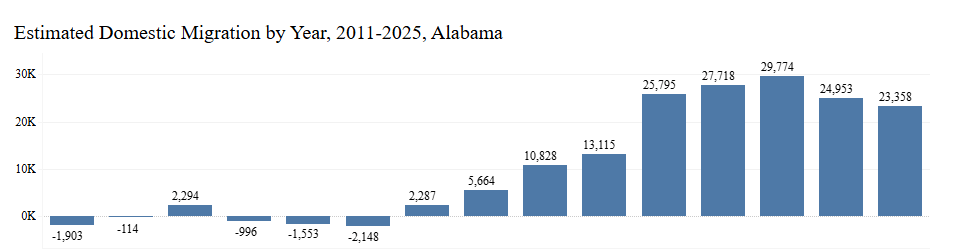
Image source: Public Affairs Research Council of Alabama
The growth is concentrated in the areas with the jobs. Yellowhammer News reports the Huntsville MSA led all metros, adding more than 13,000 residents between 2023 and 2024. Birmingham-Hoover added about 6,300, and Baldwin County added more than 7,500. The counties seeing the most growth — Madison, Baldwin, Limestone, Shelby, Tuscaloosa, and St. Clair — all have strong employment bases. Workers follow jobs, and Alabama keeps adding both; a key driver behind Alabama housing market predictions for the next two years.
In 2025, international migration slowed by about 60% as immigration policy tightened and rural counties continued to lose residents. For investors focused on Alabama’s metro markets, neither of those trends changes the picture much. Domestic migration into the state’s growth markets is what drives housing demand, and that’s still trending in the right direction.
Not sure if Alabama is right for you? Read Christine and Mauricio’s story to see how they built cash flow and equity through RealWealth’s turnkey property network.
2. Employment and economic indicators
Another key factor for Alabama housing market predictions is that the labor market ended 2025 in strong shape. The Alabama Department of Labor reports that unemployment dropped to 2.7% in December 2025, the sixth-lowest in the country and well below the national rate of 4.4%. The number of employed Alabamians hit an all-time high of 2,317,206. Construction wages hit a new record weekly average of $1,421.56. These aren’t vanity numbers. A strong labor market means employed tenants, and employed tenants pay rent.
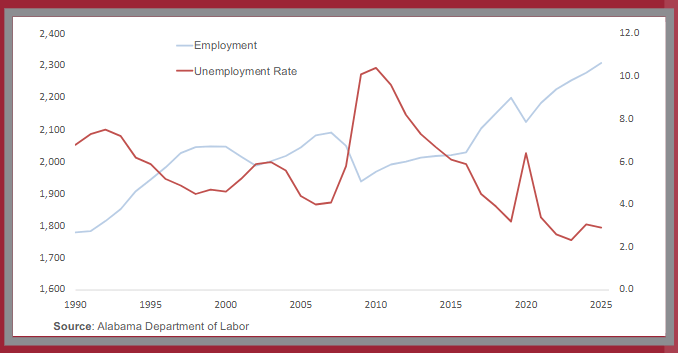
Image source: Center for Business & Economic Research
The economy itself is growing. The University of Alabama’s Center for Business and Economic Research puts Alabama’s GDP at over $262 billion in Q3 2025, up 4.7% from the previous quarter. Full-year 2025 growth is estimated at 1.7%, with 1.5% projected for 2026. Not explosive, but steady and broad-based.
The bigger story is investment. Governor Ivey’s office announced that 2025 set a new state record: 234 new and expanding industry projects committing $14.6 billion in capital investment. Foreign direct investment alone hit $3.6 billion, supporting 2,274 new jobs. The projects behind those numbers include ArcelorMittal’s $1.2 billion specialty steel facility in Mobile County, Owens Corning’s $325 million plant in Prattville, Georgia-Pacific’s $800 million mill modernization in Monroe County, and a potential multibillion-dollar AI factory from Nebius Group in Birmingham. When companies are putting that kind of capital into a state, they’re betting on its workforce and its future. That bet supports property values and rental demand for years.
Alabama also passed the Alabama Development Fund in 2025. It’s a new mechanism that captures a portion of tax revenue from incoming projects and reinvests it in site readiness, workforce training, and business recruitment. First investments were expected in early 2026. It’s designed to help Alabama compete for bigger projects without relying on one-time budget allocations, and it gives the state a more consistent tool for long-term economic development.
3. Real estate development and construction trends
Alabama home sales reached $19.37 billion in 2025, with median prices up nearly 20% year-over-year and active listings rising 8%. Alabama REALTORS expect moderate price appreciation to continue in 2026 as more buyers return to the market and inventory continues to improve. The frantic seller’s market of recent years is behind us. What’s replacing it is more balanced, and for investors, a balanced market is easier to underwrite.
New construction is tighter. Building permits for single-family units dropped roughly 8% statewide in 2025, and that decline will likely keep new inventory lean heading into the second half of 2026. Tariffs on building materials, labor costs, and workforce pressures from tighter immigration enforcement are all part of that story. Builders are still active; Huntsville has approved its most single-family lots since 2007, but the permitting slowdown means new supply won’t keep up with demand in most markets. Investors in supply-constrained areas benefit directly from that gap.
Redfin’s statewide data show Alabama’s median sale price at $290,300 in February 2026, up 3.2% year-over-year, with statewide inventory at about 6 months. More choices for buyers, prices still rising, and a labor market that keeps growing and attracting workers. That’s a reasonable setup for patient investors.
4. Government policies and regulations affecting real estate
Alabama’s policy environment is working in favor of real estate investors right now. The state has moved away from one-off legislative fixes toward a more systematic approach to economic growth, workforce development, and business attraction. The job creation and population growth driving housing demand aren’t happening by accident.
The biggest policy development in 2025 was the passage of the Alabama Development Fund. Governor Ivey signed it into law in May 2025, and it took effect on June 1, 2026. The fund captures a portion of taxes typically abated when major companies locate or expand in Alabama, then reinvests that revenue into site readiness, workforce training, and business recruitment. Alabama now has a consistent, self-sustaining funding stream for economic development that doesn’t depend on annual budget cycles or federal grants.
The Development Fund supports Catalyst, Alabama’s new statewide economic strategy launched in late 2024. Its first year delivered: $14.6 billion in capital investment, 9,388 new job commitments, and $3.6 billion in foreign direct investment.
On the construction side, a few headwinds are worth watching:
- Building permits dropped 8% statewide in 2025, which will keep new inventory lean heading into 2026 and benefit owners of existing rental properties.
- Tariffs on building materials are pushing up new construction costs, making it harder for builders to pencil out new projects.
- Tighter immigration enforcement has reduced the availability of construction labor in some markets, adding further pressure on construction costs and timelines.
At the federal level, the Senate passed the 21st Century ROAD to Housing Act in March 2026, described as the largest housing bill in decades. It targets deregulation to expand supply, expands assistance programs, and includes provisions restricting large institutional investors from buying single-family homes. It still needs to clear the House, but it signals that housing affordability is a federal priority in a way it hasn’t been in years.
Birmingham Housing Market Predictions 2026-2027
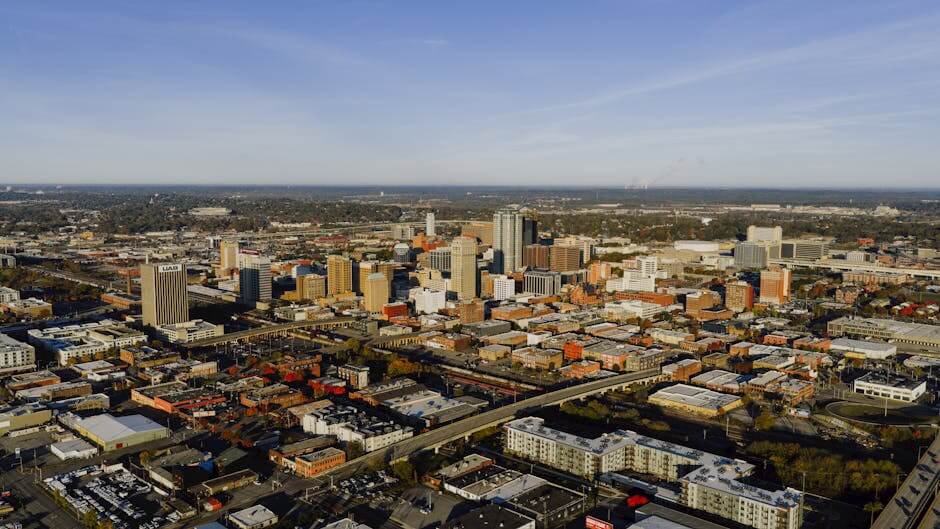
In this section, we’ll examine Alabama housing market predictions and trends in Birmingham’s housing market. We’ll highlight forecasts for Birmingham’s future and discuss why this affordable market continues attracting real estate investors.
Overview of the Birmingham metro area
Located in North Central Alabama, the Birmingham MSA, commonly called Greater Birmingham, has a population of approximately 1.2 million and represents about one-fourth of Alabama’s total population.
Birmingham distinguishes itself through world-class medical research facilities, creating significant employment opportunities. The University of Alabama at Birmingham (UAB) is Alabama’s largest employer with approximately 26,000 employees.
The city has garnered attention from millennials and Gen Z. Birmingham ranks #1 nationally for Gen Z renter growth with a 1,318% surge from 2018 to 2023. Young professionals move here for affordable housing, growing tech and manufacturing jobs, and vibrant arts and food scenes.
The economy in Greater Birmingham is diverse, ranging from service industries such as banking and finance to health-related technology research and heavy manufacturing. The metropolis houses the world headquarters for Regions Financial and Books-A-Million, the second-largest book retailer in the United States.
Birmingham’s GDP should reach $90 billion in 2025, growing 1.5-1.8% through 2027. The city ranked 5th nationally for job growth from 2022 to 2023 and eighth in “2024 Top States for Doing Business.”
Major developments include ACIPCO’s $790 million expansion, Coca-Cola United’s $330 million facility opening in 2027, and a 150,000-square-foot biotech incubator. J.M. Smucker’s $1.1 billion Uncrustables plant opened in November 2024 and is already adding a $27 million expansion.
Birmingham remains a hotspot for vacation rentals and short-term investments. In 2024, Greater Birmingham tourism reached a record $2.57 billion in economic impact, supporting 51,887 jobs and welcoming over 4 million overnight visitors. The city’s recognition as a top 2026 travel destination signals continued growth in tourism.
High-traffic attractions include the Birmingham Civil Rights Institute, the Birmingham Museum of Art, and the Barber Vintage Motorsports Museum. For culinary enthusiasts, the city, fondly known as the “Dinner Table of the South,” offers a diverse range of chef-owned restaurants.
Birmingham Real Estate Market Forecast for 2026 & 2027
1. Property prices
Birmingham Home Prices Will See Moderate Growth In A Balanced Market
Birmingham home prices are forecast to grow moderately, by 1.4-1.5% to 2-4%, in 2026-2027. The median home price sits at $251,416, 30% below the national average, making Birmingham one of the most affordable housing markets in the country.
Despite near-term moderation, long-term fundamentals remain strong. Home values have appreciated by 83.22% over the past decade, with an annual growth rate of 6.24%. This consistent appreciation, combined with affordability, creates opportunities for investors to enter at favorable price points while benefiting from steady equity growth.
Inventory Is Increasing But Still Below Historical Norms
Inventory has increased to 5-6 months of supply, creating better conditions for buyers. Homes spend 78-92 days on the market, significantly longer than in previous years. This gives buyers and investors time to evaluate properties thoroughly and negotiate effectively.
High-demand suburbs like Vestavia Hills, Hoover, and Mountain Brook still see competitive conditions, with sellers maintaining leverage. Market activity is influenced by mortgage interest rates of around 6% and strong in-migration to the area.
Builders continue new construction despite high material costs, offering incentives like rate buydowns to attract buyers. This steady construction activity helps meet demand while maintaining balanced market conditions that favor investors seeking value.
Birmingham Continues To Attract Out-Of-State Buyers
Birmingham remains a hotspot for out-of-state real estate investing. New residents arrive primarily from Georgia, Florida, Mississippi, Tennessee, California, Michigan, and Indiana. Demand for moderately priced homes ($400,000-$500,000) moves quickly, though investors targeting the $195,000 average price point through RealWealth’s recommended turnkey property teams face less competition.
The big money projects tell the story of the area’s growth. American Cast Iron Pipe Company’s $790 million expansion, Coca-Cola United’s building a $330 million facility, J.M. Smucker’s $1.1 billion plant is operational and adding a $27 million addition, and Nebius is planning a multibillion-dollar AI factory. These major corporate investments validate Birmingham’s growth trajectory and support long-term property values. Owing to its unique affordability and growing population, this area will continue to be one of the best places to invest in rental property.
2. Rental rates
Near-Term Rent Softness Followed By 2027 Recovery
Alabama housing market predictions for Birmingham’s rental market show a temporary dip in 2026, with rent growth expected to decline 4.6% as new apartment supply creates a renter-friendly market and vacancy rates increase. Currently, the median rent is $1,366, with asking rents showing approximately a 3.4% decrease in early 2026.
Vacancy rates reached 8.8%, giving renters more choices and negotiation power. Birmingham ranks among the top cities with the largest declines in median asking rent. This tenant-favorable environment is temporary, driven by a surge in multifamily construction that’s now moderating.
The good news for investors: 2027 brings recovery. Rent growth is expected to return to pre-pandemic norms with forecasts suggesting moderate 2-3% annual increases. After volatile pandemic-era rent spikes followed by corrections, the market is stabilizing at sustainable growth rates.
Median Household Income Rising As Jobs Come To Birmingham
Birmingham should add 3,700+ jobs through 2026-2027, with a growth rate around 1.5%. Unemployment sits at just 2.2%, well below national forecasts of 4.4% for 2026 and 4.2% for 2027.
UAB’s 26,000 employees anchor healthcare while downtown infrastructure projects attract young professionals. Major expansions include Brasfield & Gorrie’s $64.5 million headquarters and numerous biotech and manufacturing facilities. The Birmingham Business Alliance continues to focus on technology, life sciences, and corporate operations.
The median household income in Birmingham is $69,284. With strong job growth, low unemployment, and major corporate investments, income growth should continue supporting rental demand.
Demand for single-family rental properties remains solid, with 54% of households renting. Gen Z renters account for 33% of new residents in Alabama, and millennials continue to relocate from expensive cities. These young professionals create sustained tenant demand for quality rental properties.
Considering the temporary 2026 rent correction, favorable long-term fundamentals, and growing demographic of young renters, it’s reasonable to anticipate strong returns for single-family rental properties within the Birmingham metro area heading into 2027 and beyond.
Additional Alabama Real Estate Markets to consider
When investors look at purchasing rental properties in Alabama, Birmingham is often the first city that comes to mind. But Huntsville and Tuscaloosa, two of the state’s smaller metros with strong economies, also offer affordable entry points and cash-flow opportunities for real estate investors.
Huntsville, Alabama Housing Market Predictions 2026-2027
Huntsville’s key economic sectors are defense, aerospace, and tech, with Redstone Arsenal, NASA’s Marshall Space Flight Center, and Cummings Research Park anchoring the employment base. In addition, Boeing, Lockheed Martin, and General Dynamics all operate here. Jobs are expanding, with the FBI adding 4,000 jobs over the next five years, Eli Lilly pharmaceutical expansion bringing in 450, and Performance Drone Works adding 525. The metro is on track to create 30,000 new jobs by 2030, with unemployment at 3%.
The city grew by 15.9% since the 2020 Census, roughly 18 new residents per day. The broader MSA has approximately 542,000 residents and continues to climb.
1. Property Prices
In February 2026, Redfin recorded the median sale price at $316,000, down 2% from last year. For 2026 and 2027, local forecasters project 2-3% appreciation and Alabama REALTORS project 4-7% appreciation across key state markets, with Huntsville expected to lead. The median household income is $76,366, and wage growth is expected to outpace home price gains, giving Huntsville a perfect Housing Affordability Index score of 100. That’s not common in a city growing this fast.
2. Rental Rates
Average rents are $1,379, which is up 4.48% annually. Ten-year rent growth sits at 54.94%. Forty-two percent of households rent, and vacancy runs around 5%. The tenant base here is government contractors, defense workers, and tech employees, and they’re not moving in and out every year. New apartment construction has added some supply pressure on multifamily rents in the near term, but single-family rentals are less exposed to that.
Tuscaloosa, Alabama Housing Market Predictions 2026-2027
Tuscaloosa is home to the University of Alabama, and the university brings 39,000 students, faculty, and staff into the rental market every year. That demand doesn’t track mortgage rates or economic cycles. It just shows up.
Along with education, manufacturing and healthcare are the top sectors. Mercedes-Benz U.S. International has put over $7 billion into this market and employs 4,500 people. DCH Health System adds 3,444 more jobs. Cybersecurity jobs are expected to grow 18%. The metro itself grew 1.7% in 2025 and is projected to expand another 26.8% by 2040.
1. Property Prices
In February, Zillow puts the typical home value at $227,276, up .9% over the past year. Despite the rise in prices, homes are going pending within 29 days. Alabama housing market predictions for Tuscaloosa show entry prices remaining affordable even for new construction, remaining more affordable, and rents continue to rise at an average of 4.3% annually.
2. Rental Rates
Rents average $1,486, up 7.8% last year. Median household income is $63,900, with 55% of residents renting. New apartment supply may soften multifamily rents in 2026 while it gets absorbed. The university keeps vacancies from getting out of hand. Once that supply clears heading into 2027, nothing about the underlying demand has changed.
Conclusion: Alabama Housing Market Predictions
Alabama housing market predictions point to affordability, job growth, and a diverse mix of markets, making it one of the more straightforward cases for rental property investing right now. Birmingham offers scale and economic momentum. Huntsville brings defense and tech stability. Tuscaloosa delivers college-town demand that doesn’t quit. The fundamentals across all three markets support both cash flow and long-term appreciation for investors who buy smart and manage well.
Not a RealWealth investor yet? Join RealWealth for free to connect with our investment counselors and vetted property teams selling fully renovated single-family homes in Alabama’s top markets. It takes less than five minutes to join and gives you access to market data, pro formas, and one-on-one guidance to help you find the right property at the right price.