If you’re considering a 1031 exchange strategy, understanding the fundamentals and avoiding common pitfalls can save you thousands in taxes and prevent disqualification. This masterclass covers everything from the basic 1031 exchange timeline—including the critical 45-day identification window and 180-day closing deadline—to advanced strategies like partial exchanges.
Hosted by RealWealth and featuring Asset Preservation, Inc., a nationally recognized qualified intermediary, this masterclass will walk you through everything you need to know about IRS Section 1031 exchanges, including how to complete a partial 1031 exchange if you want to defer some taxes while cashing out a portion of your equity.
Whether you’re an experienced investor or just starting to grow your portfolio, this session will help you unlock new tax-efficient strategies and make smarter decisions with your investment properties.
What You’ll Learn in This 1031 Exchange Masterclass Webinar:
- What is a 1031 exchange, and how does it work?
- Who qualifies for a 1031 exchange, and what types of properties are eligible?
- Key 1031 exchange rules, timelines, and IRS compliance requirements.
- What is a partial 1031 exchange, and when does it make sense to use it?
- Common mistakes to avoid when initiating an exchange.
- A side-by-side case study: selling a property vs. completing a 1031 exchange.
- Live Q&A with a seasoned 1031 exchange qualified intermediary.
A 1031 exchange isn’t just about deferring taxes. It’s a strategic way to reinvest gains, increase cash flow, and build scalable wealth through real estate. Whether you’re exchanging one property or several, or considering a partial exchange for flexibility, this masterclass will give you the tools and insights to get it right.
Watch The 1031 exchange Webinar
Who Should Watch This Webinar:
- Real estate investors planning to sell an investment property
- Landlords in high-tax states looking to increase cash flow
- Investors who want to diversify from one property into multiple properties
- Anyone considering a 1031 exchange from California to other states
- Experienced investors exploring partial exchanges or advanced strategies
Ready to Start Your 1031 Exchange?
After watching this masterclass, you’ll have a solid understanding of how 1031 exchanges work. Here are your next steps:
- 1. Review the Fundamentals by starting with our comprehensive guide: 1031 Exchange Rules, Tips & Strategies for Success
- 2. Understand the Timeline and map out your exchange dates: 1031 Exchange Timeline: 8 Steps to Avoid Paying Capital Gains
- 3. Connect with a Qualified Intermediary and learn what to for: What is a Qualified Intermediary & How to Find a Great One
- 4. Find Replacement Properties by starting your search in top markets: 1031 Exchange Properties for Sale in Top U.S. Markets
- 5. Get Expert Help by Joining RealWealth to connect with trusted qualified intermediaries and access off-market replacement properties nationwide.
Summary of 1031 Exchange Webinar with Stephanie from Asset Preservation
[00:01 → 01:05] Introduction
- Stephanie from Asset Preservation, a leading national qualified intermediary with 35 years of experience and over 200,000 completed 1031 exchanges, introduces the topic.
- Participants are encouraged to ask general questions via the Q&A box; detailed personal advice should be sought from a tax professional.
- The webinar’s purpose is to provide broad education about 1031 exchanges.
[01:05 → 02:45] Overview of 1031 Exchanges
- Definition: A 1031 exchange allows deferral of capital gains taxes on the sale of investment or business-use real estate when exchanged for “like-kind” property.
- 1031 exchanges have been part of tax code since 1921 but are increasingly used.
- Benefits include tax deferral and reinvestment to grow investment portfolios.
- Options for clients on property sales:
- Hold property and wait for market changes.
- Sell and pay capital gains tax.
- Use 1031 exchange to defer tax and reinvest in new property.
[02:45 → 05:13] Reasons Investors Use 1031 Exchanges
- Key motivations:
- Leverage appreciated equity to acquire multiple properties.
- Diversify by asset class (retail, single-family, industrial) or geography.
- Consolidate multiple properties into fewer, larger ones.
- Increase cash flow.
- Reduce management complexity.
- Estate planning to divide assets among heirs and avoid disputes.
- Real Wealth assists clients in identifying suitable properties and locations
[05:13 → 07:46] Capital Gains Taxation and Example
- Taxes involved in capital gains on real estate:
- 25% depreciation recapture tax.
- 20% federal capital gains tax plus 3.8% Net Investment Income Tax.
- State tax varies (e.g., California up to 14.4%).
- Depreciation recapture applies over the lifetime of ownership (typically 27.5 years for residential rental).
- Example:
- Property purchased at $400,000, fully depreciated by $300,000, sold for $1,000,000.
- Adjusted tax basis: $100,000.
- Capital gain: $900,000.
- Taxes due on sale could be nearly $349,000.
- Using 1031 exchange defers these taxes, enabling reinvestment of full proceeds.
- Sale with taxes paid limits reinvestment to $2.6 million; 1031 exchange allows leveraging to $4 million.
[07:46 → 09:21] Legal Code and Exchange Entities
- Internal Revenue Code Section 1031 states no gain or loss is recognized on exchanges of real property held for business or investment if exchanged solely for like-kind real property.
- Exchange entities matter: The taxpayer selling must be the same taxpayer acquiring the replacement property.
- If a wife sells, she must acquire.
- If an LLC sells, the LLC must acquire.
- Correct identification of the taxpayer entity is critical to avoid invalidating the exchange.
[09:21 → 11:42] Like-Kind Property and Non-Qualifying Properties
- Like-kind property is broadly defined and includes:
- Properties not qualifying for 1031:
- Principal residences (covered under different tax code 121).
- Flips or inventory held for sale (not investment property).
- Split treatment: Mixed-use properties (e.g., a fourplex with one unit as primary residence) can combine 1031 and 121 benefits.
- Conversion of primary residence to rental property is possible to qualify for 1031 after meeting rental and ownership time requirements.
[11:42 → 13:59] Holding Period
- No official IRS minimum holding period for investment properties before exchange.
- IRS guidance (private letter ruling) suggests 24 months of ownership to satisfy long-term investment intent.
- Holding for less than 24 months is possible if there is sufficient documented intent to hold for investment purposes.
- Example given of a client who held property 8 months with clear investment intent and successfully completed 1031 exchange.
[14:34 → 16:39] Exchange Requirements and Partial Exchanges
- To defer all taxes fully:
- Reinvest all net proceeds (sale price minus closing costs).
- Acquire replacement property with same or greater debt.
- Example: Selling property for $900,000 with $300,000 debt and $60,000 closing costs → net proceeds $540,000. Replacement property bought for $1.2 million with $660,000 debt satisfies full deferral.
- Partial exchange: Allows retaining some cash (“boot”) or not replacing all debt, resulting in partial tax deferral.
- Boot (cash or mortgage) is taxable.
- Partial exchanges useful for paying off debt, funding other expenses, or not wanting to increase leverage.
[17:12 → 19:18] Steps Before Doing a 1031 Exchange
- Consult a tax advisor to evaluate if 1031 makes financial sense based on property appreciation and improvements.
- Consult a qualified intermediary to arrange the exchange.
- Confirm the taxpayer entity matches on the sale and purchase agreements.
[17:50 → 24:46] Regular Delayed Exchange Process and Identification Rules
- Process:
- Sell property, escrow funds wired to a qualified intermediary (QI).
- The seller never receives funds directly to avoid constructive receipt.
- 45 days from the close of escrow to identify replacement property.
- 180 days from the close of escrow to close on the replacement property.
- Identification rules:
- Three Property Rule: Identify up to 3 properties of any value.
- 200% Rule: Identify unlimited properties, but the total value cannot exceed 200% of the relinquished property’s value.
- 95% Rule: Identify unlimited properties of any value, but must acquire 95% of the identified value.
- Identification must be in writing, signed, and delivered by midnight of day 45.
- Offers can be made before identification; properties can be removed from the list if necessary.
[24:46 → 28:20] Multiple Properties and Reverse Exchanges
- Can sell multiple properties and buy one, or sell one property and buy multiple.
- The identification period starts with the first sale’s close of escrow.
- Reverse exchange: Purchase replacement property before selling relinquished property.
- Requires creation of an LLC as Exchange Accommodation Titleholder.
- LLC holds title temporarily and leases property back to client.
- Client must sell relinquished property within 180 days.
- Reverse exchanges are more complex and expensive.
[28:20 → 29:19] Last-Minute 1031 Exchanges
- Possible if escrow closing has not occurred.
- Requires immediate communication with escrow and a qualified intermediary to set up the exchange.
- Must prevent closing until wiring instructions are in place to avoid constructive receipt.
[29:19 → 31:59] Partial Exchange Use Cases and Clarifications
- Partial exchanges allow investors to defer most taxes while retaining some cash.
- Useful for debt paydown, other expenses (college funds, repairs).
- Alternative to partial exchange: full reinvestment plus refinancing to pull cash out.
- Clarification that adding extra funds to purchase property does not create boot.
[32:29 → 37:07] Common Questions on Debt Replacement, Foreign Properties & Identification Assistance
- Debt must be replaced or supplemented with cash to avoid a mortgage boot.
- Foreign properties can qualify only if the exchange stays within foreign countries; U.S. to foreign or vice versa is not allowed.
- Vacation rental properties can qualify if owned and rented out for specific minimum periods and usage limits.
- Asset Preservation provides client support for filling out identification forms and guiding them through the process.
- Depreciation recapture applies only if depreciation was claimed.
- Taxpayer entity must match on sale and purchase; LLCs owned by individuals may be disregarded entities—consult CPA.
- Parking lots and garages qualify as real property.
[37:07 → 38:51] Identification Failure & Fees
- No specific industry stats on failure to identify properties within 45 days; generally, clients are successful.
- IRS G6 restrictions require that the QI hold funds for the complete identification and exchange periods.
- Fees:
- Regular delayed exchange: $1,250–$2,000 depending on state.
- Reverse exchange: $7,000–$9,000 due to complexity and LLC creation.
[39:52 → 41:24] Why Choose Asset Preservation?
- Nonregulated industry; importance of choosing a trustworthy, qualified intermediary.
- Asset Preservation’s advantages:
- 35 years of experience.
- Over 200,000 exchanges completed.
- Member of the Federation of Exchange Accommodators.
- ENO insurance and additional protection through Cisco Information Systems.
- Funds held in non-commingled accounts at large national banks.
[41:58 → 42:59] Tips to Meet IRS Deadlines
- Start searching for replacement properties immediately after going under contract to sell.
- Use Real Wealth Network’s vetted property teams with replacement properties available now to identify strong candidates.
- Complete inspections and due diligence promptly to ensure properties can close within deadlines.
[41:58 → 42:59] Tips to Meet IRS Deadlines
- Stephanie offers ongoing support and consultation.
- Investors are encouraged to consult investment counselors for personalized strategy sessions before proceeding.
- The webinar concludes with thanks and encouragement to reach out with any further questions.
Key Insights & Takeaways
- 1031 exchanges enable deferral of significant capital gains and depreciation recapture taxes, allowing investors to reinvest more capital and grow portfolios faster.
- Like-kind property is broad—investors can diversify asset types and geographic locations within one exchange.
- Correct identification of the taxpayer entity and adherence to timing (45-day identification, 180-day close) are critical to avoid disqualification.
- Partial exchanges offer flexibility to defer most taxes while retaining some cash for other needs.
- Reverse exchanges allow you to secure replacement property first, but they are more complex and costly.
- Engaging an experienced, qualified intermediary like Asset Preservation minimizes risk, ensures compliance, and protects funds.
- Early preparation and using professional networks like Real Wealth improve chances of timely identification and closing on replacement properties.
Need help Finding replacement properties fast?
Join RealWealth (it’s free!) for expert guidance and access to all our 1031 Exchange resources.
Frequently Asked Questions: 1031 Exchanges
A 1031 exchange lets real estate investors defer paying capital gains taxes when they sell an investment property and purchase a “like-kind” replacement property with the proceeds. You must use a Qualified Intermediary (QI) who holds the funds, identify replacement properties within a 45-day window, and close within 180 days. Learn the complete rules and step-by-step process →
There are seven primary IRS rules that all 1031 exchanges must follow:
1. Like-Kind Property – Both properties must be investment real estate
2. Investment Property Only – No primary residences or personal use
3. Equal or Greater Value – Replacement property must be worth same or more
4. No Boot – In order for the exchange to be completely tax-free, you must not receive a “boot.”
5. Same Taxpayer – Title must be in the same name as the taxpayer on the relinquished property.
6. 45-Day Identification – Identify up to 3 properties within 45 days (no extensions)
7. 180-Day Purchase – Close on replacement within 180 days (no extensions)
You have 45 calendar days from the closing of the rental property you are selling to identify up to three replacement properties and a total of 180 days to close. These IRS deadlines are very strict with no extensions, so proper planning is critical. See the complete 8-step timeline and avoid missing deadlines →
Start early, and do so long before you put your property on the market. Planning early reduces the anxiety of the 45-day identification window, helps you connect with the best QIs, lenders, property teams, and find the best 1031 exchange replacement properties so you can meet all of your deadlines and not end up stressed out and settling for mediocre deals. RealWealth can help streamline the process for you, by connecting you with trusted 1031 exchange qualified intermediaries and property teams who have turnkey rental properties for sale now.
The IRS mandates two critical deadlines. The identification period is a 45-day window to identify potential replacement properties. The exchange period is the acquisition of the replacement property, which must be completed within 180 days of the sale of the relinquished property. Learn more about 1031 exchange timelines and mistakes to avoid →
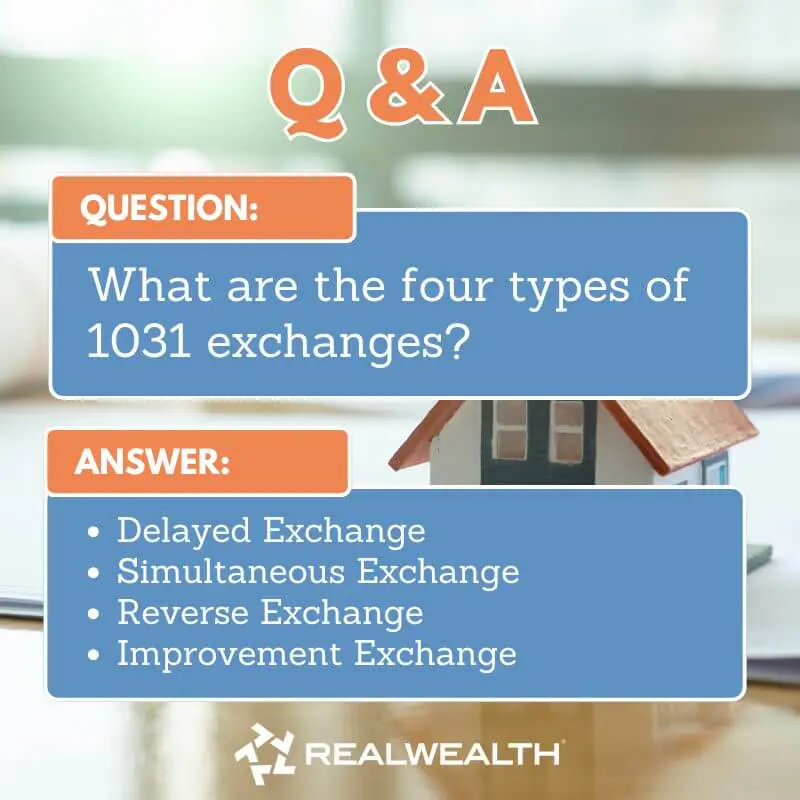
There are four main types of 1031 exchanges in real estate: Delayed Exchange (most common, where you sell first and then buy), Simultaneous Exchange (where you close both properties on the same day), Reverse Exchange (where you buy first and then sell), and Construction Exchange (where you make improvements using exchange funds). Each has different requirements and timelines. Compare all four types and choose the right one →
Yes, a 1031 exchange qualified intermediary is required by law for 1031 exchanges. The QI holds the sale proceeds, prepares documents, coordinates closings, and ensures IRS compliance. If you touch the funds at any time without a QI, you’re disqualified and will owe capital gains taxes. Learn what a QI does, costs, and how to find one →
To find 1031 exchange investment property, focus on markets with population growth, job growth, affordability, low property taxes, and landlord-friendly laws. Start your search before selling and consider multiple properties in two to three markets, so if one of the rental properties falls through, you have a backup plan. Get the 12 rules for identifying cash-flowing replacement properties →
While all RealWealth property teams have ample inventory for 1031 exchange replacement properties, some of the most popular locations have been Dallas-Fort Worth, Alabama (including Birmingham and Huntsville), San Antonio, Jacksonville, Tennessee, and Cleveland. These markets offer strong cash flow, appreciation potential, affordability, and landlord-friendly laws with available turnkey rental property inventory. Explore available properties in top markets now →
Yes! As long as the properties meet the “like kind” requirement and you can replace the full value of the relinquished property or properties, you can defer all capital gains taxes with a 1031 exchange.
Yes, you can exchange a California investment property for an out-of-state 1031 exchange investment property, provided you follow the rules. However, California requires annual Form FTB 3840 filings to track deferred gains until you sell or pass away (please consult with your tax advisor or CPA). Many investors exchange their high-equity California rental properties to dramatically increase cash flow in landlord-friendly states. Learn about California-specific requirements and why investors leave →
Buy properties in appreciating markets, hold for 4-6 years while they generate cash flow and appreciate, then exchange them for multiple properties in growth markets. RealWealth’s investment counselor Joe Torre turned two properties into five, then plans to turn two into four again—doubling his portfolio every four to six years. Read the complete portfolio doubling case study and strategy →
Yes, RealWealth offers a free 1031 Exchange Masterclass webinar covering all the critical rules, timelines, qualified intermediaries, partial exchanges, and real investor case studies. The webinar features a live Q&A session with 1031 exchange professionals and is ideal for both new and experienced real estate investors. Watch the free 1031 exchange masterclass now →
RealWealth connects its members with property teams that sell off-market, turnkey rental properties in top U.S. markets. These turnkey teams sell single-family and multi-family properties that are fully rehabbed or newly built, and come with property management in place. Free membership includes one-on-one strategy sessions and ongoing support from investment counselors who specialize in helping real estate investors find replacement properties within the 45-day deadline. Get help finding properties fast →
RealWealth specializes in connecting investors with vetted turnkey property teams in landlord-friendly states across the U.S. Our network includes trusted providers in top markets like Texas, Alabama, Tennessee, and Ohio—all offering professionally managed, 1031-eligible properties with strong cash flow and appreciation potential. Connect with vetted property teams now →
Before you begin your search, it’s critical that you know that the 1031 exchange intermediary industry is not well-regulated. Be very careful with whom you use and be sure that they will not invest your money in risky ways while you are in between purchases.
You could start by getting referrals from escrow officers, researching online reviews, and checking credentials. Look for a 1031 exchange facilitator with thousands of successful exchanges and experience with your specific exchange type (delayed, reverse, or construction). Learn how to find and vet a qualified intermediary →
To save time, become a RealWealth member (100% free). We have worked with the same reputable 1031 exchange facilitator for over a decade. We know they are great, because we use them too! Let us introduce you →
Start your search before selling. Focus on markets with strong cash flow and appreciation. Target properties in areas with population growth and job growth. Choose landlord-friendly states with low property taxes. Work with property teams that have immediate inventory to avoid missing your 45-day identification deadline. Get the 12 strategies for finding cash-flowing properties →
You can start by viewing sample investment properties here. But the best way to find qualified properties is to become a RealWealth member. After you join, schedule a strategy session with your investment counselor, who can help you identify a market that matches your goals and connect you with a property team that has 1031 exchange replacement properties for sale now. Depending on the market you choose, these turnkey properties may include single-family rentals ($120,000-$350,000), duplexes ($200,000-$600,000), and fourplexes ($500,000-$985,000) in markets such as Texas, Alabama, Ohio, and Tennessee. Properties range from rehabbed turnkey to new construction, with options for cash flow, appreciation, or hybrid strategies. View property types and examples by market →
A quick internet search will help you find 1031 exchange services. Whomever you choose, be sure to vet them thoroughly. Investors choose to work with RealWealth because we connect them to trusted 1031 exchange facilitators (whom we use ourselves) and vetted property teams. These teams have off-market turnkey properties in growth markets and have property management in place. In addition, we offer personalized strategy sessions with investment counselors who understand the stress of the timeline crunch. RealWealth membership is 100% free and provides access to educational content and a network of trusted professionals, including qualified intermediaries, attorneys, and CPAs. Explore services and get started free →
The key is to find a property of like kind. Based on what you are selling, your options may include single-family rentals for steady cash flow, duplexes and multi-family properties for higher returns, new construction in growth markets for appreciation, and rehabbed turnkey properties for immediate rental income. You can choose from markets offering various price points ($120,000-$985,000+) and investment strategies based on your goals. See available options in top markets →
RealWealth members get free access to a comprehensive directory of vetted professionals, including 1031 exchange qualified intermediaries, turnkey property teams, real estate attorneys, CPAs, lenders, and more—all experienced in real estate investing strategies. This network helps streamline your exchange process and ensures you’re working with trusted experts. Access the professional directory free →
If you don’t identify a replacement property within 45 days or close within 180 days, your entire exchange fails, and you’ll owe capital gains taxes on the full sale amount. Other risks include settling for an underperforming property due to time pressure, overpaying in competitive markets, or selecting a property in the wrong market that fails to meet your investment goals. Learn the complete timeline and avoid these risks →
Membership to RealWealth is free and gives you access to vetted Qualified Intermediaries (we’ve used them ourselves), off-market turnkey rental properties in landlord-friendly states, one-on-one strategy sessions with experienced investment counselors, educational webinars, and market research to help you complete your exchange successfully and meet critical deadlines so you avoid paying capital gains taxes. Get expert help with your 1031 exchange →
Membership to RealWealth is free and gives you access to vetted Qualified Intermediaries (we’ve used them ourselves), off-market turnkey rental properties in landlord-friendly states, one-on-one strategy sessions with experienced investment counselors, educational webinars, and market research to help you complete your exchange successfully and meet critical deadlines so you avoid paying capital gains taxes. Get expert help with your 1031 exchange →