Where are the best places to buy rental property this year? As a seasoned real estate investor with decades of experience in single-family and multifamily properties in the United States and abroad, I’m often asked this question. To help you narrow down the best market for your real estate investment goals, we’ve rounded up the top choices for 2026.
25 Best Places to Buy Rental Property in 2026
Not sure where to invest in real estate this year? We've rounded up 25 of the best places to buy rental property in 2026 for cash flow and appreciation.
Before we dive into our best places to buy rental property for 2026, here are some tips for analyzing potential real estate markets.
3 Factors for Analyzing a Real Estate Market
Before researching and analyzing markets, you’ll want to understand your real estate investment goals so you can avoid making impulse decisions. Ask yourself, “What do I want from my investment?” Knowing your goals and the answer to this question is critical to choosing the right path for you.
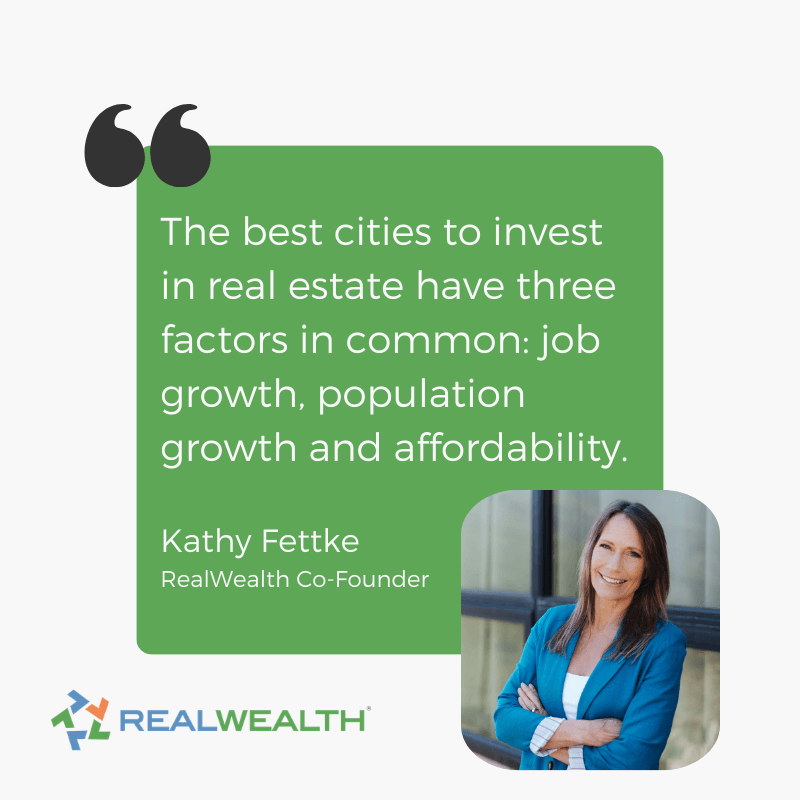
I’ve found that the best cities to invest in share three factors: job and population growth, and affordability.
1. Job Growth
Because population growth correlates with the availability of job opportunities, real estate investors should prioritize markets where job opportunities are expanding.
When assessing a location for a strong job market, here are key points to keep in mind:
- Number of jobs. The number of jobs in an area signifies which locations are experiencing growth and which are not.
- Rise in median salary. The median salary is the midpoint of all wages. When it rises, it indicates a growing economy with a demand for skilled workers.
- Job diversity. A strong mix of industries and workforce signals a location is on an upward momentum.
- Commercial buildings. When the economy improves, industries expand, and more commercial buildings and towers are built.
2. Population Growth
Despite what the numbers on your pro forma may say, a rental property only brings in revenue if you can find someone willing to rent it. To identify the best places to buy rental properties in 2026, look for areas with strong population growth and housing demand.
To analyze a region’s real estate market, look for signs of population growth, as this often translates into higher housing demand. Real estate markets with growing populations also tend to have strong economies. When more jobs are available, more people can afford to pay rent.
When demand for houses outpaces supply, home prices rise, and rents increase. When you invest in rental properties in an area with high population growth and housing demand, your investment should pay off over time as rents rise.
3. Affordability
Every housing market has its own pricing and market trends. Different factors come into play when researching where to invest in rental property. Here are three:
- Location. A property’s location, including the city and neighborhood, plays a big role in its current value, appreciation potential, and how long it takes to recoup your initial investment. At RealWealth, we recommend that investors avoid high-priced markets such as New York City, Los Angeles, and San Francisco, and instead focus on markets with strong appreciation and job growth, such as Cleveland, Ohio; San Antonio, Texas; and Jacksonville, Florida.
- Price-to-rent ratio. Investors use this benchmark number to gauge an area’s potential profitability. To find this number, divide the median home price by the median yearly rent. The calculated number lets you know if renting or owning a property is cheaper. A price-to-rent ratio of 15 or lower favors buying, while 21 and above means it’s cheaper to rent than buy. The higher the price-to-rent ratio, the worse the market is for real estate investing (rentals in particular). It also translates to lower cash flow potential. Conversely, an area with affordable real estate but increasing rents will almost always make for a good investment.
- Fixer-upper. A fixer-upper in a popular or up-and-coming neighborhood can also be a good investment if you have the time, money and experience to make improvements that increase rent and property values.
- Turnkey rental properties: Move-in-ready rental properties that have been renovated or are new construction, and are rent-ready, with professional management. Unlike fixer-uppers, turnkey properties let you start generating rental income immediately without the time, money, or experience needed for renovations. At RealWealth, we work with vetted property teams that meet our REAL Income Property Standards—ensuring properties are in strong rental markets, structurally sound, professionally managed, and priced appropriately. For investors who want cash flow without the hassle of rehab work, turnkey properties offer a straightforward path to building a rental portfolio.
When you find a market with all three factors – job growth, population growth, and affordability – you’ll likely be able to find good real estate investment opportunities for both cash flow and appreciation.
To help you with your market research, we’ve rounded up 25 of the best places to buy rental property for 2026. We’ll also explain why these markets are strong for investors.
Where is the Best Place To Buy Rental Property Today?
25 Cities To Consider in 2026
Please note: The following real estate markets are ranked based on our estimates of their cash flow and appreciation potential. We’ve made this determination based on insights from RealWealth Investment Counselors, who are highly experienced real estate investors with rental properties in many of these markets.
Using our local property team’s networks and expertise, we’ve compiled and analyzed current home value and rental data based on the current inventory, as well as metro-area historical home value and rental data (dating back to 2014) from Zillow’s Housing Data spreadsheets. In addition, we’ve researched and calculated metro population growth over the past 11 years using Census.gov data.
We’ve spent months researching to update this article for 2026. However, please do your due diligence when deciding which real estate market to invest in and which property to purchase. This is the only way to ensure you make the best investment decision for your goals and financial situation.
#1 Dallas, Texas

Often referred to as DFW or The Metroplex by locals, the Dallas–Fort Worth–Arlington Metropolitan Statistical Area is the bustling hub of North Texas. With over 8.3 million residents and projected to surpass 10 million by 2030, Dallas ranks among the top metro areas for economic growth and GDP. Its diverse economy, forward-thinking development, and status as one of the top five Sun Belt cities make it one of the best places to buy rental property for appreciation-focused investors.
MSA and Economy
Dallas-Fort Worth covers 12 counties with two main economic centers—Dallas, Plano, Irving, Fort Worth, andArlington. While the area may have roots in cotton and oil, it’s now leading in technology, healthcare, business, financial services, and telecommunications. This economic diversity helps the Dallas real estate market remain stable even during economic uncertainty. Currently ranked in the top ten cities for GDP, Dallas is expected to have a GDP of $770 billion in 2024, with a 3.23% growth rate, positioning it as a business and innovation powerhouse.
Population Growth
The Dallas-Fort Worth Metroplex became home to more than 8.3 million people in 2025. Data from the Kinder Institute for Urban Research projects it will exceed 10 million residents by 2030, placing it in the top five U.S. metros. The area features some of the fastest-growing suburbs in the country, driven by strong migration for job opportunities, business-friendly policies, and quality of life.
Job Growth
Between March 2024 and March 2025, Dallas created more than 59,000 jobs and had a 1-year job growth rate of 1.5%, higher than the national average. The unemployment rate sits around 4%, lower than the national average. Leading sectors include technology, healthcare, financial services, defense, and telecommunications, which together provide diverse employment opportunities that support sustained housing demand.
Investing Through Turnkey Teams In RealWealth‘s Network
The Dallas-based turnkey real estate company in our network sells new-construction investment properties in the Sherman-Denison and Greenville areas. The average price range for a single family home is $200,000 to $250,000. The average price range for a duplex is $365,000 to $565,000. Rents average $1,500 for an SFR and $3,750 for a duplex. The market’s strong appreciation potential, diverse economy, and rapid population growth are major draws for real estate investors seeking the best places to buy rental property. To connect with the team, join RealWealth today.
About the Dallas Housing Market
Dallas-Fort Worth is expected to become more balanced in 2026. From July 2023 to July 2024, the area saw a 13% increase in single-family home building permits, which slightly stabilized housing inventory and rents. While more inventory has entered the market, the area’s strong economic growth and robust population continue to drive housing demand. Home values have appreciated at a consistent 9% annual rate, well above the national average. As one of Texas’s most dynamic real estate markets, Dallas continues to deliver strong long-term appreciation potential for investors.
Dallas Housing Market Statistics
- Median Household Income: $75,220
- Metro Population: 8.3 Million
- 12-Year Population Growth: 30.54%
- Median Home Price: $365,329
- 1-Year Equity Growth: 7.95%
- 10-Year Equity Growth: 114.94%
- Median Rent Per Month: $1,671
- 1-Year Rent Growth: 2.96%
- Job Growth: +59,000 jobs created over the last year
- 1-Year Job Growth Rate: 1.5% (higher than the national average)
- Unemployment Rate: 4% (lower than the national average)
Top 3 Reasons to Invest in the Dallas Real Estate Market in 2026
1. Strong appreciation potential
Dallas home appreciation has consistently exceeded the national average, with an annual appreciation rate of 7.95%. Over the past 10 years, home values have increased 115%, and rent appreciation averaged 2.96% annually. This reliable growth makes Dallas an ideal destination for investors seeking long-term equity growth and wealth accumulation.
2. Rapid Population Growth and Urbanization
Dallas-Fort Worth ranks among the fastest-growing metro areas in the United States and is projected to reach 10 million residents by 2030. People are drawn to the metro for job opportunities, more affordable living than in coastal cities, cultural diversity, and a high quality of life. This rapid urbanization creates sustained housing demand and rental stability.
3. Diversified economic powerhouse
Dallas consistently ranks among the fastest-growing economies in the U.S. and boasts a flourishing, diversified economy beyond any single industry. The metro continues to attract Fortune 500 companies, tech firms, and major employers, driving job creation and supporting housing market growth. This economic diversity reduces investment risk and strengthens long-term market fundamentals.
How To Purchase Investment Property in Dallas
- Research the market: Familiarize yourself with different neighborhoods and their investment potential. Areas like Denison, Greenville, and Sherman offer a range of entry points, from lower-cost options to new construction, each with unique growth drivers.
- Understand the laws: Texas property laws are generally landlord-friendly. However, be aware of specific local regulations regarding property rental and maintenance.
- Financial planning: Texas property taxes are higher than in other states, which could impact your investment’s profitability. Review your real estate pro forma thoroughly and talk with a trusted CPA.
- Work with a local team: Partner with experts who know the Dallas and North Texas market well and can help you find the best properties. Connect with the Dallas Property Team in RealWealth’s network today to view current turnkey rental property inventory.
#2 Cleveland, Ohio

Cleveland, Ohio, offers an attractive investment opportunity for investors seeking a real estate market with balanced, sustainable growth rather than the boom-and-bust cycles of some overheated markets. Grounded in a diverse economic landscape across healthcare, manufacturing, and bioscience, it attracts a steady stream of young professionals and families. Although the Cleveland real estate market may not be experiencing rapid population growth like other markets, its population remains stable, providing a stable foundation for long-term investors.
MSA and Economy
The Cleveland-Elyria metropolitan area consists of six counties, each with a rich history dating back to its industrial heyday. Once a manufacturing powerhouse, the region has evolved, diversifying its economy into thriving healthcare, bioscience, and technology sectors. This economic transformation, combined with the city’s natural amenities, such as Lake Erie, and cultural attractions (Rock and Roll Hall of Fame), has created a dynamic investment climate. Major employers span healthcare systems, manufacturing companies, and tech firms, creating a diversified employment base that supports stable housing demand.
Job Growth
Between August 2024 and August 2025, the Cleveland metro area added 8,200 jobs, with a job growth rate of 0.70%. The unemployment rate is 4%, below the national average. The region’s diverse economy across healthcare, manufacturing, bioscience, and technology provides stability. This economic diversity helps maintain steady employment levels and supports consistent housing demand, making Cleveland a reliable market for long-term rental property investors.
About the Cleveland Housing Market
At the heart of Cleveland’s appeal for real estate investors is its affordability. The median home price in the broader Cleveland-Elyria metropolitan area is $294,281, 17.96% lower than the national average. The annual appreciation rate is 9.01%, and over the past 10 years, home values have increased by 136.89%. Average rents stand at $1,530, with a 4.45% annual growth rate and a 10-year growth rate of 54.61%. Approximately 59% of households in the metro area choose to rent rather than own, creating a consistent tenant pool.
Investing Through Property Teams In RealWealth‘s Network
The Cleveland turnkey real estate company we work with sells single-family investment properties and occasionally multifamily properties. The average price is $125,000, 65.20% lower than the national average. Rents average $1,200, offering excellent cash flow opportunities. The market’s exceptional affordability, strong appreciation potential, and high rental demand are major draws for real estate investors seeking the best places to buy rental property. To connect with the team, join RealWealth today.
Cleveland Housing Market Statistics
- Median Household Income: $73,000
- Metro Population: 2.34 Million
- 12-Year Population Growth: 10.95%
- Median Home Price: $294,281
- 1-Year Equity Growth: 9.01%
- 10-Year Equity Growth: 136.89%
- Median Rent Per Month: $1,530
- 1-Year Rent Growth: 4.45%
- 10-Year Rent Growth: 54.61%
- Job Growth: 8,200 jobs created
- 1-Year Job Growth Rate: .70% (higher than the national average)
- Unemployment Rate: 4% (lower than the national average)
Top 3 Reasons to Invest in the Cleveland Real Estate Market in 2026
1. Affordable real estate market
In 2025, the average home price in Cleveland was $294,281, 18.06% below the national average. Investment properties are available at even lower price points, with the average around $125,000—65.20% below the national average. Neighborhoods such as North Collinwood and South Broadway offer attractive investment opportunities, with median sale prices under $100,000. This affordability delivers excellent cash-on-cash returns for investors seeking monthly income.
2. High rental yield potential
Fifty-nine percent of households in Cleveland are renter-occupied, creating strong, consistent rental demand. Over the past 10 years, rent has increased by 54.61%, with an annual growth rate of 4.45%. Cuyahoga County, which includes Cleveland-Elyria, ranked among the top three counties in Attom’s 2025 rankings for buying single-family rentals, with a median sales price of $172,199 and an annual gross rental yield of 10.1%. The combination of high rental occupancy, affordable entry prices, and strong rental yields presents excellent opportunities for real estate investors.
3. Steady home prices and rent appreciation
Cleveland’s real estate isn’t just affordable; it also comes with strong appreciation potential. The Cleveland metro area has averaged a 9.01% annual home appreciation rate, totaling 136.89% over the past 10 years. This demonstrates steady, reliable appreciation that outpaces many markets. Unlike boom-and-bust cycles in overheated markets, Cleveland offers measured, sustainable growth that supports long-term wealth building through real estate.
How To Purchase Investment Property in Cleveland
Cleveland offers real estate investors a solid rental market, with strong rental areas and relatively low property prices, making it an attractive location for buying rental properties. The city has been experiencing urban revitalization, which has contributed to property value appreciation.
How to Purchase:
- Research: Understand neighborhood dynamics, with a focus on revitalization areas. Neighborhoods like North Collinwood and South Broadway offer entry points under $100,000, while other areas provide different price points and tenant profiles.
- Property taxes: Taxes vary significantly between neighborhoods, so do your due diligence. Understanding property tax rates in your target areas will help you accurately project cash flow and returns. Taxes vary significantly between neighborhoods; do your due diligence.
- Financing: Local banks and credit unions offer competitive mortgage rates for investment properties. Building relationships with local lenders can provide access to better terms and faster closings.
- Legal considerations: Be aware of Ohio tenant laws, which tend to favor landlords. Understanding these laws will help you operate your rentals effectively and avoid potential issues.
- Networking: Connect with local real estate agents and investors with experience in the Cleveland market. Connect with the Cleveland Property Team in RealWealth’s network today to view current turnkey rental property inventory.
#3 San Antonio, Texas

San Antonio and the surrounding New Braunfels area have experienced significant growth, with a population increase of 34,000 residents from 2024 to 2025. What makes San Antonio stand out is its diverse economy, which includes healthcare, tourism, tech, and a large military presence (it’s nicknamed “Military City, U.S.A.” for a reason). Add a rich cultural heritage and affordability (a housing market that is 22.50% lower than the national average), and you’ve got a market that continues to attract new residents and investors alike.
MSA and Economy
The San Antonio-New Braunfels metro area has one of the most stable and diversified economies in Texas. The military is the city’s top employer, creating over 242,000 direct and indirect jobs. Healthcare is another primary sector, along with finance, tourism, and a growing cybersecurity hub supported by UTSA and other local universities. About 40 million tourists visit annually, generating significant revenue for the local economy. This economic diversity means the market can handle ups and downs better than cities dependent on just one or two industries, which is precisely what you want as a long-term real estate investor.
Population Growth
San Antonio’s population grew 28.33% from July 2010 to July 2024, well ahead of the national average. The metro is home to 2.8 million people and growing at 1.94% annually. The population is expected to continue increasing and exceed 3 million by 2030. People are moving here for the jobs, affordability, and quality of life. Sustained population growth drives housing demand, supporting long-term appreciation.
Job Growth
San Antonio added 23,100 new jobs with a job growth of 1.95%—well above the national average. The unemployment rate sits at 4.2% (Sept 2025), slightly lower than the national average. The city’s economy is anchored by major employers in healthcare, military installations, finance, and tourism. The cybersecurity sector is expanding, and the city continues investing in infrastructure ($46.5 million in public improvements). This job growth and economic stability are what drive housing demand and property value appreciation over time.
About the San Antonio Housing Market
Here’s what matters for rental property investors: San Antonio has a history of stability and resilience. As the seventh-largest city in the U.S., it’s attracted a diverse population for decades. The military foundation protects it from major market volatility, positioning it for a long-term investment strategy with steady appreciation. With an annual appreciation rate of 4.70% and 10-year equity growth of 58.36%, San Antonio delivers the consistent returns that buy-and-hold investors seek.
Investing Through Property Teams at RealWealth
The San Antonio turnkey real estate company we recommend sells new construction single-family homes, duplexes, and quadplexes. The average price for duplexes is $487,500, with rents averaging $3,150 (55.10% above the national average). To connect with the team, join RealWealth today.
San Antonio Housing Market Statistics
- Median Household Income: $88,500
- Metro Population: 2.8 Million
- 12-Year Population Growth: 28.33%
- Median Home Price: $278,002
- 1-Year Equity Growth: 4.70%
- 10-Year Equity Growth: 58.36%
- Median Rent Per Month: $1,404
- 1-Year Rent Growth: 3.34%
- 10-Year Rent Growth: 38.86%
- Job Growth: 23,100 jobs created over the last year
- 1-Year Job Growth Rate: 1.95% (higher than the national average)
- Unemployment Rate: 4.2% (slightly lower than the national average)
Top 3 Reasons to Invest in the San Antonio Real Estate Market in 2026
1. Steady appreciation in a stable market
San Antonio is built for long-term wealth building through appreciation. Home values have grown 4.70% year over year and 58.36% over the past decade. Rents have climbed 3.34% annually over 10 years. In addition, the market’s military foundation and diverse economy keep it stable even when other markets get shaky. For investors focused on building equity over time, that stability is gold.
2. Population growth with staying power
When a city grows 28.33% over 12 years and is projected to double by 2040, you know demand isn’t going anywhere. San Antonio gained 34,000 residents in just one year and ranks among the top 10 cities for population growth. People are moving here for jobs, affordability, culture, and quality of life. That kind of sustained migration means consistent rental demand and the property value growth that comes with it.
3. An economy that can weather storms
San Antonio’s economy is diverse and recession-resistant. The military creates over 242,000 jobs and provides a stable foundation that doesn’t disappear during downturns. Healthcare, finance, cybersecurity, and tourism round out the economy. The city is investing heavily in infrastructure and attracting businesses. When you’re making a long-term real estate investment, you want an economy that can handle market volatility.
How To Purchase Investment Property in San Antonio
- Market research: Different neighborhoods offer different opportunities, so be clear bout your investment strategy. In the Eastside, you’ll find more young professionals, while West San Antonio offers more budget-friendly entry points near major military employers.
- Legal considerations: Texas property taxes are higher than in some states; factor that into your calculations. Make sure you understand state laws around landlord rights and tenant protections. If you’re considering short-term rentals, research the local regulations as they vary by area.
- Investment strategy: The military presence is a double-edged sword. It creates consistent rental demand, but military relocations can impact vacancy rates. Build that into your planning. Also, if you’re looking at short-term rentals near tourist areas, understand the rules and make sure the numbers still work.
- Networking: Local real estate professionals and investor groups can give you insights you won’t find online. Connect with the San Antonio Property Team in RealWealth’s network today to view current turnkey rental property inventory, including single-family homes, duplexes, and quadplexes.
#4 Birmingham, Alabama

Birmingham, Alabama, is deeply tied to industries like iron and steel production, earning it the nickname “Pittsburgh of the South.” Over time, however, the city shifted away from these ctors and key industries now include aerospace, distribution, manufacturing, bioscience, healthcare, education, financial services, and technology. This transformation has brought economic stability and increased interest in Birmingham’s housing market. Adding to its appeal, the city boasts remarkable affordability, ranking third in cost of living out of 50 states. It has also been undergoing a renaissance with a forward-looking approach to urban development, making it one of the best places to buy rental property for cash flow investors. This change has brought economic stability and increased interest in Birmingham’s housing market.
MSA and Economy
The Birmingham-Hoover MSA has a diversified economy with aerospace, distribution, manufacturing, bioscience, healthcare, education, financial services, and technology. The Greater Birmingham Region actively attracts business development through incentives such as job credits, investment credits, and tax abatements. The Birmingham metro area’s GDP is projected to reach $90 billion in 2025. The city ranked 5th nationally for job growth from 2022 to 2023 and eighth in the “2024 Top States for Doing Business” report. This economic diversity and business-friendly environment support steady housing demand and create opportunities for rental property investors.
Population Growth
The Birmingham-Hoover MSA has experienced steady population growth, with 1.19 million residents in 2024, up 12.33% from 2010. For 2025, population estimates are expected to reach 1.2 million, with continued gradual growth reaching 1.3 million by 2030. This measured, stable growth creates a consistent demand for housing without the rapid price appreciation that can make markets volatile.
Job Growth
For 2025, forecasters predict that the Birmingham-Hoover MSA will add between 3,700 and 8,100 new jobs. The unemployment rate is 2.8%, below the national average. The area’s key industry sectors, combined with business incentives and a growing reputation as a business-friendly destination, drive the city’s robust job market and low unemployment. This job growth supports rental demand and provides stability for long-term investors.
About the Birmingham Housing Market
The Birmingham real estate market‘s affordability and cash flow opportunities make it one of the best places to buy rental property. The median home price is $251,416, approximately 30% less than the national average. Birmingham’s real estate market has demonstrated steady appreciation, with prices growing 83.22% over the last decade at an annual rate of 6.24%. Average rents stand at $1,366, up 39.89% over ten years at an annual rate of 3.41%. With 54% of households renting, Birmingham offers strong cash-flow potential and modest appreciation. In 2024, the metro saw a surge in new construction, creating opportunities for investors to access both renovated and new properties. Experts forecast steady growth in property values over time, free from the ups and downs experienced by more volatile markets.
Investing Through Turnkey Teams In RealWealth‘s Network
The Birmingham turnkey real estate companies in our network sell single-family and multi-family investment properties across Birmingham, Huntsville, and Tuscaloosa. The average price is $195,000, 45.71% lower than the national average. Rents average $1,500, providing solid cash-flow opportunities. The market’s affordability, potential for modest appreciation, and strong cash flow are major draws for real estate investors seeking the best places to buy rental property. To connect with the team, join RealWealth today.
Birmingham Housing Market Statistics
- Median Household Income: $69,284
- Metro Population: 1.18 Million
- 12-Year Population Growth: 12.33%
- Median Home Price: $251,416
- 1-Year Equity Growth: 6.24%
- 10-Year Equity Growth: 83.22%
- Median Rent Per Month: $1,366
- 1-Year Rent Growth: 3.41%
- 10-Year Rent Growth: 39.89%
- Job Growth: 3,700+ jobs created
- 1-Year Job Growth Rate: .16% (lower than the national average)
- Unemployment Rate: 3.1% (lower than the national average)
Top 3 Reasons to Invest in the Birmingham Real Estate Market in 2026
1. Strong cash flow opportunities
Birmingham creates an environment conducive to generating consistent passive income. With reasonable property prices (median home price of $251,416, 30% less than the national average), moderate operating costs, steady rent growth, and low state income taxes, investors can achieve strong cash-on-cash returns. The area’s cost of living is 9% lower than the national average, and housing expenses are 24% lower. With 54% of households renting, there’s solid demand for rental properties. For investors focused on monthly cash flow, Birmingham delivers.
2. Exceptional affordability
Birmingham is known as one of the most affordable housing markets in the country, with an average home price of $251,416, 30% below the national average. This affordability creates opportunities for investors to acquire multiple properties and build their real estate portfolios faster than in higher-priced markets. Alabama ranks third in cost of living, making Birmingham attractive to renters seeking affordability and investors seeking value.
3. thriving job market
Birmingham-Hoover MSA is a hub of economic growth, ranking 5th nationally for job growth (2022 to 2023) and eighth in the “2024 Top States for Doing Business” report. While recent job growth has been modest (estimated at 3,700 jobs added in 2025), the unemployment rate remains low at 3.1%, below the national average. The metro’s diverse industry sectors, business incentives, and landlord-friendly laws contribute to economic stability and consistent demand for rental properties. This stable economic environment supports reliable rental income for long-term investors.
How To Purchase Investment Property in Birmingham
- Identify growth areas: Look for properties in neighborhoods with new business development and employment opportunities. The Birmingham metro area offers options across Birmingham, Huntsville, and Tuscaloosa, providing diverse investment opportunities at various price points.
- Renovated vs. new construction: Birmingham offers both renovated properties and new construction options. Renovated single-family homes and duplexes typically range from $120K-$160K, while new construction single-family homes range from $240K-$270K. Choose based on your investment strategy and cash flow goals.
- Tax considerations: Learn about Alabama’s property taxes to see how they’ll affect your investment costs. Alabama has some of the lowest property taxes in the country, which helps improve cash flow.
- Work with a local team: Work with Birmingham-based real estate agents, property managers, and contractors knowledgeable in rehabilitating properties for high rental yields. Connect with the Birmingham Property Team in RealWealth’s network today to view current turnkey rental property inventory for single-family homes and duplexes.
#5 Cincinnati, Ohio

Cincinnati, Ohio, is known for its beer, baseball (Cincinnati Reds), and historic architecture. Many neighborhoods and downtown are pedestrian-friendly, and the Cincinnati Metro bus route is estimated to bring at least 20% of the workforce into downtown. Across the Ohio River in Kentucky is the Cincinnati/Northern Kentucky International Airport, which is 13 miles from downtown. The established infrastructure in the Cincinnati, OH-KY-IN MSA enhances its livability and sustains real estate demand. With steady appreciation, affordability, and a diverse economy, Cincinnati is one of the best places to buy rental property.
MSA and Economy
The Cincinnati MSA has a stronghold on exports in aerospace ($4.25 billion), medical instruments ($1.35 billion), and chemical analysis instruments ($376 million). In regional exports per capita, the city often outperforms other top metros, including Detroit, Indianapolis, and Dallas. Its strategic location along the Ohio River and the presence of major companies, including 8 Fortune 500 headquarters, have established this Midwest city as an economic powerhouse. Transportation, warehousing, consumer goods, and healthcare have also been crucial to Cincinnati’s economy. The GDP for 2025 is expected to be $198 billion. The Cincinnati Regional Chamber reports that, over the past five years, the region’s GDP has been 24% higher than the rest of the state.
Population Growth
The current population of the Cincinnati, OH-KY-IN MSA is 2.33 million. In 2024, the metro added over 20,000 residents. Counties leading the way for population growth are Hamilton and Butler, with Boone, Kentucky, coming in third. By 2050, projected population growth is expected to reach 2.9 million. This steady population growth, combined with Connected Communities zoning legislation that fosters strategic business and housing developments, supports the increase in the affordable housing supply.
Job Growth
Between August 2024 and August 2025, the Cincinnati metro area added 8,200 jobs, with a job growth rate of 0.70%. According to the Federal Reserve Economic Data (FRED), jobs in Cincinnati have grown steadily since 1990, with only brief declines during the COVID-19 pandemic and the 2008 market crash. The unemployment rate is 3.9%, below the national average. The diverse economy spans manufacturing, logistics, healthcare, and financial services, creating stable employment that supports rental demand and property values.
About the Cincinnati Housing Market
In 2026, the Cincinnati real estate market is poised for moderate growth and steady appreciation. Job creation and the constant influx of professionals seeking long-term residences provide opportunities for investors seeking a stable, profitable real estate market with balanced cash flow and appreciation. The area’s affordability helps real estate investors leverage appreciation gains over time. The average home price is $294,281, 17.96% lower than the national average. Over the last ten years, home appreciation has increased by 107.11%, with an annual rate of 7.55%. Rents have also increased steadily, with a 10-year growth of 54.29% and a yearly rate of 4.43%. Average rents stand at $1,530. Inventory remains low, and sought-after neighborhoods may be more competitive than others.
Investing Through Turnkey Teams In RealWealth‘s Network
The Cincinnati turnkey real estate company we recommend sells single-family investment properties, and occasionally duplexes. The average price is $125,000, 65.20% lower than the national average. Rents average $1,200. The market’s exceptional affordability, steady appreciation, and diverse economy are major draws for real estate investors seeking the best places to buy rental property. To connect with the team, join RealWealth today.
Cincinnati Housing Market Statistics
- Median Household Income: $81,489
- Metro Population: 2.33 Million
- 12-Year Population Growth: 7.57%
- Median Home Price: $294,281
- 1-Year Equity Growth: 7.55%
- 10-Year Equity Growth: 107.11%
- Median Rent Per Month: $1,530
- 1-Year Rent Growth: 4.43%
- 10-Year Rent Growth: 54.29%
- Job Growth: +8,200 jobs created
- 1-Year Job Growth Rate: .07% (slightly higher than the national average)
- Unemployment Rate: 3.9% (16% lower than the national average)
Top 3 Reasons to Invest in the Cincinnati Real Estate Market in 2026
1. Strong home price and rent appreciation
Cincinnati’s real estate market has shown substantial growth. Over the past ten years, home prices rose by 107.11%, with an annual rate of 7.55%. During that same period, rents grew by 54.29%. The 2025 State of the Region Report noted that Cincinnati reported a 3.2% increase in home values, outpacing cities such as Indianapolis, St. Louis, and Atlanta. Rents also grew by 4.5% between May 2024 and May 2025, outpacing cities like Cleveland, Kansas City, and Pittsburgh. The numbers point to a market with healthy growth in both the housing and rental sectors.
2. Stable and diverse employment growth
Cincinnati’s economy is strong in several areas: exports, manufacturing, logistics, healthcare, and financial services. According to the 2025 State of the Region Report, healthcare is the largest employer in the Cincinnati region, followed by government, manufacturing, and retail. Over the next decade, 69,362 jobs are projected to be added to the economy. This economic diversity and stability support consistent rental demand and reduce investment risk.
3. Affordability
Cincinnati is known for its affordability, with a cost of living 3% lower than the national average. The average home price is $294,281, 17.96% lower than the national average. Investors can find a range of investment opportunities, including turnkey properties at $125,000. This affordability extends across the entire market, making it one of the best places to buy rental property. A lower cost of living attracts young professionals and families, driving demand for homes. The affordability of Cincinnati’s properties, combined with strong appreciation potential, makes it a smart choice for real estate investors seeking both cash flow and equity growth.
How To Purchase Investment Property in Cincinnati
- Market research: Monitor Cincinnati’s neighborhood revitalization efforts and invest accordingly. The Connected Communities zoning legislation approved in 2024 is fostering strategic business and housing developments that will create opportunities.
- Financing: Explore Ohio’s first-time investor loan programs and urban development incentives, including the Ohio Opportunity Zones Tax Credit program. These programs can improve your returns and reduce barriers to entry.
- Work with a local expert: Engage with Cincinnati real estate professionals who understand the local market dynamics. Connect with the Cincinnati Property Team in RealWealth’s network today to view current turnkey rental property inventory.
#6 Jacksonville, Florida

Jacksonville, Florida, is the 11th-largest city in the United States, with a population of 1.4 million. A key driver of its growth is affordability. The cost of living is 9% below the national average, which is a significant draw for people relocating from higher-cost regions, especially the Northeast. Add in economic stability, beautiful beaches, and year-round warm weather, and you’ve got a city that keeps attracting new residents, which means strong demand for rental properties.
MSA and Economy
Jacksonville’s economy isn’t tied to just one industry, which is good news for real estate investors. The city has a strong presence in finance, healthcare, logistics, manufacturing, and tech. It’s also home to multiple military facilities and three Fortune 500 companies. Downtown alone has over 2,400 businesses and a daytime workforce of 53,450 people. This economic diversity helps keep the market stable even when certain sectors slow, making it a solid choice for long-term rental property investments.
Population Growth
Jacksonville has been growing. The metro reached 1.76 million residents and has grown 30.52% over the past 12 years—that’s more than triple the national average. The city added more than 130,000 residents over the last decade and now ranks as the sixth most popular city for relocation. People are drawn here for the lower cost of living, warm weather, proximity to beaches, and job opportunities. This kind of sustained population growth is exactly what creates consistent demand for rental housing.
Job Growth
Jacksonville added 10,500 jobs in 2025. Its job growth is at 1.3%, higher than the national average, and the unemployment rate is 4.3% (Sept 2025). The city’s strategic location has turned it into a major hub for logistics and distribution. Other strong sectors include advanced manufacturing, aviation and aerospace, finance, IT, and life sciences. This diverse job market means the economy can handle ups and downs better than cities dependent on just one or two industries.
About the Jacksonville Housing Market
The Jacksonville real estate market is stabilizing and shifting to a buyer’s market, which is actually good news for investors. The median home price is $350,687, 2.23% below the national average, with average rent at $1,672. Homes are appreciating at 7.62% yearly, with 10-year equity growth of 108.34%, and rents are growing at 4.15% annually, with 10-year rent growth of 50.15%. People continue to move to Jacksonville for the job market, affordability, and quality of life. That steady demand keeps market fundamentals strong and makes Jacksonville one of the best cities in Florida for buying rental property.
Investing Through Turnkey Teams In RealWealth‘s Network
The Jacksonville turnkey real estate company we recommend sells single-family and duplex investment properties. The average price is $367,500, 2.45% higher than the national average. Rents average $2,850, 40.32% higher than the national average. The market’s strong appreciation potential, rapid population growth, and diverse economy are major draws for real estate investors seeking the best places to buy rental property. To connect with the team, join RealWealth today.
Jacksonville Housing Market Statistics
- Median Household Income: $87,378
- Metro Population: 1.76 Million
- 12-Year Population Growth: 30.52%
- Median Home Price: $350,687
- 1-Year Equity Growth: 7.62%
- 10-Year Equity Growth: 108.34%
- Median Rent Per Month: $1,672
- 1-Year Rent Growth: 4.15%
- 10-Year Rent Growth: 50.15%
- Job Growth: +10,500 jobs created over the last year
- 1-Year Job Growth Rate: 1.5% (higher than the national average)
- Unemployment Rate: 4.3% (slightly lower than the national average)
Top 3 Reasons to Invest in the Jacksonville Real Estate Market in 2026
1. Population growth that won’t quit
When a city grows 30.52% in 12 years—three times the national average—you know demand for housing isn’t going away. Jacksonville added over 130,000 residents in the last decade and ranks as the sixth most popular city where people move to. They’re coming for the affordability, the weather, the beaches, and the jobs. That kind of sustained migration creates the rental demand and property value growth investors need.
2. A job market built to last
Jacksonville isn’t dependent on one industry, and that matters when you’re making a long-term investment. The city added 12,400 jobs last year, with unemployment at 3.6%. It’s a major logistics hub with strong sectors in manufacturing, aviation, finance, and tech. When the economy dips, cities with diverse job markets handle it better. That translates to more stable rental income and property values for real estate investors.
3. Steady appreciation & Affordability
Jacksonville has been delivering consistent appreciation—7.62% year-over-year—while keeping entry prices reasonable. Over the past decade, home values jumped 108.34%, and rents climbed 50.15%. What makes this special is you’re getting strong long-term equity growth without the sky-high purchase prices you’d find in other Florida markets. For investors focused on building wealth through real estate, that’s a winning combination.
How To Purchase Investment Property in Jacksonville
- Market research: Different neighborhoods offer different opportunities. Downtown Jacksonville and Orange Park tend to be higher-end investments, while Inverness gives you more affordable entry points. Know what fits your budget and strategy.
- Insurance costs: Florida does not have a state income tax, which can benefit rental income. But here’s something you need to factor in: hurricane insurance. Properties close to water can have higher insurance costs, so make sure you’re running the numbers correctly.
- Build a network: Connecting with local real estate agents and investors can provide valuable insights into the market and help you find good deals. Connect with the Jacksonville turnkey team in RealWealth’s network today to view current turnkey rental property inventory for both single-family homes and duplexes.
#7 Oklahoma City, Oklahoma

Oklahoma City is the capital of Oklahoma and the state’s largest city. Known as OKC, the city offers affordable living, a family-friendly environment, outdoor recreation, a vibrant downtown, and a growing economy. It has an established, extensive transportation network, including Will Rogers World Airport (averaging 150 commercial flights daily) and three major interstates (I-35, I-40, and I-44) that pass through the city. Businesses appreciate its tax credits, incentives, and tax packages. With steady appreciation and affordability, Oklahoma City is one of the best cities to buy rental property in today’s market.
MSA and the Economy
In the 1980s, Oklahoma City started diversifying its economy, and that diversification has paid off. Primary industries include aerospace, advanced manufacturing, biotech, tech, education, and healthcare. The city’s major employers include the State of Oklahoma (37,000 employees), Tinker Air Force Base (26,000 employees), Oklahoma State University (13,940 employees), and INTEGRIS Health (11,000 employees). This economic diversity creates stability and consistent job growth, which supports housing demand and property values.
Population Growth
The Greater Oklahoma City Chamber reports the area continues to experience population and economic growth. Since 2010, the population has increased by 19%, reaching 1.54 million residents in 2025. The metro is expected to reach 2 million by 2040. People are drawn to the area for its low cost of living, outdoor spaces, entertainment, and affordable housing. A report projects the market will need more than 70,000 new housing units by 2030, signaling continued growth to support housing demand.
Job Growth
Between August 2024 and August 2025, Oklahoma City added 8,600 jobs, with a job growth rate of 1.22%—higher than the national average. The unemployment rate is 3.5%, below the national average. With continued business development and expansion, job growth shows no signs of slowing down. Leading the way are aerospace, healthcare, tech, and hospitality. The city appeals to young professionals with career opportunities, short commute times, and affordable housing, three key factors that drive rental demand.
About the Oklahoma City Housing Market
The Oklahoma City housing market benefits from a stable, highly diversified economy and is among the most affordable places to invest. The median sale price is $238,751, significantly below the national average. Together with Tulsa, Oklahoma City has a higher percentage of reasonably priced homes than many other cities nationwide. Even though home prices have risen in line with general U.S. housing trends, investors can still find homes priced under $150K here. The annual appreciation rate is 6.18%, and over the past 10 years, home values have increased by 82.18%. Average rents stand at $1,334, with yearly growth of 3.67% and 10-year rent growth of 43.37%. The city’s affordability and steady appreciation make it attractive to investors focused on long-term value creation.
Investing Through Turnkey Teams In RealWealth‘s Network
The Oklahoma turnkey real estate company we recommend sells single-family and duplex investment properties. The average price is $321,000, 10.51% lower than the national average. Rents average $2,275, 12.01% higher than the national average. The market’s exceptional affordability, steady appreciation, and diverse economy are major draws for real estate investors seeking the best places to buy rental property. To connect with the team, join RealWealth today.
Oklahoma City Housing Market Statistics
- Median Household Income: $75,229
- Metro Population: 1.54 Million
- 12-Year Population Growth: 19.08%
- Median Home Price: $238,751
- 1-Year Equity Growth: 6.18%
- 10-Year Equity Growth: 82.18%
- Median Rent Per Month: $1,334
- 1-Year Rent Growth: 3.67%
- 10-Year Rent Growth: 43.37%
- Job Growth: +8,600 jobs created
- 1-Year Job Growth Rate: 1.22% (higher than the national average)
- Unemployment Rate: 3.3% (lower than the national average)
Top 3 Reasons to Invest in the Oklahoma City Real Estate Market in 2026
1. Affordability for Investors
Oklahoma City’s real estate market is one of the most affordable in the country. The cost of living is 16% lower than the national average, with housing expenses 41% lower. Oklahoma City ranks as the #1 city with the lowest cost of living among large populations exceeding 500,000. While the median price is $238,751, investors can still find homes priced under $150K. This affordability maximizes buying power and portfolio growth.
2. Steady appreciation driven by revitalization
Oklahoma City’s real estate market has appreciated steadily over the past decade, with the average home price increasing by more than 82%. While growth hasn’t been as explosive as some other U.S. metros, it’s been consistent and sustainable. Part of this can be attributed to the city’s commitment to revitalization through its Metropolitan Area Projects (MAPs) program, which has led to over $7 billion in investments to revitalize the downtown area and attract new businesses. This ongoing investment in infrastructure and development supports continued property appreciation.
3. Strong rental demand and job growth
Oklahoma City has strong rental demand, with 43% of households renting (in Tulsa, 49%). The combination of affordability and growing job opportunities attracts young professionals and families seeking a high quality of life. The Oklahoma Employment Security Commission projects 10.4% job growth between 2020 and 2030. The city’s vibrant arts scene, including the entertainment hub of Bricktown, and outdoor activities along the Oklahoma River, enhance its appeal. This combination of job growth, affordability, and quality of life creates consistent rental demand.
How To Purchase Investment Property in Oklahoma City
- Focus on economic hubs: Look for properties near job centers and areas with infrastructure developments. Areas like Downtown OKC and Edmond are popular economic hubs. Properties are also available in nearby areas, such as Lawton (duplexes) and Perry (single-family homes), offering different price points and investment opportunities.
- Understand state and local laws: Familiarize yourself with Oklahoma’s landlord-tenant laws, including details on security deposits and eviction procedures. This knowledge is vital for all property investors and will help you operate your rentals smoothly.
- Tax incentives: Research state and local programs that offer tax breaks for property rehabilitation, particularly in districts earmarked for revitalization projects. These incentives can improve your investment returns and support the city’s ongoing development efforts.
- Property management: Consider partnering with a property management company familiar with the Oklahoma City market to handle day-to-day operations. Connect with the Oklahoma City Property Team in RealWealth’s network today to view current turnkey rental property inventory for both single-family homes and duplexes.
#8 Columbus, Georgia

Columbus is Georgia’s second-largest city, 109 miles south of Atlanta. The Chattahoochee River is a prominent feature, and the popular 15-mile riverwalk stretches from downtown to Bibb City Historic District. The river features the world’s longest whitewater rafting course, making it a popular destination for tourists. The town has a vibrant restaurant scene, unique historical sites, museums, and outdoor activities. Its lower cost of living, especially compared to Atlanta, job opportunities, the military base, outdoor activities, and overall quality of life attract residents and a steady stream of visitors. In addition, just minutes from neighboring Phenix City, Alabama.
MSA and the Economy
The Columbus, GA-AL Metro is Georgia’s fourth-largest metro area, consisting of six counties in Georgia and one in Alabama. The city attracts new businesses and development thanks to its low cost of doing business, easy access to water, electricity, rail transportation, and zoning designed for business growth. Columbus’s main industries include defense, aerospace, financial services, automotive, technology, robotics, hospitality, education, healthcare, and leisure. It’s also home to Fortune 500 companies like Aflac and Coca-Cola. Fort Moore supports more than 120,000 active-duty military personnel and their families. The area’s 11 educational institutions, such as Columbus State, Troy University, and Columbus Technical College, help build a highly skilled workforce that supports and attracts businesses and entrepreneurs.
Population Growth
The Columbus, GA-AL MSA has a total population of 326,693. Over the past decade, the population grew by 4.80%. The population is expected to reach 330,000 by 2029. Currently, most residents are of working age. This steady population base, combined with the military presence at Fort Moore, creates consistent housing demand.
Job Growth
With its business-friendly climate, Columbus continues to attract new businesses and business developments. This past year (2025) saw a boom in business growth with several significant investments totalling $408 million, creating 1,230 jobs. The town’s proximity to Fort Moore gives it an edge, particularly in the aviation sector. Each year, approximately 700 soldiers choose to remain and work in the area after leaving Fort Moore. The unemployment rate sits at 4.1%, slightly below the national average. Growing employment opportunities, anchored by the military base and defense and aerospace sectors, support consistent rental demand.
About the Columbus Housing Market
The Columbus, Georgia, housing market has experienced notable growth and activity. The median home price is $198,208, 44.74% below the national average. This exceptional affordability attracts real estate investors seeking lower entry points and cash flow opportunities. The annual appreciation rate is 6.11%, and over the past 10 years, home values have increased by 80.90%. Average rents stand at $1,283, with a 5.29% annual growth rate and a 10-year growth rate of 67.37%. Half of households are renter-occupied, and a steady stream of military personnel, working professionals, and students sustains housing demand. For investors seeking strong cash flow with modest appreciation in an affordable market, Columbus delivers.
Investing Through Turnkey Teams In RealWealth‘s Network
The Columbus turnkey real estate company we work with sells single-family investment properties. The average price is $150,000, 58.18% lower than the national average. Rents average $1,250, providing excellent cash flow. The market’s exceptional affordability, modest appreciation potential, and strong cash flow are major draws for real estate investors seeking the best places to buy rental property. To connect with the team, join RealWealth today.
Columbus Housing Market Statistics
- Median Household Income: $56,622
- Metro Population: 326,693
- 12-Year Population Growth: 4.80%
- Median Home Price: $198,208
- 1-Year Equity Growth: 6.11%
- 10-Year Equity Growth: 80.90%
- Median Rent Per Month: $1,283
- 1-Year Rent Growth: 5.29%
- 10-Year Rent Growth: 67.37%
- Job Growth: +1,230 jobs created
- 1-Year Job Growth Rate: 1.1% (higher than the national average)
- Unemployment Rate: 4% (lower than the national average)
Top 3 Reasons to Invest in the Columbus, GA Real Estate Market in 2026
1. Exceptional Affordability
The cost of living in Columbus, GA-AL MSA is 13% lower than the national average. The average home value is $198,208, 44.74% below the national average, with investment properties available for around $150,000. This lower entry point attracts real estate investors seeking more affordable opportunities and strong cash-flow potential. The combination of low acquisition costs and solid rents creates excellent cash-on-cash returns for investors focused on monthly income.
2. Steady appreciation
Columbus has delivered consistent appreciation over the past decade. Homes have appreciated 80.90% over the past 10 years, at an annual rate of 6.11%. For buy-and-hold investors, a low entry point combined with steady appreciation can boost long-term equity gains. While appreciation may not be as explosive as in some markets, Columbus’s stability and affordability make it an attractive option for investors seeking to build wealth through real estate.
3. Increasing rents and housing demand
The average rent in Columbus is $1,283, with a yearly appreciation rate of 5.29%. Over the past 10 years, rents have increased by 67.37%. Half of households are renter-occupied, and a steady stream of military personnel from Fort Moore, working professionals, and students sustains consistent housing demand. This diverse tenant base, combined with the area’s affordability, creates stable occupancy rates and reliable rental income for long-term investors.
How To Purchase Investment Property in Columbus
- Research the market: Familiarize yourself with the different counties and neighborhoods and their investment potential. Understanding the areas near Fort Moore and the various employment centers will help you identify properties with the strongest rental demand.
- Evaluate your strategy: Know the why behind your investing strategy. If your strategy is to buy and hold, Columbus may be a good market for your goals.
- Work with a local team: Our nationwide network of resources and professional property teams can help you find a property that fits your needs. Connect with the Columbus turnkey team in RealWealth’s network today to view available turnkey rental property inventory.
#9 Indianapolis, Indiana

The Indianapolis real estate market offers investors strong economic growth and affordability in America’s heartland. The Indianapolis-Carmel-Anderson metro area has experienced steady population growth, with suburban counties such as Hancock and Boone leading the way. Despite the national housing market’s price surge, Indianapolis remains relatively affordable, with a median home price of $272,161—24% lower than the national average. This affordability, combined with positive cash flow opportunities and the region’s robust economic growth, makes Indianapolis one of the best places to buy rental property.
MSA and Economy
The Indianapolis-Carmel-Anderson diversified economy sets it apart from other Midwest markets and provides a solid foundation for the local housing market. In addition, its GDP is projected to grow by 2.1% in 2025. Several factors are driving this increase, including new capital projects, like the Traction Yard redevelopment project ($600 million investment), a new Hilton hotel ($780 million investment), and completion of the new IU Health campus ($4.3 billion investment), sports and entertainment convention business, manufacturing expansions, and population growth. The city is a hub for healthcare, manufacturing, and education sectors. Major employers include IU Health (the region’s largest employer, with over 32,000 employees), leading logistics and transportation companies such as FedEx Express and CSX, and pharmaceutical companies such as Eli Lilly and Roche Diagnostics.
Population Growth
The Indianapolis metro area has grown consistently, with 2.22 million people in 2025 and projections to reach 2.2 million by 2030. The population has increased by 14.91% over the past 12 years, outpacing the U.S. average. This steady influx of new residents creates reliable demand for housing in the city and surrounding suburbs, supporting both rental occupancy and property values.
Job Growth
Between August 2024 and August 2025, the Indianapolis metro area created 12,500 jobs, with a 1.05% annual job growth rate, higher than the national average. As of September 2025, the unemployment rate is 3.7%, below the national average. The city’s job market is anchored in healthcare (led by IU Health), manufacturing, logistics, transportation, and pharmaceuticals. This diverse employment base helps maintain housing demand and provides stability for real estate investors.
About the Indianapolis Housing Market
For investors seeking cash flow with modest appreciation, Indianapolis offers a balanced opportunity as the housing market has risen consistently in recent years. In 2025, the median sales price for single-family homes was $284,099, with an annual appreciation rate of 7.39%. Over the past 10 years, home values have increased by 104.02%. Average rents stand at $1,492, with an annual growth rate of 3.84% and a 10-year growth rate of 45.79%. The city often ranks among the top investment markets, and in 2026, it made the National Association of REALTORS®’ list of 10 Home Buy Hot Spots to Watch.
Investing Through Turnkey Teams In RealWealth‘s Network
The Indianapolis turnkey real estate company in our network sells single-family and duplex investment properties in outlying cities like Muncie, Anderson, Elwood, and Rockport. The average price is $329,500, 8.14% lower than the national average. Rents average $2,350, 15.71% higher than the national average. The market’s affordability, strong rental demand, and steady appreciation are major draws for real estate investors seeking the best places to buy rental property. To connect with the team, join RealWealth today.
Indianapolis Housing Market Statistics
- Median Household Income: $69,477
- Metro Population: 2.2 Million
- 12-Year Population Growth: 14.91%
- Median Home Price: $284,099
- 1-Year Equity Growth: 7.39%
- 10-Year Equity Growth: 104.02%
- Median Rent Per Month: $1,492
- 1-Year Rent Growth: 3.84%
10-Year Rent Growth: 45.79% - Job Growth: +12,500 jobs created over the last year
- 1-Year Job Growth Rate: 1.05% (higher than the national average)
- Unemployment Rate: 3.8% (lower than the national average)
Top 3 Reasons to Invest in the Indianapolis Real Estate Market in 2026
1. Cash Flow & Affordability
Indianapolis offers a more accessible real estate market compared to the national average. The median home price is $284,099, 20.80% lower than the national average. This lower entry point means better cash-on-cash returns for investors.
2. Steady population growth driving demand
The Indianapolis metro area has grown steadily over the last 12 years, reaching 2.22 million residents, and is projected to add 383,000 people between 2020 and 2060. This steady influx of new residents creates reliable demand for housing in the city and surrounding suburbs. Consistent population growth supports stable occupancy rates and rental demand, which are essential for cash-flow investing.
3. Appreciating Home Prices and Rents
The Indianapolis real estate market also delivers modest annual appreciation, averaging 7.39%, outpacing the national average. Over the past decade, home values have grown 104.02%. Rent appreciation has also been strong at 3.84% per year, with 45.79% growth over 10 years. This consistent growth in property values and rental income provides investors with both monthly cash flow and long-term equity growth, making this Midwest market a balanced investment opportunity. investors.
How To Purchase Investment Property in Indianapolis
- Identify the best areas: Familiarize yourself with different areas and their investment potential. New Castle and Muncie offer affordable entry points with solid cash flow, while areas closer to Indianapolis proper may offer more appreciation potential. Understand which neighborhoods align with your investment strategy.
- Legal framework: Indiana’s laws are generally considered favorable to landlords. However, be mindful of local ordinances in Marion County or specific Indianapolis city regulations.
- Research: Revitalization efforts in specific neighborhoods and monitor potential property tax changes. Understanding local development trends can help you identify areas with growth potential.
- Investment strategy: Given relatively low property prices, investors may consider acquiring multiple properties to diversify their portfolios and maximize cash flow. Lower entry costs make it easier to scale your rental portfolio in Indianapolis compared to higher-priced markets.
- Get assistance: Partner with experts who know the Indianapolis market and surrounding areas well. Connect with the Indianapolis turnkey team in RealWealth’s network today to view current turnkey rental property inventory for both single-family homes and duplexes.
#10 Chattanooga, Tennessee

Tucked along the Tennessee River at the foot of the Appalachians in Southeast Tennessee, Chattanooga is known for its natural beauty and vibrant arts, entertainment, and cultural scene. Small businesses and start-ups are drawn to the city’s innovative thinking, which brought gigabit-speed internet to the community, earning it the nickname “Gig City.” All of this has helped attract professionals and young families to the area, making it one of the best places to buy rental property.
MSA and the Economy
The Chattanooga, TN-GA metropolitan statistical area covers two states, Tennessee and Georgia, with three counties in each. The Chattanooga Area Chamber reports that the top industry sectors include finance, insurance, real estate, manufacturing, education, and healthcare. The GDP is $42.83 billion, a 5.2% increase from 2022 to 2023. Major employers include BlueCross BlueShield of Tennessee, Erlanger Health System, and Volkswagen Group of America. This economic diversity, combined with the manufacturing sector boom, provides a solid foundation for the local housing market.
Population Growth
The Chattanooga, TN-GA MSA has been growing steadily. For 2025 estimates, the population is 597,679 residents. The Boyd Center for Business and Economic Research projects the population to increase by 10.4% by 2030. This consistent population growth and the area’s cost of living drive housing demand, supporting both rental occupancy and property values.
Job Growth
The Center for Regional Economic Research (CRER) reports that the Chattanooga MSA has experienced higher-than-average employment growth over the past ten years, driven primarily by the manufacturing sector. In 2026, job growth is expected to be slightly slower, with a projected 6,700 jobs added. The unemployment rate is 3.3%, well below the national average. Manufacturing, government, education, healthcare, and professional services are the top employment sectors.
Investing Through Turnkey Teams In RealWealth‘s Network
The Chattanooga turnkey real estate company in our network specializes in selling single-family and multifamily investment properties. The average price is $250,000, 30% lower than the national average. Rents average $1,950, 1.5% higher than the national average. Market affordability, potential for appreciation, and strong cash flow are major draws for real estate investors seeking the best places to buy rental property. To connect with the team, join RealWealth today.
Chattanooga Housing Market Statistics
- Median Household Income: $68,600
- Metro Population: 597,679
- 12-Year Population Growth: 11.14%
- Median Home Price: $317,604
- 1-Year Equity Growth: 7.75%
- 10-Year Equity Growth: 111%
- Median Rent Per Month: $1,496
- 1-Year Rent Growth: 5.47%
- 10-Year Rent Growth: 70.37%
- Rental Vacancy Rate: 4.9%
- Job Growth: +3,000 jobs
- 1-Year Job Growth Rate: .47% (higher than the national average)
- Unemployment Rate: 3.3% (lower than the national average)
Top 3 Reasons to Invest in the Chattanooga Real Estate Market in 2026
1. Affordability
The cost of living in Chattanooga is 12% lower than the national average, and the median home price of $317,604 is 12% below the national average. This lower entry point allows investors to achieve better cash-on-cash returns. With average rents at $1,496, 5.47% higher than the national average, investors can secure positive cash flow while building equity. The affordability attracts both renters and investors, creating a solid foundation for rental property investments.
2. Strong Home Appreciation
From 2014 to 2025, Chattanooga delivered consistent home appreciation with a 111% increase. For 2026, prices are expected to stabilize; however, home inventory levels remain limited, and appreciation and cash flow are expected to remain steady, making Chattanooga a balanced investment opportunity.
3. Increasing Demand and Rents
Census Reporter notes that 31% of Chattanooga households are renter-occupied. The average rent is $1,496, with an annual appreciation rate of 5.47%. The job market added 3,000 jobs last year and is expected to add 6,500 more in 2026. This will help drive housing demand, while the limited supply will keep the market somewhat competitive. This combination of job growth, limited inventory, and rising rents supports consistent rental income for investors.
How To Purchase Investment Property in Chattanooga
- Market research: The MSA covers both Tennessee and Georgia; review neighborhoods, landlord laws, and property taxes for the specific location where you’re considering investing. Laws and tax structures can vary between the two states, so understanding these differences is important for your investment planning.
- Local laws and regulations: Be aware of local laws, including the short-term vacation rental reform limiting STR in neighborhoods, the new zoning code that provides flexibility to housing types in the same zone, and the new pilot program for building affordable housing units. These regulations can impact your investment strategy and rental approach.
- Financial planning: Review your real estate pro forma carefully. Factor in property taxes, insurance, and property management costs. Ensure your projections account for all operating expenses and that the cash flow projections align with your investment goals.
- Build a network: Partner with experts who know both the Tennessee and Georgia sides of the market well, including the best neighborhoods and new build development opportunities. Connect with the Chattanooga Property Team in RealWealth’s network today to view current turnkey rental property inventory for sale.
#11 Fort Worth, Texas
Fort Worth is the fourth-most populous city in Texas and consistently ranks among the top 10 fastest-growing metro areas in the U.S. The city has something for everyone: arts, culture, outdoor activities, good schools, nightlife, affordable housing, and career opportunities. The metroplex is a business powerhouse, with multiple Fortune 500 headquarters. Fort Worth’s combination of rapid growth, economic diversity, and strong appreciation makes it one of the best places to buy rental property.
MSA and the Economy
The Dallas-Fort Worth-Arlington MSA area includes 11 counties, with Dallas and Fort Worth as its two core cities. It consistently ranks among the largest metropolitan areas in the U.S. and has a GDP of $744 billion. Fort Worth’s economy has a history of resilience and growth, dating back to its origins as a hub of the cattle trade. Over the decades, the city’s industrial base expanded to include aerospace and technology, healthcare, manufacturing, logistics, energy, and financial services. Its pro-growth business environment offers robust infrastructure, a strong talent pool, a low cost of doing business (3% below the national average), and state and local incentives. This economic diversity and growth attract new residents and businesses, supporting strong housing demand.
Population Growth
Fort Worth is the 11th largest city in the U.S. In January 2024, the city had a population of 990,000, an increase of 21,365 people. It is estimated to reach 1.2 million by 2030. The metroplex area has 8.1 million residents, with projections indicating it will likely reach 9 million by 2030. This ongoing population growth creates high demand for housing, creating substantial investment opportunities for real estate investors.
Job Growth
While Texas experienced lower-than-expected overall job growth, Fort Worth’s job growth rate was 1.5%, one of the highest among the state’s largest metros. In 2025, the city added 17,700 jobs. The unemployment rate is 3.9%, below the national average. Major players are transportation, education, manufacturing, and health care. Growing sectors include information technology and skilled trades. The DFW area also boasts the nation’s largest industrial development pipeline, with over 62 million square feet of industrial space under construction. The area’s career opportunities, affordability, and thriving economy continue to attract people to Fort Worth and boost housing demand.
About the Fort Worth Housing Market
The Fort Worth housing market is stabilizing. While current inventory has risen, supply still remains limited. From 2020 to 2024, the average home sale price in Fort Worth increased from $234,900 to $369,000, highlighting a rapidly growing market. The median home price is $365,329, with an annual appreciation rate of 7.95% and a 10-year equity growth rate of 114.94%. Average rents stand at $1,671, with yearly growth of 2.96% and 10-year rent growth of 33.89%. The growing popularity of build-to-rent models further underscores the market’s adaptability, offering real estate investors a range of investment opportunities. For investors focused on appreciation and long-term equity building, Fort Worth delivers strong returns.
Investing Through Turnkey Teams In RealWealth‘s Network
The Fort Worth turnkey real estate company we recommend sells duplex investment properties with an average price of $465,000, 29.64% below the national average, and rents for an average of $3,750. These properties offer investors the opportunity to benefit from Fort Worth’s strong appreciation while generating rental income from multiple units. The market’s rapid growth, strong appreciation potential, and expanding job market are major draws for real estate investors seeking the best places to buy rental property. To connect with the team, join RealWealth today.
Fort Worth Housing Market Statistics
- Median Household Income: $77,909
- Metro Population: 8.3 Million (Dallas-FW metro)
- 12-Year Population Growth: 30.54%
- Median Home Price: $365,329
- 1-Year Equity Growth: 7.95%
- 10-Year Equity Growth: 114.94%
- Median Rent Per Month: $1,671
- 1-Year Rent Growth: 2.96%
- 10-Year Rent Growth: 33.89%
- Job Growth: +17,700 jobs created
- 1-Year Job Growth Rate: 1.5% (higher than the national average)
- Unemployment Rate: 3.4% (lower than the national average)
Top 3 Reasons to Invest in the Fort Worth Real Estate Market in 2026
1. Exceptional home value appreciation
Over the past decade, Fort Worth’s housing market has grown substantially, with home values increasing by 114.94%. The region has consistently outpaced the national average, with an annual growth rate in home values of 7.95%. This trend demonstrates the market’s stability and resilience, making Fort Worth ideal for investors focused on long-term wealth building through real estate appreciation.
2. Dynamic job market
The diverse and robust economy of the DFW metro, with sectors like aerospace, aviation, healthcare, manufacturing, logistics, and tech, provides a stable job market that attracts and retains residents. This economic strength supports sustained housing demand and property value growth.
3. Rapid population growth
Fort Worth is growing rapidly and will likely reach 1.2 million people by 2030, with the broader metroplex area projected to hit 9 million. This rapid population growth creates a strong demand for housing. In addition, the city’s economic plan focuses on developing core areas, including downtown, historic neighborhoods, and locations poised for business growth. This focus on future development makes Fort Worth a prime destination for real estate investors seeking to capitalize on the region’s long-term potential.
How To Purchase Investment Property in Fort Worth
- Identify growth areas: Look for neighborhoods that are expanding or undergoing revitalization. These areas are likely to see property values increase.
- Evaluate property taxes: Texas has higher property taxes, which could affect your investment’s profitability. Factor these in and review your pro forma carefully to ensure the numbers align with your investment goals.
- Utilize local financing options: Texas has numerous investment-friendly financing options. Explore local banks and credit unions for competitive mortgage rates and build relationships with lenders who understand the Fort Worth market.
- Work with a local team: Connect with the Dallas-Fort Worth turnkey team in RealWealth’s network today to view current rental property inventory.
#12 Kansas City, Missouri

The Kansas City metropolitan area spans two states: Missouri and Kansas. After St. Louis, it’s Missouri’s second-largest metro area and the second-largest employment region, accounting for 20% of the state’s employment. Thanks to its diverse business base, the economy has historically been stable. The cost of living is 10% below the national average, attracting residents seeking a high quality of life and investors seeking opportunities. With strong appreciation over the past decade and continued economic growth, Kansas City ranks among the best places to buy rental property.
MSA and Economy
The Kansas City metro area’s diverse economy has traditionally been stable and resilient. In 2025, it experienced setbacks, following federal government layoffs and resignations (the city’s largest employer, with approximately 30,000 employees). The Mid-America Regional Council reports that the economy has lagged in sectors such as technical, professional, and scientific. In contrast, manufacturing, pharmaceuticals, and construction are outperforming national averages. More than a dozen companies are headquartered here, including H&R Block, Hallmark Cards, and American Century. The look ahead is one of cautious stability.
Population Growth
The Kansas City metropolitan area has been growing steadily, with a current population of 2.25 million. From 2024 to 2025, it added an estimated 16,000 new residents. Over the last 12 years, the population has increased by 10.33%, outpacing the national average. New residents are attracted to the area for its vibrant lifestyle, affordable living, and economic opportunities. According to Redfin, Kansas City is seeing an influx of residents from more expensive metros, including Los Angeles, Seattle, and Denver. The metro population is projected to reach 3 million by 2035, indicating sustained long-term growth that will support housing demand.
Job Growth
In 2025, Kansas City made LinkedIn’s America’s Fastest-Growing Metros by Jobs list. The metro is projected to have added 10,700 jobs in 2025, with a job growth rate of 1.7%, higher than the national average. The unemployment rate is 3.5%, below the national average. The region’s diverse employment base provides economic stability, with some sectors growing more than others. For 2026, modest job growth is expected.
About the Kansas City Housing Market
The median home price is $307,607, 14.24% lower than the national average. The annual appreciation rate is 7.45%, and over the past 10 years, home values have increased by 105.12%. Average rents stand at $1,450, with yearly growth of 4.82% and 10-year rent growth of 60.16%. The region’s strong economic performance, diverse job market, and steady population growth create stable conditions that support appreciation. With 46% of households renting and an 8.45% vacancy rate, Kansas City offers solid opportunities for investors focused on moderate appreciation and stable rental demand.
Investing Through Turnkey Teams In RealWealth‘s Network
The Kansas City turnkey real estate company we recommend sells duplex investment properties. The average price is $540,000, 50.54% higher than the national average. Rents average $3,700, 82.18% higher than the national average. The market’s strong appreciation, affordable metro pricing, and robust rental demand are major draws for real estate investors seeking the best places to buy rental property. To connect with the team, join RealWealth today.
Kansas City Housing Market Statistics
- Median Household Income: $81,800
- Metro Population: 2.25 Million
- 12-Year Population Growth: 11.93%
- Median Home Price: $307,607
- 1-Year Equity Growth: 7.45%
- 10-Year Equity Growth: 105.12%
- Median Rent Per Month: $1,450
- 1-Year Rent Growth: 4.82%
- 10-Year Rent Growth: 60.16%
- Job Growth: +10,700 jobs projected for 2025
- 1-Year Job Growth Rate: 1.7% (higher than the national average)
- Unemployment Rate: 3.2% (lower than the national average)
Top 3 Reasons to Invest in the Kansas City Real Estate Market in 2026
1. Soaring home Appreciation
Over the past decade, home prices in the Kansas City metro area have increased 105.12%, at an annual rate of 7.45%. In December 2025, Redfin reported that home prices rose 7.9% year over year. This consistent home appreciation and rent stabilization make Kansas City attractive for real estate investors focused on building equity.
2. Affordability With high quality of life
Despite the rapid growth, Kansas City remains more affordable than many other major cities in the U.S. Healthcare, transportation, goods and services, and food costs are well below the national average. The overall cost of living is 10% below the national average, and housing costs are 14% lower. The area also offers residents a high quality of life with cultural amenities, sports teams, and dining and entertainment options. This combination of affordability and quality of life attracts long-term residents, contributing to a stable rental market for real estate investors.
3. Steady population growth and Migration
The Kansas City metropolitan area has grown 11.93% over the last 12 years, outpacing the national average by 20%. The current population of 2.25 million is expected to reach 3 million by 2035. Kansas City is attracting residents from more expensive metros like Los Angeles, Denver, and Seattle, who are drawn to the area’s affordability and economic opportunities. This steady population growth and migration from higher-cost areas create consistent demand for housing and support long-term property appreciation.
How To Purchase Investment Property in Kansas City
- Research neighborhoods: Focus on areas with high rental demand, such as those near major employers or universities. Understanding neighborhood dynamics will help you identify the best opportunities for appreciation and stable tenancy.
- Two-state considerations: Since the Kansas City metro spans Missouri and Kansas, research the specific regulations, property taxes, and landlord laws for the state where you’re considering investing. These can vary between the two states and will impact your investment returns.
- Understand local regulations: Kansas City has specific regulations regarding rental properties. Ensure compliance with inspection and registration requirements to avoid any issues with your rental operations.
- Network with local experts: Engage local real estate agents specializing in investment properties to gain valuable insights and access to off-market deals. Connect with the Kansas City turnkey team in RealWealth’s network today to view current turnkey rental property inventory for sale.
#13 Huntsville, Alabama

In Huntsville’s early days, the town made a name for itself with textile mills and ammunition factories. Today, Alabama’s largest city, nicknamed “Rocket City,” is known worldwide for the space sector. You’ll find NASA’s Marshall Space Flight Center and the world’s most extensive collection of space artifacts here. Huntsville’s low cost of living, family-friendly atmosphere, strong education system, and strong economy are major draws. Outdoor activities, historical sites, museums, and all things space-related spur year-round tourism. Companies appreciate its business-friendly environment, which includes tax credits for job creation, investments, apprenticeships, and the Enterprise Zone Program.
MSA and the Economy
The Huntsville MSA is centered around the city and includes Madison and Limestone counties. Economic drivers include Redstone Arsenal, which houses up to 70 organizations, including the U.S. Army, NASA, and the FBI. Cummings Research Park, the second-largest research park in the U.S., is home to more than 300 companies. Several Fortune 500 companies operate in Huntsville, including Boeing, Lockheed Martin, and General Dynamics. Top industry sectors include space, aerospace, defense, tech, advanced manufacturing, bioscience, automotive, and hospitality. The GDP for 2024 is $42 billion, and for 2025 is expected to increase 2.8%. This economic diversity and strength create stable job growth and consistent housing demand.
Population Growth
Huntsville’s metro population is at 542,297 and forecast to reach 530,000 by 2030. An estimated 18 people move here daily, making it the fastest-growing city in the state. Much of this is due to revitalization efforts, including new construction and additional dining, shopping, and living options. Plentiful tech jobs have also attracted the attention of millennials, a segment that is growing quickly. This steady population growth, combined with the city’s affordability and quality of life, supports consistent housing demand.
Job Growth
Huntsville is projected to add 30,000 jobs to the market by 2030. The unemployment rate is 3%, below the national average. Business expansion and company relocation will add new jobs to the economy in 2026 and beyond. Eli Lily has a $6 million pharmaceutical manufacturing expansion projected that will add 450 jobs. Performance Drone Works will add 525 jobs. The FBI is expected to add 2,200 jobs over the next five years. Food City (grocery chain) is expanding and will add 1,350 jobs over the next five years. This robust job growth supports rental demand and property values.
About the Huntsville Housing Market
In 2026, the Huntsville, Alabama, real estate market is expected to experience steady price growth. The average home value is $301,448, with an annual appreciation rate of 7.46% and a 10-year equity growth rate of 91.10%. Average rents stand at $1,468, with annual growth of 5.72% and a 10-year rent growth of 64.98%. The market is stabilizing, with active inventory rising and sales growing. With 42% of households renting and an average vacancy rate of 5%, Huntsville offers strong cash flow opportunities alongside steady appreciation. The city’s affordability (housing costs are 27% below the national average), job growth, and quality of life make it attractive to investors seeking balanced returns.
Investing with the Turnkey Team In RealWealth’s Network
The Huntsville turnkey real estate company sells single-family investment properties and new construction properties. The average price is $195,000, 45.64% below the national average, and rents average $1,500, 26.14% lower than the national average. The market’s affordability, diverse job market, and growing population make it ideal for real estate investors seeking affordable entry points while capitalizing on cash flow and long-term equity gains. To connect with the team, join RealWealth today.
Huntsville Housing Market Statistics
- Median Household Income: $76,366
- Metro Population: 542,297
- 12-Year Population Growth: 2%
- Median Home Price: $306,904
- 1-Year Equity Growth: 6.88%
- 10-Year Equity Growth: 94.56%
- Median Rent Per Month: $1,379
- 1-Year Rent Growth: 4.48%
- 10-Year Rent Growth: 54.94%
- Job Growth: +30,000 jobs created
- 1-Year Job Growth Rate: 1.71% (higher than the national average)
- Unemployment Rate: 3% (lower than the national average)
Top 3 Reasons to Invest in the Huntsville Real Estate Market in 2026
1. Affordability
Huntsville’s cost of living is 9% lower than the national average, and housing is 27% lower. In addition to affordability, professionals, young families, and retirees come here for the quality of life, which includes excellent schools, low crime, restaurants and shops, outdoor activities, and job opportunities. This hasn’t gone unnoticed. In the U.S. News and World Report, Huntsville ranked 7th on the “Best Places to Live” and 8th for the “Best Places to Retire.”
2. Increasing property values and rents
Homes in Huntsville are appreciating at an annual rate of 6.88%. Over the last ten years, they’ve appreciated by 94.56%. Rents have also grown significantly. In 2014, the average rent was $890. In 2025, it was $1,379, a 54% increase over 10 years. The growing population, job growth, and rising demand for housing will likely continue to drive property values and rents higher over time. For investors seeking both cash flow and appreciation, Huntsville delivers balanced returns.
3. Diverse economic growth
The Huntsville metro area has a diverse economy. Its business-friendly environment, low cost of doing business, and strong infrastructure attract businesses and draw top talent to the area. Major companies like Boeing, Lockheed Martin, and General Dynamics operate here, and expansion projects are underway (Eli Lilly, $6 million) and redevelopment projects are underway (Mill Creek, $400 million). Business and job growth will continue to support housing demand and investment potential.
ntial.
How To Purchase Investment Property in Huntsville
- Identify growth areas: Huntsville is Alabama’s fastest-growing city. Research neighborhoods that align with your investment goals. You can find older homes in need of repairs to convert into rental properties, or purchase newer homes to rent to more affluent tenants. Understanding the different neighborhood profiles will help you maximize returns.
- Tax considerations: Learn about Alabama’s property taxes to see how they’ll affect your investment costs. Alabama has some of the lowest property taxes in the country, which improves cash flow relative to other markets.
- Outdoor lifestyle appeal: With its proximity to the Smokies, properties that cater to outdoor lifestyles or offer short-term vacation rentals may be lucrative investments. The year-round tourism driven by space attractions and outdoor activities creates diverse rental opportunities.
- Work with a local team: Work with Huntsville-based real estate professionals, property managers, and contractors knowledgeable about the market and rehabilitation opportunities for high-rental yields. Join RealWealth to connect with the Huntsville Property Team in RealWealth’s network to view available turnkey investment properties.
#14 Lehigh Acres, Florida
Lehigh Acres is a fast-growing residential community in Lee County, Florida. It’s known for its natural beauty with parks and lakes, and the coast is only a short drive away. Residents appreciate its low cost of living, suburban feel, outdoor recreation, and proximity to Fort Myers and Cape Coral. Businesses are tapping into the growth here, capitalizing on affordable land, a growing population, and incentives that support and encourage business development.
MSA and the Economy
Lehigh Acres is part of the Cape Coral-Fort Myers Metropolitan Statistical Area. The metro’s top sectors are healthcare, education, construction, hospitality, tourism, retail, and technology. In 2023, the metro area’s GDP is $50 billion, and is expecting a 12.3% increase in 2025. Over the next 10 years, Lee County will widen roads, make traffic improvements, and resurface roads ($358 million in transportation improvements). In addition, active commercial, industrial, and residential developments support the area’s infrastructure and growth. This economic activity and infrastructure investment create a foundation for continued housing demand.
Population Growth
Lee County has grown quickly over the past several years and is the 8th most populous county in Florida. For 2025, the population is projected at 878,024 residents. The current metro population is estimated at 975,000, and projected to reach 1 million by 2030. The area’s quality of life and affordable housing are huge draws. Steady population growth creates continual demand for housing and supports both rental occupancy and property values.
Job Growth
The job market in the Cape Coral-Fort Myers area is projected to add 200,000 new jobs over the next five years. In 2025, projections are 7,900 jobs added, with a 1% increase in nonfarm jobs, higher than the national average. The unemployment rate sits at 5.5%, higher than the national average. According to FloridaCommerce, three sectors drove job growth in the Cape Coral-Fort Myers MSA: construction, information tech, and manufacturing. In Lehigh Acres, industrial and commercial development is ongoing, encouraging growth and new job opportunities. The Lee County Market Report notes that job growth is expected increase by 44% over the next decade, supporting continued housing demand.
About the Lehigh Acres Housing Market
The Lehigh Acres housing market offers strong appreciation potential combined with growing rental demand. The median home price in the metro area is $355,842. The Cape Coral-Fort Myers MSA has seen significant home appreciation, increasing 76.98% over the last ten years with a yearly appreciation rate of 5.87%. Average rents in the metro stand at $1,906, with yearly growth of 5.42% and 10-year rent growth of 69.56%. For 2026, it is expected to stabilize and see modest price growth. As businesses and the population continue to grow, demand for housing will support property values and rental rates.
Investing Through Turnkey Teams In RealWealth‘s Network
The Florida turnkey real estate company we recommend sells turnkey and new construction single-family investment properties, duplexes, and quads in the Cape Coral-Fort Myers area. The average price is $367,500, 2.32% higher than the national average. Rents average $2,250, 17.07% higher than the national average. The market’s strong appreciation potential, robust rent growth, and growing population are major draws for real estate investors seeking the best places to buy rental property. To connect with the team, join RealWealth today.
Lehigh Acres Housing Market Statistics
- Median Household Income: $73,099
- Metro Population: 878,024
- 12-Year Population Growth: 2.55%
- Median Home Price: $355,842 (Metro)
- 1-Year Equity Growth: 5.87%
- 10-Year Equity Growth: 76.98% (Metro)
- Median Rent Per Month: $1,906
- 1-Year Rent Growth: 5.42%
- 10-Year Rent Growth: 69.56% (Metro)
- Job Growth: +7,900 jobs created
- 1-Year Job Growth Rate: 1% (higher than the national average)
- Unemployment Rate: 5.5% (lower than the national average)
Top 3 Reasons to Invest in the Lehigh Acres Real Estate Market in 2026
1. Strong home price appreciation
The Cape Coral-Fort Myers MSA has seen significant home appreciation, rising 91.26% over the last 10 years with an annual appreciation rate of 5.87%. People are drawn to the area for its relative affordability, quality of life, and proximity to both the coast and the Space Coast. With new developments and businesses moving into the area, Lee County can better support its residential community with services and amenities. As the population increases, demand for housing and property values will continue to rise. For investors focused on long-term equity building, this appreciation potential is compelling.
2. Fast population growth Driving Demand
The Cape Coral-Fort Myers metro area continues to grow rapidly. Lee County is one of the fastest-growing communities in the metro, adding 27,000 people from July 2020 to July 2021 alone. The metro population of 878,024 is projected to reach 1 million by 2030. As the city continues to improve, develop, and attract businesses and career opportunities, population growth will bolster housing demand. This sustained migration creates a consistent need for both rental housing and properties to purchase. Lee County is one of the fastest-growing communities in the metro, and as the city continues to improve, develop, and attract businesses and career opportunities, the more it will bolster the population.
3. Strong Rent Growth and Cash Flow Potential
According to RentCafe, the average rent in Lehigh Acres is $1,867. In the MSA, rents have appreciated 69.56% over the past 10 years at an annual rate of 5.42%. As the population in Lehigh Acres and the metro area continues to grow, buy-and-hold real estate investors may find that Lee County’s affordability offers strong cash flow opportunities over time. The combination of low entry prices and strong rent growth yields attractive returns for long-term investors.
How To Purchase Investment Property in Lehigh Acres
- Hurricane risks: While Lehigh Acres is not on the coast, hurricanes may affect it. Before purchasing, thoroughly evaluate flood zones and insurance requirements. Factor higher insurance costs into your pro forma to ensure the investment numbers still work.
- HOA and community developments: Many properties in Lehigh Acres are in planned communities or have HOA fees. Investors should learn about these costs and regulations before purchasing, as they will impact your cash flow and operating expenses.
- Leverage the retirement community market: Target investments that cater to the significant retiree population, such as single-floor living accommodations. Understanding your tenant demographic will help you select the right properties and amenities.
- Vacation rental opportunities: Due to Florida’s tourism and proximity to the coast, explore the potential for short-term vacation rentals. Keep in mind local regulations around short-term rentals and factor in seasonality when projecting cash flow.
- Get professional help: Enlist the services of a local real estate agent who specializes in investment properties. Consider hiring a property manager if you’re investing from afar or prefer not to manage day-to-day operations. Looking to invest in the area? For new construction properties in Lehigh Acres, join RealWealth to connect with the Florida Property Team in RealWealth’s network today to view current turnkey rental property inventory.
#15 Columbia, South Carolina
Located in the middle of South Carolina, Columbia is the state’s capital city and second-largest city. The town offers residents a range of amenities, from a vibrant downtown cultural scene to outdoor activities and career opportunities. Companies appreciate its business-friendly climate, including tax incentives, low operating costs, and a talented labor pool. Columbia’s affordability—11% lower than the national average—combined with its quality of life, makes it attractive for young professionals, families, and the 50,000 college students who attend area universities annually. With steady population growth and a proactive approach to economic development, Columbia is emerging as one of the best places to buy rental property in the Southeast.
MSA and the Economy
The Columbia metro area includes eight counties. The GDP is $58 billion, increasing by 7.8% between 2022 to 2023. Its mainThe Columbia metro area comprises eight counties and had a GDP of $58 billion, up 7.8% from 2022 to 2023. Main industry sectors include healthcare, retail, advanced manufacturing, education, info tech, transportation, logistics, and hospitality. Top employers include the State of South Carolina, Prisma Health Midlands, BlueCross BlueShield of South Carolina, public schools, and the United States Army. The University of South Carolina (USC) plays a crucial role, putting $4.2 billion into the economy annually. Columbia is also home to Fort Jackson, the largest U.S. Army installation for basic combat training. The low costs for doing business, skilled workforce, and infrastructure boost economic growth and attract new companies to the area.
Population Growth
Columbia’s metro population has been growing steadily, reaching 786,000 residents. The area’s quality of life, family-friendly atmosphere, and several universities that attract 50,000 students annually are huge draws. By 2035, the population is expected to reach 1 million. This sustained population growth, driven by the area’s affordability, job opportunities, and educational institutions, creates consistent demand for housing in both the city and surrounding suburbs.
Job Growth
Columbia was named to Zonda’s 2026 “Markets to Watch” list of cities driving housing demand, based on metrics such as employment resilience and high-income growth. As of July 2025, Columbia added 1,200 jobs. As of November 2025, the unemployment rate was 4.8%, slightly higher than the national average. The city’s incentives and tax credits help support business growth and job creation. Several business developments, including an $80 million downtown mixed-use apartment and retail space, a new 50,000-square-foot Publix, and a 320-unit luxury apartment project, will create more jobs in the area. This combination of established employers and new development supports consistent housing demand.
About the Columbia Housing Market
According to Realtor.com, the Columbia housing market has become more balanced. For 2026, they are predicting an annual appreciation rate of 7.2%. The median home price is $259,900. Average rents stand at $1,700, with yearly growth of 1.65%. With 55% of households renter-occupied and strong demand from the workforce and college students, Columbia offers solid opportunities for investors focused on rental income. The area’s affordability, combined with steady population and job growth, makes Columbia attractive for long-term buy-and-hold investors.
Columbia Housing Market Statistics
- Median Household Income: $67,800
- Metro Population: 786,000
- Annual Population Growth: 1.16%
- Median Home Price: $259,900
- 1-Year Equity Growth: -1.35%
- Median Rent Per Month: $1,700
- 1-Year Rent Growth: 1.65%
- Job Growth: +1,200 jobs created
- 1-Year Job Growth Rate: 1.9% (higher than the national average)
- Unemployment Rate: 4.8% (higher than the national average)
Top 3 Reasons to Invest in the Columbia Real Estate Market in 2026
1. Strong rental demand
Columbia’s rental market benefits from multiple demand drivers, including major employers that attract a stable tenant base. Additionally, approximately 50,000 college students attend the universities, creating consistent demand for housing. Columbia’s affordability, combined with its quality of life, attracts both young professionals and families. Festivals, sports, and government-related events also make the area attractive for short-term rental investing strategies.
2. Fast-growing economy
The city proactively retains and attracts new businesses with business-friendly incentives and tax credits. Growing sectors include manufacturing, with strong demands for machine operators and industrial engineers, high-demand positions in healthcare, such as nurses and medical assistants, and skilled trades for construction and logistics. The tech sector also continues to grow, particularly in cloud computing, software development, and cybersecurity. As the economy grows and companies tap into the area’s skilled workforce, housing demand follows.
3. Steady appreciation growth
Columbia’s affordable entry point into the Southeast market attracts investors. The median home price is $259,900, significantly lower than many other metros in the region. In addition, housing expenses are 30% lower than the national average. While the 1-year equity growth for 2025 was -1.35%, the market has shown long-term resilience with 84.64% appreciation over the past decade. The median rent is $1,700, growing 1.65% annually. With the population expected to reach 1 million by 2035 and ongoing economic development, the area’s fundamentals are poised to deliver stability for long-term investors seeking rental income and gradual appreciation.
How To Purchase Investment Property in Columbia
- Research neighborhoods: Understand neighborhood dynamics, including regulations for historic homes and short-term rentals, best areas for student housing, and opportunity zones. Certain cities in the Columbia metro area are seeing higher home prices and may offer different investment opportunities.
- Property taxes: Taxes vary by county and municipality within the Columbia metro area. Do your due diligence to understand the tax burden on the properties you’re considering, as it will affect your cash flow projections.
- Work with a local team: Partner with experts who know the neighborhoods and area well and can help you find the best properties. Join RealWealth to connect with turnkey real estate companies that sell investment properties similar to those in Columbia, SC.
#16 Ocala, Florida

Located in the heart of Florida, Ocala offers a lifestyle that’s hard to find elsewhere in the state. This mid-sized city combines small-town charm with a revitalized downtown, natural beauty, and family-friendly amenities. Known as the “Horse Capital of the World,” Ocala is surrounded by rolling hills, pristine springs, and the Ocala National Forest. The area is inland, which reduces hurricane risk compared to coastal Florida markets. What really draws people here is affordability—housing costs are significantly lower than in other Florida metros, yet residents still have access to outdoor activities, and major cities are within an hour’s drive. With new development transforming the area and a growing community of young families and retirees, Ocala is emerging as one of the best places to buy rental property for investors seeking Florida’s growth without the high price tag.
MSA and Economy
Ocala’s economy is diverse with strong healthcare, manufacturing, education, and tourism sectors. Major employers like AdventHealth Ocala, HCA Florida West Marion Hospital, Amazon, FedEx Ground, and Lockheed Martin create employment opportunities. In addition, the region’s manufacturing sector is growing, with companies in aerospace, food processing, and advanced manufacturing establishing operations. This economic diversity creates stability support consistent housing demand, making Ocala an attractive market for real estate investors.
Population Growth
The Ocala metropolitan area has experienced remarkable growth, with the population reaching 446,280. In 2025, it ranked number one (again) on U-Haul’s Top 10 Move-to Cities. From July 2010 to July 2024, the population grew by 29.45%. The consistent influx of new residents is driven by Ocala’s central Florida location, offering proximity to beaches, theme parks, and major cities like Jacksonville and Orlando, as well as a lower cost of living that attracts retirees, professionals, and families. The area’s growing job market, particularly in healthcare, tourism, and logistics, further fuels this population boom, creating strong demand for housing.
Job Growth
Between August 2024 and August 2025, the Ocala metro area added 900 jobs, with a job growth rate of 0.73%. The unemployment rate sits at 4.4%, slightly higher than the national average. Despite the modest recent job growth, Ocala’s growing presence in manufacturing and logistics continues to expand employment opportunities. Major employers like Amazon and FedEx Ground strengthen the job market, and healthcare provides stable employment, with ongoing expansions at local medical facilities. This combination of established employers and new business development supports consistent housing demand.
About the Ocala Housing Market
Ocala’s real estate market has been on an impressive trajectory in recent years. The median home price is $276,938, 22.79% lower than the national average. The annual appreciation rate is 9.18%, and over the past 10 years, home values have increased by 140.62%. Average rents stand at $1,610, with yearly growth of 6.60% and 10-year rent growth of 89.41%. The presence of new construction projects signals a growing housing market, creating opportunities for real estate investors. Ultimately, Ocala’s livability, including its affordable living costs (7% lower than the state of Florida and 8% lower than the national average) and high quality of life, makes it an attractive location for renters and property investors seeking strong appreciation with affordable entry points.
Investing Through Turnkey Teams in RealWealth’s Network
The Ocala turnkey real estate company we recommend sells single-family and duplex investment properties. The average price is $435,000, 21.27% higher than the national average. Rents average $2,995, 47.46% higher than the national average. The market’s exceptional appreciation, rapid population growth, and affordability compared to other Florida metros are major draws for real estate investors seeking the best places to buy rental property. To connect with the team, join RealWealth today.
Ocala Housing Market Statistics
- Median Household Income: $63,191
- Metro Population: 446,280
- 12-Year Population Growth: 29.45%
- Median Home Price: $276,938
- 1-Year Equity Growth: 9.18%
- 10-Year Equity Growth: 140.62s2%
- Median Rent Per Month: $1,610
- 1-Year Rent Growth: 6.60%
- 10-Year Rent Growth: 89.41%
- Job Growth: +900 jobs created
- 1-Year Job Growth Rate: .73%
- Unemployment Rate: 4.4% (higher than the national average)
Top 3 Reasons to Invest in the Ocala Real Estate Market in 2026
1. Affordable real estate prices
The Ocala metropolitan area is an exceptionally affordable real estate market, with a median home price of $276,938, 22.79% lower than the national average. Redfin recently ranked Ocala the most affordable place to live in Florida, making it an attractive destination for homebuyers and investors seeking budget-friendly options compared with popular Florida metros such as Tampa, Miami, and Orlando. This affordability creates opportunities for investors to enter the Florida market at a lower price point while still benefiting from strong appreciation potential.
2. Fast population growth
The Ocala metropolitan area has a population of 446,280. From July 2010 to July 2024, the population surged by 29.45%. In 2024, the U.S. Census Bureau ranked Ocala as the fourth fastest-growing metro area. This continued influx of new residents is driven by Ocala’s central Florida location, proximity to beaches and theme parks, lower cost of living, and growing job market. This explosive population growth creates strong and sustained demand for housing.
3. Strong home price and rent appreciation
While other parts of the Florida housing market may be cooling, Ocala’s is not. Over the last decade, Ocala has experienced home price appreciation of 140.62% and rent appreciation of 89.41%. The annual appreciation rate is 9.18%, and the annual rent growth is 6.60%. This steady home and rental appreciation, combined with the area’s affordability, makes Ocala’s rental market an attractive investment opportunity for real estate investors focused on building long-term wealth through appreciation.
How To Purchase Investment Property in Ocala
How to Purchase:
- Research location: Areas close to major employers and the downtown district offer potential due to their popularity among renters. Ocala’s central Florida location provides easy access to beaches, theme parks, and major cities, making it attractive to a diverse tenant base.
- Regulatory considerations: Understand statewide regulations while paying attention to specific local zoning laws or development plans. Ocala has seen significant new construction, so staying informed about development plans can help identify growth areas.
- Research equestrian-friendly properties: Evaluate the potential for horse-related property investments. Evaluate the potential for horse-related property investments if this niche market aligns with your investment strategy.
- Work with experts. Work with a team that knows the local market. Connect with the Florida turnkey team in RealWealth’s network today to view available turnkey rental property inventory.
#17 Atlanta, Georgia

Metro Atlanta, also known as the Atlanta-Sandy Springs-Roswell Metropolitan Statistical Area, comprises 29 counties and 149 cities. It is Georgia’s largest city and the sixth-largest metropolitan region in the United States. The area has grown dramatically over the past few decades. Its easy access to the interstate, railroad, and air cargo systems boosts business growth and drives the transportation and logistics sectors. With strong appreciation and economic diversity, Atlanta is one of the best places to buy rental property.
MSA and Economy
Metro Atlanta’s economy is strong and diverse, and the metro consistently ranks among the top 10 U.S. metropolitan areas by GDP ($570.66 billion in 2023). Top industries include healthcare, education, technology, cybersecurity, life sciences, manufacturing, transportation, financial services, and government. Since the 1990s, the region has been a hub for corporate headquarters. The Metro Atlanta Chamber reports that there are 15 FORTUNE 500 headquarters, including The Coca-Cola Company, UPS, and Delta, and 37 FORTUNE 1000 companies. In addition, it’s home to approximately 1,200 regional and global headquarters. The area’s easy access to the interstate, railroad lines, and air cargo systems boosts business growth. This economic diversity and corporate presence create stable employment and sustained housing demand.
Population Growth
Atlanta’s population of 6.4 million continues to grow, projected to reach 7.9 million by 2050. From July 2010 to July 2024, the population grew by 20.91%. Roughly 176 people move to the region every day. The most significant growth driver is jobs. The Atlanta Regional Commission reports the area will add 840,000 jobs by 2050. This ongoing population increase creates sustained demand for housing.
Job Growth
Between August 2024 and August 2025, the Atlanta metro area added 7,300 jobs, representing a 0.23% job growth rate. The unemployment rate is 3.5%, below the national average. The labor market is strong, largely due to Atlanta’s educated workforce and the growth of innovation and tech. In 2025, healthcare, manufacturing, and warehousing/distribution will drive job creation through current and upcoming expansion and development projects. This diverse employment base supports consistent rental demand and property values.
About the Atlanta Housing Market
In 2026, the Atlanta housing market is forecast to become more balanced, with increased inventory and steady appreciation. The median home price is $380,191, 5.99% higher than the national average. The annual appreciation rate is 8.69%, and over the past 10 years, home values have increased by 130.13%. Average rents stand at $1,834, with yearly growth of 4.66% and 10-year rent growth of 57.70%. The Atlanta MSA comprises 149 cities with varying demand and inventory levels, and investors should thoroughly research each area before investing. With a strong economy and healthy job growth, demand for housing in the Atlanta MSA will likely stay strong, supporting continued appreciation for long-term investors.
Investing Through Turnkey Teams In RealWealth‘s Network
The Georgia property team we work with sells single-family investment properties and new construction properties in Atlanta and Columbus (GA). The average price is $162,500, 54.76% lower than the national average. Rents average $1,350. Investors can find opportunities that benefit from Georgia’s growth while accessing more affordable entry points with strong cash flow potential. The market’s affordability are major draw for real estate investors seeking the best places to buy rental property. To connect with the team, join RealWealth today.
Atlanta Housing Market Statistics
- Median Household Income: $93,843
- Metro Population: 6.6 Million
- 12-Year Population Growth: 20.91%
- Median Home Price: $380,191
- 1-Year Equity Growth: 8.69%
- 10-Year Equity Growth: 130.13%
- Median Rent Per Month: $1,834
- 1-Year Rent Growth: 4.66%
- 10-Year Rent Growth: 57.70%
- Job Growth: +7,300 jobs created
- 1-Year Job Growth Rate: .23% (lower than the national average)
- Unemployment Rate: 3.5% (lower than the national average)
Top 3 Reasons to Invest in the Atlanta Real Estate Market in 2026
1. Strong population growth driving demand
Atlanta’s population continues to grow, with 170 people moving to the region every day. The population is expected to grow to 7.9 million by 2050, a 22% increase. The most significant growth driver is jobs. The Atlanta Regional Commission projects that by 2050, the region will add 856,000 jobs (totaling 4.6 million), 130,000 of which will be in professional and business services. This sustained population and job growth create ongoing demand for housing, supporting both rental occupancy and property values.
2. High home equity growth
Atlanta home prices have grown by 130.13% over the last 10 years, with an annual appreciation rate of 8.69%. Rent prices have increased by 57.70% over the same period, with annual growth of 4.66%. With a strong economy, healthy job growth, and sustained population increases, demand for housing in the Atlanta MSA will likely stay strong. This combination makes Atlanta ideal for investors focused on long-term wealth building through real estate appreciation.
3. Diverse and stable economy
Atlanta’s economy is strong and diverse. Top industries include healthcare, education, technology, cybersecurity, life sciences, manufacturing, and transportation. In addition, it is home to Fortune 500 and Fortune 100 companies, as well as regional and global headquarters. Its diversity and favorable business climate attract companies, which draw more people to the area. The economic strength and stability reduce investment risk and support sustained housing demand.
How To Purchase Investment Property in Atlanta
- Identify growth areas: Atlanta is one of the fastest-growing cities in the U.S., with a growing economy and population. This combination creates an excellent environment for investors to buy older homes that need repair and convert into rental properties, or purchase newer, larger homes in upscale neighborhoods to rent to more affluent tenants.
- Understand market diversity: Remember that the Atlanta MSA comprises 149 cities with varying demand and inventory levels. Research the specific area you’re considering investing in to understand neighborhood dynamics, rental demand, and growth potential.
- Evaluate your strategy: If you’re considering buying and holding investments in Atlanta or any other market, watch this webinar about out-of-state investing.
- Work with a local team: Our nationwide network of resources and professional property teams can help you find a property that fits your needs. Connect with the Georgia Property Team in RealWealth’s network today to view current turnkey rental property inventory.
#18 Wichita, Kansas

Wichita is Kansas’s largest metro area and the “Air Capital of the World” thanks to its aerospace industry. What draws people here is simple: affordability. Housing costs are 35% below the national average, and the overall cost of living is 12% lower. New restaurants, breweries, and entertainment venues have transformed the downtown and Old Town areas. With a housing shortage, Wichita offers investors an affordable market with strong rental demand.
MSA and Economy
Wichita’s economy is driven by aerospace and manufacturing. Spirit AeroSystems and Textron Aviation lead the way, with manufacturing providing over 50,000 jobs. Major employers such as Koch Industries and Cargill provide stability across the energy and food processing sectors. The big news is what’s coming: Spirit is investing $1 billion and creating 1,000 jobs, a new semiconductor plant will bring 2,500 jobs, and downtown is getting a $300 million Biomedical Campus. The city’s also pushing into tech, automation, and AI to diversify beyond traditional manufacturing. Its GDP is $86 billion (2024).
Population Growth
Wichita’s metro population is around 400,000, with projections indicating slow but steady growth reaching 550,000 by 2030. The population is young (median age is 35.9 years), and its low cost of living, family-friendly environment, and jobs help attract families and professionals, especially in tech and healthcare. Growth isn’t explosive, but it’s consistent.
Job Growth
In 2024, Wichita added between 5,200 and 6,300 jobs. The unemployment rate is 3.4%, and the employment rate hits 98%. Job growth is expected to slow in 2025 as the labor market tightens, but the major projects coming online should pick things back up. Spirit’s $1 billion investment means 1,000 new jobs, and the semiconductor plant will add 2,500. Manufacturing still dominates, but the city’s betting on tech and automation to sustain growth.
About the Wichita Housing Market
Here’s what makes Wichita interesting: the median home price is $215,000 and appreciates by 4.9% annually. Rents average $1,200 and are growing at 5% annually. Housing costs are 35% below the national average. But the real story is supply, which is short 17,000 homes. That shortage, combined with 41.6% of households renting, creates strong rental demand. The downtown revitalization and new entertainment venues are making the city more attractive. For investors seeking affordability and solid fundamentals, Wichita checks the boxes. Its climate, proximity to mountains and beaches, and broad appeal attract a diverse demographic. This results in consistent demand in rental and resale markets, making it a popular choice for real estate investors nationwide.
Investing Through Turnkey Teams in RealWealth’s Network
The Wichita turnkey real estate company we recommend offers new construction single-family homes with an average price of $240,000, with rents around $1,600. New construction duplexes average $447,500, with a monthly rent of $3,200. With a home shortage and major employers bringing in high-paying jobs, Wichita’s rental market is tight. To connect with the team, join RealWealth today.
Wichita Housing Market Statistics
- Median Household Income: $63,072
- Metro Population: 400,991
- Median Home Price: $215,000
- 1-Year Equity Growth: 4.9%
- Median Rent Per Month: $1,200
- 1-Year Rent Growth: 5%
- Job Growth: +6,300 jobs created
- Unemployment Rate: 3.4% (lower than the national average)
Top 3 Reasons to Invest in the Wichita Real Estate Market in 2026
1. Affordable prices with a housing shortage
According to Realtor.com, the median home price is $215,000, up 4.9% from last year. The cost of living is low and housing costs are 35% below the national average. That’s affordable. But here’s what matters more: Wichita is short 17,000 homes. The lack of housing creates pricing power for landlords and keeps occupancy high. With 41.6% of households renting and rents growing at 5% annually, the fundamentals work.
2. Major investments creating high-paying jobs
Spirit AeroSystems is dropping $1 billion and creating 1,000 jobs. A new semiconductor plant will add 2,500 more. The downtown Biomedical Campus is a $300 million project. These aren’t retail or service jobs; they’re high-paying positions in aerospace, semiconductors, and healthcare. Manufacturing already provides 50,000+ jobs, and the city’s pushing into tech and automation. All of this helps support rental demand.
3. Aerospace hub with economic stability
Spirit AeroSystems (12,000+ employees) and Textron Aviation (10,000 employees) anchor the aerospace sector. Koch Industries, Cargill, and healthcare provide economic diversity. Manufacturing provides jobs across the metro. The downtown transformation with new restaurants, breweries, and entertainment makes the city more livable. For investors, economic stability matters. Wichita’s economy is diverse, which helps reduce risk for real estate investors.
How To Purchase Investment Property in Wichita
How to Purchase:
- Market analysis: Focus on upcoming neighborhoods and suburbs for the best investment returns. Look near Spirit AeroSystems, Textron Aviation, and where the new semiconductor plant is going in. The downtown Biomedical Campus area is worth watching, too, as development continues.
- Local regulations: Familiarize yourself with Kansas landlord-tenant laws and regulations
- Professional help: Consider hiring a property manager, especially if you are an out-of-state investor. Connect with the Charlotte Property Team in RealWealth’s network today to view current turnkey rental property inventory.
#19 Dayton, Ohio
In Southwestern Ohio, Dayton lies along the confluence of the Mad and Miami Rivers. It’s the sixth-largest city in Ohio and is known for its significant role in the aviation industry, including being home to the Wright brothers. The city offers much, including affordable living, outdoor recreation, cultural activities, a stable economy, and a strong job market. Businesses are drawn here for its centralized location, competitive taxes, and pro-business policies. With a cost of living 2% below the national average and housing costs 15% below the national average, Dayton offers exceptional affordability for both residents and real estate investors. The city’s proactive economic development and infrastructure investments make it one of the best places to buy rental property in the Midwest.
MSA and the Economy
The Dayton-Kettering-Beavercreek MSA includes four counties: Greene, Miami, Preble, and Montgomery. Top sectors include healthcare, education, aerospace, information technology, and a flourishing research and development sector. The city is proactively growing its economy and workforce by investing millions in infrastructure improvements, including new housing developments and roads, and by removing blighted structures. One of the area’s economic strengths is its location and accessibility to interstates, airports, a military air force base, and rail and freight truck terminals. Wright-Patterson Air Force Base is a leader in logistics, research and development, and advanced aviation technology, contributing $4 billion to the local economy. The city also offers efficient public transportation options, including buses and trolleys, supporting workforce mobility.
Population Growth
While Dayton has experienced some population fluctuations in recent years, the metro area remains stable, with a population of 820,000. Top employers like Primer Health, Kettering Health, and Wright-Patterson Air Force Base help ensure stability. The base alone employs approximately 38,000 military, civilian, and contract workers, creating a significant employment anchor for the region. Large-scale investments in downtown development and infrastructure improvements are positioning Dayton to attract new residents and retain existing ones, supporting consistent housing demand.
Job Growth
City officials expect job growth to accelerate in 2025, particularly in the manufacturing, distribution, and healthcare sectors. In the first half of 2025, Dayton created 1,500 new jobs. Newer businesses such as Sierra Nevada Corporation and Dine Development Corporation have helped strengthen the workforce, and latest developments such as OnMain are projected to create 2,000 jobs. In the Department of Job and Family Services‘ “2030 Job Outlook: Dayton Metropolitan Statistical Area” report, the agency projects that 18,723 jobs will be added to the Dayton metropolitan statistical area economy between 2020 and 2030. Large-scale investments, such as the $440 million in downtown and United Alloy’s $10 million manufacturing facility expansion, will foster continued employment opportunities in the area. The unemployment rate sits at 4.1%.
About the Dayton Housing Market
Dayton’s real estate market is increasingly drawing investors’ attention. The median home price is $255,000, with yearly equity growth of 6%. Average rents stand at $1,325, with annual growth of 1.9%. A notable trend in Dayton’s market is the sharp decline in the number of homes for sale. With construction not keeping up with the demand for new homes, Dayton presents a ripe opportunity for developers and investors. The market’s affordability, combined with the city’s stable economy and numerous development initiatives, creates a solid foundation for potential growth in its real estate sector.
Investing Through Turnkey Teams in RealWealth’s Network
The Dayton turnkey real estate company we work with sells single-family and duplex investment properties. The average price is $125,000, 65.20% lower than the national average. Rents average $1,200. The market’s exceptional affordability, stable employment base, and infrastructure investments are major draws for real estate investors seeking the best places to buy rental property. To connect with the team, join RealWealth today.
Dayton Housing Market Statistics
- Median Household Income: $57,574
- Metro Population: 820,000
- Median Home Price: $255,000
- 1-Year Equity Growth: 6%
- Median Rent Per Month: $1,325
- 1-Year Rent Growth: 1.9%
- Job Growth: +1,500 jobs created
- Unemployment Rate: 4.1% (higher than the national average)
Top 3 Reasons to Invest in the Dayton Real Estate Market in 2026
1. Exceptional affordability with strong fundamentals
Dayton’s real estate market stands out because of its remarkable affordability. While the metro median home price is $255,000, you can still find homes for $100,000 and under. Despite this affordability, home values are appreciating at 6% annually, showing strong market fundamentals. These low costs, the city’s stable economy, and numerous development initiatives create a solid foundation for potential growth in its real estate sector.
2. Proactive economic & Infrastructure development
Dayton is pouring millions of dollars into infrastructure improvements. Large-scale investments, such as the $440 million in downtown and United Alloy’s $10 million manufacturing facility expansion, demonstrate the city’s commitment to growth. New developments like OnMain are projected to create 2,000 jobs and housing demand. This proactive approach to economic development will foster continued demand in the area.
3. Housing supply shortage
A notable trend in Dayton’s market is the sharp decline in the number of homes for sale. With construction not keeping up with the demand for new homes, Dayton presents a ripe opportunity for developers and real estate investors. This supply-demand imbalance supports rental demand and helps maintain occupancy rates. For investors, this housing shortage, combined with affordability, creates conditions for both rental income and appreciation potential.
How To Purchase Investment Property in Dayton
How to Purchase:
- Analyze economic development projects: Investing in areas targeted for economic development can yield high returns. Research new developments and growth zones.
- Consider the suburbs: The suburbs around Dayton are becoming increasingly popular and often offer better returns on investment due to newer and more diverse property options.
- Budget for renovations: Many properties in Dayton may require renovations. Factoring this into your budget can significantly improve rental yields and help you acquire property.
- Work with local investing experts: Connect with the Dayton Property Team in RealWealth’s network today to view current turnkey rental property inventory for both single-family homes and duplexes.
#20 Columbus, Ohio
Columbus is Ohio’s state capital and home to one of the United States’ most prominent universities. Its thriving student and young professional population creates consistent demand for rental properties, offering investors the potential for stable cash flow and long-term appreciation. Businesses appreciate Columbus’s strategic location, strong workforce, and favorable tax climate. The city’s affordability, with a cost of living and housing expenses 6% below the national average, makes it attractive for residents and investors alike. With a diverse economy and steady population growth, Columbus is emerging as one of the best places to buy rental property in the Midwest.
MSA and the Economy
The Columbus MSA comprises ten counties, and its diverse economy includes strong sectors such as technology, finance, healthcare, retail, and education. This diversity provides a stable job market, which drives demand for housing. Major employers include JPMorgan Chase, Nationwide, and Abercrombie & Fitch, as well as smaller companies and startups. The economy is balanced and resilient, with no single industry accounting for more than 17% of employment. According to the Ohio Department of Job and Family Services’ 2030 Job Outlook Report, the Columbus MSA will add 102,228 jobs between 2020 and 2030, representing a 9.4% increase.
Population Growth
The Columbus MSA has a population of 2.4 million residents, with an annual growth rate of approximately 1.5%. This steady stream of new residents creates a large, dependable pool of potential tenants for rental properties. Students, young professionals, and families are drawn by the strong job market, affordable cost of living, and quality of life. This sustained population growth, combined with the presence of Ohio State University and other significant institutions, ensures consistent housing demand. By 2050, the region is projected to reach 3 million residents.
Job Growth
In 2024, the Columbus metro added approximately 4,500 jobs, with a job growth rate of 0.4%. The unemployment rate is 3.6%, below the national average. While recent job growth has been modest, this is partly due to a housing shortage. The region needs 16,000 new housing units annually to meet projected household growth. The Columbus region expects job increases in technology, healthcare, advanced manufacturing, and construction sectors. Intel’s multi-billion-dollar plant, set to be operational by 2030, is expected to create abundant high-income jobs, which should attract additional workers to the area and further strengthen the local economy.
About the Columbus Housing Market
Due to limited inventory and the area’s job growth, the Columbus, OH, housing market is expected to remain competitive, with home appreciation projected to rise by 4%. Columbus made it on NAR’s “10 Home Buying Hot Spots to Watch in 2026” list based on affordability, demand, and available buyers. The median home price is $302,000, and the annual equity growth is 4.8%. Average rents are $1,850, with a 5%yearlyl increase. Even as home values rise, you can still find properties for $150,000, making the market appealing to a wide range of investors, from first-timers to seasoned pros. Due to a housing shortage relative to demand, Columbus rental prices are rising. With solid economic fundamentals and a growing population, Columbus offers consistent returns for real estate investors seeking to diversify their real estate portfolios.
Columbus Housing Market Statistics
- Median Household Income: $100,500
- Metro Population: 2.4 Million
- Median Home Price: $302,000
- 1-Year Equity Growth: 4.8%
- Median Rent Per Month: $1,850
- 1-Year Rent Growth: 5%
- Job Growth: +4,500 jobs created over the last year
- 1-Year Job Growth Rate: 0.4% (same as the national average)
- Unemployment Rate: 3.6% (lower than the national average)
Top 3 Reasons to Invest in the Columbus Real Estate Market in 2026
1. High rental demand
Columbus faces a significant housing shortage, with the region needing 16,000 new housing units annually to meet projected household growth. This supply-demand imbalance is driving up rental prices. The presence of students and young professionals, combined with limited housing supply, creates high demand and excellent conditions for investors seeking stable cash flow.
2. Affordable market
Columbus’s median home price is significantly lower than that of many major U.S. cities, reflecting an accessible market for investors. The low cost of living also means your investment dollars can buy more square footage and amenities. Even as home values rise, you can still find investment properties for $150,000, making the market appealing to a wide range of investors, from first-timers to seasoned pros. This affordability, combined with strong rental demand, creates opportunities for positive cash flow.
3. Economic diversity and stability
Columbus’s highly diversified economy provides stability to the region and housing market, which makes the area appealing to real estate investors.
How To Purchase Investment Property in Columbus
How to Purchase:
- Consider student housing: With Ohio State University being one of the largest universities in the United States and a significant student population, properties near campus offer great rental potential. Research neighborhoods popular with students and understand seasonal demand patterns.
- Get a rental license: Columbus requires a rental license for non-owner-occupied properties; ensure compliance with local regulations. Factor in the licensing costs and requirements when planning your investment.
- Leverage property management firms: Given the fluctuating student rental market, consider engaging a local firm to maintain occupancy and manage the property effectively. For similar properties or markets, join RealWealth to connect with the team we work with in Ohio.
#21 Augusta, Georgia
Augusta sits along the Georgia-South Carolina border on the Savannah River. Every April, the world watches the Masters Tournament at Augusta National. But people move here for reasons beyond golf—the cost of living runs 13% below the national average, housing costs 32% less, and there’s a mild climate and plentiful outdoor recreation. Businesses can tap into tax incentives, a skilled workforce, and specialized support. For investors, it’s simple: affordable housing, diverse employment, and 11% annual home price appreciation.
MSA and the Economy
The Augusta-Aiken MSA is Georgia’s second-largest metro and spans seven counties—five in Georgia (Richmond, Burke, Columbia, Lincoln, McDuffie) and two in South Carolina (Aiken, Edgefield). The economy runs on cybersecurity, healthcare, manufacturing, education, and leisure and hospitality. Fort Eisenhower houses the U.S. Army Cyber Command, and Plant Vogtle’s new nuclear reactors provide a foundation for the local economy. The area attracts both new industry and residents with its strong, diverse economy.
Population Growth
The metro population is projected to be between 636,000 and 650,000 for 2025. Between 2020 and 2023, the area grew by 2.82%, driven by growth in the cybersecurity sector, healthcare expansion, and economic initiatives. Growth is expected to remain steady, reaching 653,560 residents by 2030. The cybersecurity sector at Fort Eisenhower and the healthcare sector at Augusta University Medical Center continue to attract workers and their families. Downtown revitalization, including “The Standard” apartments, the Sibley and King Mills projects, and a new arena, is making the area more attractive.
Job Growth
As of November 2025, Augusta added about 2,700 jobs with a job growth rate of 1.5%. As of November 2025, the unemployment rate was 4.9%. Major employers include Fort Gordon, Fort Eisenhower’s Cyber Command, Plant Vogtle’s nuclear reactors, NSA Georgia, Augusta University Health, John Deere, Procter & Gamble, T-Mobile, and ADP. Education and health services, leisure and hospitality, and government and defense lead job creation.
About the Augusta Housing Market
The Augusta, Georgia, housing market is predicted to be strong in 2026. Realtor.com reports that the median home price is $236,450, up 11.23% year over year. Rents average $1,389, with a 0.79% annual growth rate. With prices ranging from $99,000 in affordable areas like Harrisburg to $415,000 in high-end areas like Forest Hills, investors have entry-point options. Housing inventory is low, and housing demand is high (49% of households renting) due to job growth, creating consistent housing demand.
Augusta Housing Market Statistics
- Median Household Income: $55,547
- Metro Population: 636,000-650,000
- Population Growth Rate: 2.82% (2020-2023)
- Median Home Price: $236,450
- 1-Year Equity Growth: 11.23%
- Median Rent Per Month: $1,389
- Rent Growth Rate: 0.79%
- Job Growth: +2,700 jobs
- 1–Year Job Growth Rate: 1.5% (higher than the national average)
- Unemployment Rate: 4.9% (higher than the national average)
Top 3 Reasons to Invest in the Augusta Estate Market in 2026
1. Strong appreciation with deep affordability
Home value was 11.23% over the last year and 15.46% over the past three years. That’s solid appreciation. But here’s the kicker—housing costs are still 32% below the national average. The median home price is $236,450, and you can find properties in the $99,000 range. You’re getting appreciation without paying coastal prices. For investors, that combination of growth and affordability creates margin for cash flow.
2. Cybersecurity and nuclear energy driving growth
Fort Eisenhower houses the U.S. Army Cyber Command and employs thousands of personnel. Plant Vogtle’s new nuclear reactors just came online. These aren’t temporary projects—they’re long-term economic anchors. Add Augusta University Health, John Deere, Procter & Gamble, and T-Mobile, and you’ve got job stability. The cybersecurity sector is expanding, healthcare is growing, and manufacturing provides a base. That economic diversity reduces risk for real estate investors.
3. Downtown revitalization creating momentum
Downtown Augusta is getting a makeover. “The Standard” apartments, the Sibley and King Mills revitalization, a new arena, and the Beacon Bluff project are all happening now. Tiger Woods is designing a golf course in the area. These projects signal momentum. With 49% of households renting and low inventory, demand remains high. For investors who get in during the transition, that timing works.
How To Purchase Investment Property in Augusta
How to Purchase:
- Research the market: Lower-priced properties can generate strong cash-on-cash returns, while higher-end areas attract professionals. Know your investing strategy and end-goal.
- Understand the laws: As with any real estate investment, conduct due diligence on local and state laws, including those that require investors to publicly record ownership.
- Work with a local team: To see properties similar to those in Augusta, join RealWealth to connect with property teams in similar markets.
#22 Tuscaloosa, Alabama

Tuscaloosa sits in west-central Alabama along the Black Warrior River. People are attracted to this Southern town for its affordability, vibrant nightlife, family-friendly environment, historical charm, and its college-town energy. Businesses are drawn here for Alabama’s competitive tax structures, abatements, grants, and Opportunity Zone incentives. For investors, the affordability and stable rental demand make it a good option for finding real estate investment opportunities.
MSA and the Economy
The Tuscaloosa metro covers four counties: Tuscaloosa, Pickens, Hale, and Greene. The economy is largely driven by education, healthcare, and manufacturing. The University of Alabama is the largest employer. Mercedes-Benz U.S. International anchors automotive manufacturing and has invested over $7 billion. DCH Health System leads healthcare. Other major employers include Phifer Inc., Nucor Steel, ZF Chassis Systems, and Lear Corp. The area’s GDP hit $11.6 billion in 2023. Alabama’s pro-business climate with tax incentives, Opportunity Zones, and a skilled workforce keeps companies investing here.
Population Growth
The metro population sits at 281,963 as of 2025. The area added 30,000 residents in 2025 alone, a 1.7% growth rate. Since 2000, the population has grown 24%. By 2040, Tuscaloosa is projected to grow by another 26.8%. The University of Alabama brings students, faculty, and staff, while other key sectors bring workers and their families. The lower cost of living and family-friendly Southern lifestyle keep people here. Steady population growth means steady tenant demand.
Job Growth
Between July 2024 and July 2025, Tuscaloosa added about 2,500 jobs. Unemployment sits at 2.8%, well below the national average. The University of Alabama is the biggest employer. Mercedes-Benz U.S. International employs 4,500 people. DCH Health System has 3,444 employees. Tech jobs in cloud computing, AI, and cybersecurity are booming, with cybersecurity expected to grow 18%. When your rental market depends on a major university, a major automotive manufacturer, and expanding healthcare, you’ve got employment stability.
About the Tuscaloosa Housing Market
In Tuscaloosa’s housing market, the median home price is $223,218, up 0.7% from last year. Rents average $1,486, but are growing at 7.8% annually. That’s the story right there: home prices are flat, but rents are climbing. Housing costs run 26% below the national average. With 55% of residents renting and the students creating constant demand, the rental market stays tight. Neighborhoods vary—the University area hits $413,819 median, while Forest Lake sits at $227,161. Zillow reports steady appreciation in specific neighborhoods, showing why localized market analysis matters here.
Tuscaloosa Housing Market Statistics
The Tuscaloosa real estate company we work with sells new construction and REAL Income single family homes investment properties averaging $195,000, 45% below the national average. Rents average $1,500. The market’s steady rental demand and rising rents are attractive to real estate investors. To connect with the team, join RealWealth today.
Tuscaloosa Housing Market Statistics
- Median Household Income: $63,900
- Metro Population: 281,963
- Median Home Price: $223,218
- 1-Year Equity Growth: 0.7%%
- Median Rent Per Month: $1,486
- 1-Year Rent Growth: 7.8%
- Job Growth: +2,500 jobs
- Unemployment Rate: 2.8% (lower than the national average)
Top 3 Reasons to Invest in the Tuscaloosa Real Estate Market in 2026
1. Strong rental demand
The University of Alabama student population creates year-round rental demand for student housing and properties near campus. But it’s not just students—faculty, staff, and university-affiliated professionals need housing too. With 55% of residents renting, the demand base is broad. The university isn’t going anywhere, and enrollment continues to grow. When your rental market has a built-in tenant pipeline of 39,000 students plus faculty and staff, occupancy rates stay high.
2. Rent growth outpacing home price appreciation
Home prices grew 0.7% last year, but rents jumped 7.8%. That spread matters. You’re buying in at relatively flat prices while rents climb. With housing costs 26% below the national average, investors can capitalize on lower entry points to achieve better cash-flow gains.
3. Diverse and expanding local economy
Beyond the university, Tuscaloosa has a diverse economy, Mercedes-Benz U.S. International is a long-term anchor for the economy, along with healthcare, automotive suppliers, and manufacturers. With continued infrastructure improvements and business expansion, Tuscaloosa remains an investor-friendly market with strong employment fundamentals.
How To Purchase Investment Property in Tuscaloosa
How to Purchase:
- Identify growth areas: Look for properties in neighborhoods for student housing or near business development and employment opportunities. If you’re going after student housing, understand seasonal leasing patterns.
- Tax considerations: Alabama has some of the lowest property taxes in the country. That impacts your operating expenses and improves cash-on-cash returns. Make sure you’re factoring in the actual tax burden for the properties you’re considering.
- Work with a local team: Tuscaloosa-based real estate agents, property managers, and contractors experienced in rehabilitating properties for high rental yields. Join RealWealth to connect and see turnkey properties available now in Alabama.
#23 Tulsa, Oklahoma
Tulsa is Oklahoma’s second-largest city. Once known as the “Oil Capital of the World,” it’s diversified into aerospace, tech, energy, finance, healthcare, and education. The cost of living is 16% below the national average, and a small-town feel with big-city amenities such as art, culture, and entertainment is a big draw. In addition, the “Tulsa Remote” program brings in remote workers and startups. Businesses appreciate the central U.S. location, established distribution and logistics infrastructure, low cost of doing business, and a growing tech scene.
MSA and the Economy
The Tulsa metro area spans seven counties and accounts for more than 28% of Oklahoma’s population. The main sectors are aerospace, advanced manufacturing, biotech, tech, education, and healthcare. Major employers include Saint Francis Health System, American Airlines, ONEOK, and BOK Financial. The tech sector is taking off with 56,000 new jobs expected over the next 10 years. New developments include the Fair Oak Industrial Park, a 2,000-acre, $50 million international customs facility at the airport; Tulsi Commerce Park, a 684,616-square-foot industrial project; and Google’s expansion, among others. The central location makes Tulsa a logistics hub, and the business-friendly environment keeps companies investing in the city.
Population Growth
The metro population sits at 807,000 as of 2025, growing at 1% annually. By 2034, the population is expected to be around 1.51 million. People are drawn to the area for its low cost of living, which is 16% below the national average, and housing expenses that are 36% below the national average. The Tulsa Remote program continues to attract remote workers who want affordability without sacrificing lifestyle. Young professionals are relocating for job opportunities and lower costs, but the housing supply can’t keep up. The city needs thousands of additional units. For rental property investors, that shortage means consistent demand.
Job Growth
By April 2025, Tulsa added 5,400 nonfarm jobs, and for 2025 is expected to have a job growth rate of 1.4%. Unemployment sits at 3.1% as of August 2025. Saint Francis Health System, American Airlines, ONEOK, and BOK Financial anchor employment. The tech sector is the growth story with 56,000 jobs expected over the next decade. That’s not speculative; companies are already expanding. SIXT USA and Lufthansa are opening new facilities. The aerospace and advanced manufacturing sectors continue hiring. With a 3.1% unemployment rate, the labor market is tight. That employment stability backs up rental demand.
About the Tulsa Housing Market
The median home price is $246,000, up 8% from last year. Rents average $1,500 and are growing at 3% annually. Housing expenses run 36% below the national average. The market is a seller’s market with limited inventory and high demand from young professionals. With 49% of residents renting and a “significant shortfall” in housing units, rental demand stays strong. You can still find homes under $150,000 here. The housing shortage isn’t getting fixed quickly, as the city needs thousands of additional units over the next decade. For investors, tight supply plus growing demand equals pricing power.
Tulsa Housing Market Statistics
The Tulsa turnkey real estate company we work with sells new construction single-family homes and duplexes averaging $321,000, 10.51% below the national average. Rents average $2,275, 12.01% above the national average. With young professionals moving in and a housing shortage, rental demand stays consistent. To connect with the team, join RealWealth today.
Tulsa Housing Market Statistics
- Median Household Income: $70,459
- Metro Population: 807,000
- Median Home Price: $246,000
- 1-Year Equity Growth: 8%
- Median Rent Per Month: $1,500
- 1-Year Rent Growth: 3%
- Job Growth: +5,400 nonfarm jobs (by April 2025)
- 1-Year Job Growth Rate: 1.4% (higher than the national average)
- Unemployment Rate: 3.1% (lower than the national average)
Top 3 Reasons to Invest in the Tulsa Real Estate Market in 2026
1. Housing shortage driving rental demand
Tulsa has a “significant shortfall” in housing units. The city can’t build fast enough to keep up with demand. With 49% of residents renting and young professionals moving in for jobs and affordability, rental demand stays high. Limited inventory means low vacancy rates. When supply can’t meet demand, real estate investors have opportunities for cash flow.
2. High rental demand
Tulsa’s rental market is driven by a growing tech sector, established aerospace and healthcare employers, and incoming remote workers. With 49% of households renting and a growing population, housing demand stays strong.
3. affordability with solid appreciation
The median home price is $246,000, but you can still find properties under $150,000. But prices jumped 8% last year. That combination of affordability and appreciation is rare. Young professionals can afford to rent, which supports consistent occupancy. The margin for cash flow and equity growth is there.
How To Purchase Investment Property in Tulsa
How to Purchase:
- Focus on economic hubs: Look for properties near new developments, major employers, and neighborhoods that attract your ideal tenants.
- Understand state and local laws: Familiarize yourself with Oklahoma’s landlord-tenant laws, including specifics about security deposits and eviction processes. This knowledge is vital for all property investors.
- Tax incentives: Research state and local programs offering tax breaks for property rehabilitation, especially in districts earmarked for revitalization projects.
- Property management: Consider partnering with a property management company familiar with the Tulsa market to handle day-to-day operations. If you are looking for properties in Oklahoma, connect with the team we work with.
#24 Houston, Texas
Houston is the fourth-largest city in the United States, and a thriving hub with more than 20 Fortune 500 companies headquartered here, including ExxonMobil, Hewlett-Packard, and NRG Energy. It’s incredibly diverse, with a vibrant culinary and arts scene, plentiful recreational activities, strong schools, and a high quality of life. Family-friendly activities, such as those at NASA Space Center Houston, enhance appeal. The business-friendly environment features cost-effective tax structures and state-backed incentives. Real estate investors are drawn here for its affordability, cash flow potential, and growing housing demand.
MSA and the Economy
The Houston-The Woodlands-Sugar Land MSA comprises nine counties. It has a GDP of $697 billion—the seventh-largest metro economy in the U.S. It’s known as the Energy Capital of the World, with 4,600 energy-related firms, and other key sectors such as aerospace, education, and healthcare provide stability. Companies stay here for the pro-business environment, cost-effective tax structures, and state incentives. Additionally, the strategic location offers access to two international airports and the nation’s busiest port by cargo volume.
Population Growth
Houston has 7.79 million residents and is expected to hit 8 million by 2030. People move here for job prospects, a diverse economy, quality of life, and a lower cost of living compared to other major metros. This sustained population growth, driven by Fortune 500 companies, major employers, and the university, creates consistent housing demand.
Job Growth
The Greater Houston Partnership projects steady job growth, with the largest gains in healthcare, construction, professional and technical services, government, and hospitality. With 20+ Fortune 500 companies headquartered here and energy, aerospace, and healthcare sectors driving hiring, the employment base remains diverse. In 2025, Houston added 27,500 jobs, representing a 0.80% growth rate. The unemployment rate sits at 4.5%. Major employers include the University of Houston, Walmart, Memorial Hermann Health System, H-E-B, and Houston Methodist, each providing tens of thousands of jobs. That diversity reduces risk for rental investors.
About the Houston Housing Market
For 2026, the Houston housing market is expected to be more balanced with moderate equity growth. The median home price is $306,586, 14.64% below the national average. Home values are appreciating at 5.95% annually. Over the past 11 years, homes have appreciated by 78.23%. Rents average $1,634, sitting 14.98% below the national average, with annual growth of 2.19%. Over the past 11 years, rents have increased by 24.18%. With its affordability, ongoing population growth, and major employers creating jobs, this metro will continue to generate consistent rental demand.
Houston Housing Market Statistics
- Median Household Income: $79,463
- Metro Population: 7.79 Million
- Annual Population Growth: 2.10%
- Median Home Price: $306,586
- 1-Year Equity Growth: 5.95%
- Median Rent Per Month: $1,634
- 1-Year Rent Growth: 2.19%
- Job Growth: +27,500 jobs created
- 1-Year Job Growth Rate: 0.80% (higher than the national average)
- Unemployment Rate: 4.5% (same as the national average)
Top 3 Reasons to Invest in the Houston Real Estate Market in 2026
1. Fast population growth
Houston’s metro area is home to approximately 7.79 million people and is rapidly growing, making it one of the fastest-growing cities in the United States. This rapid expansion, fueled by job prospects, a diverse economy, and a cheaper cost of living compared to other major metropolitan areas, makes it attractive to real estate investors.
2. High rental yield potential
Despite its size and economic significance, Houston offers relatively affordable real estate, providing investors with a lower entry point than other major metros and better cash-flow opportunities. Houston’s reputable educational institutions and high quality of life also attract students and academic staff, creating strong rental demand in areas near universities and colleges. What distinguishes Houston is its ability to preserve an affordable housing market despite its continuous growth and success.
3. Steady job growth
Houston’s diverse and robust economy, with leading industries like energy, healthcare, and technology, creates steady jobs, attracting professionals and families. Skilled workers, the 46,000 students at the University of Houston, and robust job creation all sustain the demand for housing, making Houston a highly sought-after destination as one of the best places to buy rental property.
How To Purchase Investment Property in Houston
How to Purchase:
- Understand market segments: Houston’s economy supports various real estate sectors, including commercial, residential, and industrial. Conduct research to find the niche that aligns with your investment goals.
- Consider flood zones: Houston has a history of flooding, so it’s crucial to check flood zone maps and consider flood insurance for properties in susceptible areas.
- Leverage economic growth centers: Focus on areas near economic growth centers such as the Texas Medical Center, the Energy Corridor, and Innovation Districts to capitalize on rental and appreciation potential.
- Networking: Connect with local real estate agents who specialize in investment properties. Join RealWealth to connect with the team we work with in Texas.
#25 Saint Louis, Missouri
Saint Louis is known for its iconic Gateway Arch, world-class cultural attractions, and Midwestern charm. People are drawn here for its affordability, diverse, walkable neighborhoods, a welcoming community, and a strong job market. Businesses appreciate its central location, lower costs of doing business, skilled workforce, and exceptional infrastructure, including six Class I railroads, Mississippi River access, and an international airport with a Foreign Trade Zone. Real estate investors are drawn here by deep affordability, major employers that support rental demand, and a manufacturing sector that has grown significantly in recent years.
MSA and the Economy
The Saint Louis MSA covers 15 counties across Missouri and Illinois. The economy is primarily driven by healthcare, aerospace, manufacturing, education, finance, retail, and logistics. Major employers include Anheuser-Busch, Boeing, Monsanto, Express Scripts, Enterprise, Edward Jones, Wells Fargo, Mastercard, Walmart, and Amazon. Washington University and St. Louis University anchor education. Manufacturing and distribution GDP increased 33% from 2020 to 2025, positioning St. Louis as a high-value producer in the Midwest. The city’s robust logistics advantage keeps companies investing here.
Population Growth
The metro has 2.27 million residents, growing at 0.75% annually. Growth is modest and steady, with a large influx of international migration. Major employers like BJC HealthCare, Boeing, and the universities keep people here. Affordability (housing costs are 27% below the national average) attracts residents from higher-cost markets. With Washington University and St. Louis University attracting students and faculty, and healthcare and manufacturing creating jobs, the population base remains stable. Steady population growth means steady tenant demand.
Job Growth
In 2024, Saint Louis added 36,600 jobs, representing 2.6% growth. Unemployment sits at 3.6%. The job market is anchored by healthcare (BJC HealthCare with 28,000 employees), aerospace (Boeing with 14,000 employees), and major corporations such as Anheuser-Busch, Monsanto, Express Scripts, and Enterprise. The region has a high concentration of STEM jobs and a strong biotechnology sector. With this level of job diversity and growth, employment remains stable even when one industry slows.
About the Saint Louis Housing Market
For 2026, the St. Louis housing market is expected to be more stable and experience moderate appreciation. The median home price is $177,484, up 0.5% from last year. Rents average $1,394 and are growing at 0.69% annually. Housing expenses run 27% below the national average. With 30% of residents renting, there’s consistent demand. Home prices and rents aren’t jumping, but they are appreciating slowly. For real estate investors, affordability means there’s a margin for cash flow.
Saint Louis Housing Market Statistics
- Median Household Income: $56,245
- Metro Population: 2.27 Million
- Median Home Price: $177,484
- 1-Year Equity Growth: 0.5%
- Median Rent Per Month: $1,394
- 1-Year Rent Growth: 0.69%
- Job Growth: +36,600 jobs
- 1-Year Job Growth Rate: 2.6% (higher than the national average)
- Unemployment Rate: 3.6% (lower than the national average)
Top 3 Reasons to Invest in the Saint Louis Real Estate Market in 2026
1. Affordability
The Saint Louis MSA offers investors affordable entry points, with the median home price averaging $177,484. If flipping is your strategy, you can find homes for under $100,000; just be sure to do your due diligence on the neighborhood and property. When you’re buying at these prices in a metro with so many major employers, the entry point creates more opportunities for cash flow and long-term appreciation.
2. Manufacturing and distribution boom
Manufacturing and distribution GDP jumped 33% from 2020 to 2025. That’s not typical growth—that’s a sector boom. With the metro having such robust infrastructure (rail, river, and an international airport), it can support logistics and manufacturing at scale. This growth isn’t speculative; it’s happening now. When manufacturing GDP grows by 33% over five years, it creates jobs, attracts workers, and drives housing demand.
3. Stable job market with economic diversity
Saint Louis added 36,600 jobs in 2024. The job market doesn’t depend on one single industry. It’s spread across healthcare, aerospace, manufacturing, education, finance, retail, logistics, and major retailers provide employment stability. The biotechnology sector is growing, and manufacturing is expanding. When your rental market depends on this many sectors and major employers, no single industry downturn tanks demand.
How To Purchase Investment Property in Saint Louis
How to Purchase:
- Target employment centers: Look near BJC HealthCare facilities, Boeing operations, and the universities (Washington University, St. Louis University). Healthcare workers, aerospace employees, and university staff need housing. Properties near these employment centers see consistent rental demand.
- Research neighborhood dynamics: Saint Louis has diverse, walkable neighborhoods with different tenant profiles. Some areas attract young professionals working downtown. Others appeal to families near schools. University areas cater to students and faculty. Match your property type to your target tenant.
- Work with market experts: Work with local real estate agents, property managers, and contractors experienced in rehabilitating properties for high rental yields. Join RealWealth to connect with property teams in similar markets.
Final Thoughts
I hope this list of the 25 best places to buy rental property helps inform your real estate investment strategy for the coming years. As mentioned in the preliminary notes, we spent several months pulling and analyzing data to complete this article. We take great pride in our content and hope you find it useful.
RealWealth is one of the country’s top real estate investment clubs, and membership is 100% free. We are dedicated to educating investors and connecting our members with thoroughly vetted property teams selling and managing single and multi-family properties around the country. If you need help with your investment strategy, join RealWealth today!
FAQs
Where are the best places to buy rental property?
The best cities for rental property investing strike a balance between affordability, job growth, population increases, and strong rent-to-price ratios. Many investors are finding great opportunities in the Midwest, Southeast, and parts of Texas and Florida. See the complete list in our guide, 25 Best Places To Buy Rental Property.
What are the biggest mistakes to avoid when buying rental property?
Common mistakes include underestimating expenses, skipping due diligence, selecting the wrong market, or failing to have property management in place. Learn from other investors’ missteps in the Top 18 Biggest Mistakes When Buying Rental Property.
How do you actually make money from rental properties?
Investors earn returns from four primary sources: monthly cash flow, property appreciation, principal loan paydown, and tax benefits. We break these down in How to Make Money from Rental Properties Today.
Can I buy a rental property in just 90 days?
Yes, with the right roadmap. Many busy professionals successfully close on their first property in three months or less by following a proven process. See the plan here: How to Buy Rental Property in 90 Days to Start Earning While You Sleep.
What’s the best way to invest in rental properties?
The best strategy depends on your goals and risk tolerance. Options include turnkey investing, BRRRR, house hacking, short-term rentals, and long-term buy-and-hold. Explore strategies in How to Invest in Rental Properties and Actually Build Wealth: 10 Proven Tips.
Can rental properties really provide retirement income?
Yes. With just four well-performing rental properties, many investors create enough monthly income to retire comfortably. Learn how in Rental Properties for Retirement: How Four Rentals Can Set You Up for Success.
How many rental properties do I need to make $100k annually?
The answer depends on cash flow per property, location, and financing. On average, investors may need anywhere from 5 to 15 rentals. Find a full breakdown in How Many Rental Properties Do You Need To Make $100k Annually?
How can I build wealth by investing in rental properties?
Yes, investors build long-term wealth through rental properties by combining cash flow, appreciation, loan paydown, and tax advantages. Over time, these factors compound, making investing in rental properties a proven strategy for achieving financial freedom and building generational wealth. Read our full guide on How To Build Wealth By Investing In Rental Properties.
How do I use online tools to analyze rental property investment ROI?
While you can stress test a property using the 1% rule and 2% rule, many investors use online deal analysis calculators to evaluate if a deal pencils out and to run different scenarios. One of the most popular platforms for analyzing cash flow, cap rates, and return on investment is DealCheck. Learn exactly how to use it in our free training: How to Analyze Your Real Estate Investment Deals. RealWealth members receive a special discount.
What are the best online courses or tutorials for beginner rental property investors?
If you’re just getting started, we recommend beginning with proven education from experienced investors. All our members start with our Investor Core Curriculum Series. This step-by-step series shows you how to begin your real estate investing journey with RealWealth and sets you up for success so you can build wealth through rental properties without the common mistakes.
You’ll find additional free resources on our website, including our free weekly webinars, learning center articles, and links to Kathy Fettke’s podcasts, The RealWealth Show and Real Estate News for Investors. We also suggest reading Kathy’s best-selling book Retire Rich with Rentals and attending a live event.
How do I compare rental property insurance providers and coverage options?
Choosing the right landlord insurance can protect your investment and your peace of mind. The key is understanding what coverage you actually need versus what’s optional. Get expert guidance on comparing providers and policies in our free webinar: Landlord Insurance for Rental Properties.
What are the best mortgage lenders for rental property investors?
Not all lenders understand investment properties, and working with the wrong one can slow down your deal or cost you thousands. RealWealth members have access to our vetted network of lenders specializing in rental property financing and understanding investors’ unique needs.
Where can I find websites with listings of single-family rental homes for passive income investors?
Finding quality rental properties that actually cash flow can be challenging on your own. RealWealth connects members with vetted property teams selling single-family rental properties for sale, which come with property management already in place, so you can start earning passive income right away.
Which rental property insurance providers are best suited for passive income landlords?
Passive investors need insurance that protects their investment without adding unnecessary complexity or cost. RealWealth works with insurance providers who understand rental properties and can tailor coverage for investors who prefer a hands-off approach to property management.
Where can I find rental properties for sale in high-performing markets like Florida, Texas, and Ohio?
RealWealth connects investors with vetted turnkey rental properties in some of the nation’s strongest markets for cash flow and appreciation. Whether you’re looking for properties in landlord-friendly states with no income tax or growing Midwest markets with affordable entry points, our members get access to off-market opportunities with property management already in place. Explore available properties in Florida, Texas, and Ohio.
What are the best rental property marketplaces with turnkey investment opportunities?
Turnkey properties let you invest without the hassle of rehabs, finding tenants, or coordinating repairs. RealWealth specializes in connecting investors with vetted turnkey real estate companies offering off-market opportunities in high-performing markets. You can see how we compare here, and become a member to access rental properties ready to generate income from day one.
Author