When new and experienced real estate investors come to me with questions about asset protection and tax planning, one topic always rises to the top:
“Is it better to own rental property in an LLC?”
For many investors—especially those starting out or managing their own deals—this question can feel overwhelming. You may have heard conflicting advice online, from friends, or in investor forums. And, if you’re a DIY investor trying to build a solid foundation without overspending, it can be difficult to know where to begin.
The truth is this: the business structure for rental property you choose can protect your personal assets, simplify your taxes, and support long-term growth. Or it can create avoidable problems, extra filing fees, or tax traps you didn’t see coming.
Let’s walk through the pros and cons of an LLC for rental property, what alternatives exist, and how to choose the best entity for rental property based on where you are in your investing journey.
To keep things simple, this guide focuses on the basics so you understand what matters now, and what you can grow into later.
Watch the full webinar here for an in-depth look at real estate asset protection strategies.
Quick Answer: Should I put my rental property in an LLC?
For most long-term rental property investors, an LLC is the best choice as it:
- Protects your personal assets from lawsuits
- Keeps your business and personal finances separate
- Provides valuable tax benefits, such as the QBI deduction (up to a 20% reduction in taxable rental income)
While LLCs entail state filing fees and can make conventional financing slightly more challenging, the liability protection usually outweighs these costs. In addition, if you’re getting traditional financing, you can close in your personal name and then transfer the property to an LLC afterward with help from a real estate attorney who knows the rules in your state.
Ready to find the best structure for your rental properties? Book your 45-minute Strategy Session with Anderson Advisors.
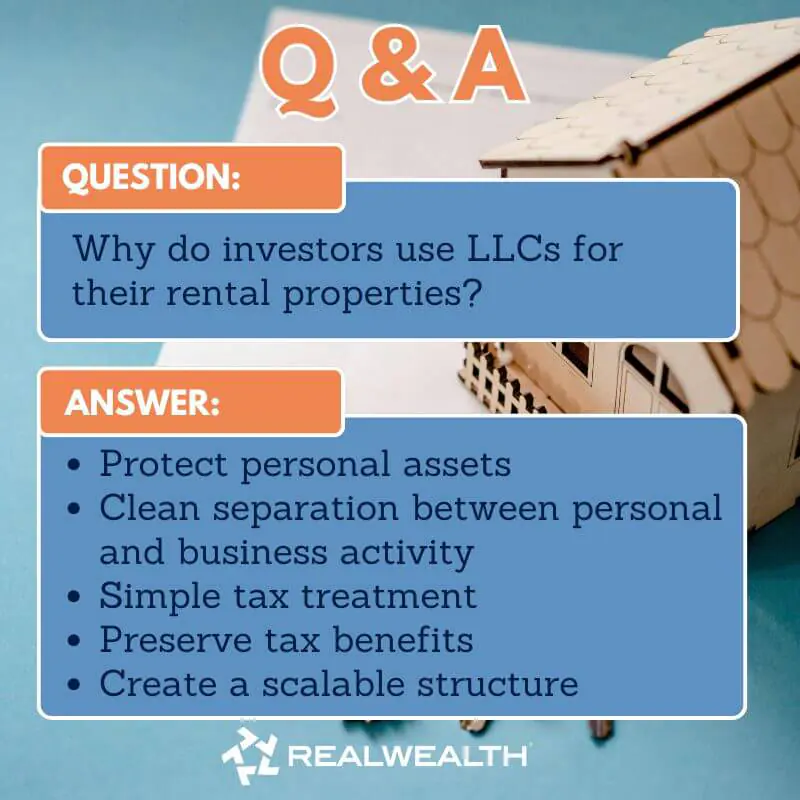
Why Do So Many Investors Use LLCs for Rental Property?
A limited liability company (LLC) is one of the most common legal entities used by real estate investors. There’s a good reason for that.
When structured correctly, an LLC can:
1. Protect your personal assets
If someone sues over an issue at your investment property, the LLC—not you—is the legal owner. That means your home, savings, and wages are generally shielded from claims.
2. Provide a clean separation between personal and business activity
An LLC has its own bank accounts, bookkeeping, and financial records. This helps you avoid commingling funds which is a major problem for DIY investors using a sole proprietorship.
3. Offer simple tax treatment
A single-member LLC is ignored for tax purposes, meaning you pay taxes on your personal return. Multi-member LLCs file a partnership return, but income still flows to your personal tax return. There’s no double taxation.
4. Preserve tax benefits
LLCs often qualify for the Qualified Business Income (QBI) deduction, which may reduce taxable rental income by up to 20%. A major tax benefit of owning rental property in an LLC.
5. Create a scalable structure
As you acquire more investment properties, your LLC framework can grow with you. One of the best ways to structure an investment property portfolio is to use a holding LLC at the top and individual property LLCs underneath.
For these reasons, an LLC is often the best entity for rental property, especially for long-term investors focused on protection and simplicity.
What Are the Downsides of Putting Rental Property in an LLC?
LLCs aren’t perfect. To make the best decision, you need to understand the disadvantages of an LLC for rental property before moving forward.
Here are the biggest ones:
1. LLCs come with costs
Every state charges filing fees and annual report fees. Some charge franchise taxes. Depending on where you invest, these costs add up.
2. Financing can be more difficult
Lenders often prefer lending to individuals rather than legal entities. When you attempt to borrow in the name of an LLC, you may face:
- Higher interest rates
- Personal guarantees
- Additional underwriting
3. Insurance must be updated
Your liability insurance should list the LLC as the insured party, not you personally.
4. Some states impose transfer taxes
States like Florida and Pennsylvania may charge transfer taxes or reassess your property taxes if you deed a mortgaged property into an LLC.
None of these is a deal-breaker. But they do affect whether an LLC is practical for your rental property.
When Is an S-Corporation Not a Good Fit for Rental Property?
Another common question from new investors is whether an S-Corporation is a better business structure than an LLC. For long-term rental property, the answer is almost always no.
Here’s why:
1. You must pay yourself a salary
That means converting passive rental income into wage income, which increases payroll taxes.
2. You may lose part of your QBI deduction
Wages paid out of an S-Corporation are not eligible for QBI.
3. Refinancing becomes risky
If you move a property out of an S-Corp to refinance, the IRS can treat it as a taxable sale, even though you didn’t sell it.
S-Corporations work beautifully for active real estate businesses, such as flipping, wholesaling, and construction, but for long-term rentals, an LLC is almost always the better choice.
When Should You Not Put a Rental Directly Into an LLC? (And What to Do Instead)
There are three common exceptions where using an LLC is not the first step, but each has a safe, simple solution.
1. When obtaining conventional financing
Most lenders will not allow you to close in an LLC, and loans to entities often carry higher interest rates.
Solution: Close with your personal name, then, with help from an attorney, move the property into a single-member LLC or land trust after the loan funds are disbursed. This preserves your financing while still giving you limited liability protection.
2. When buying subject-to
If you transfer a subject-to property directly to an LLC, you risk triggering the due-on-sale clause.
Solution: Take title in a land trust first. Then assign the beneficial interest to your LLC. This protects your privacy, maintains loan stability, and keeps the deal safe.
3. When state taxes or reassessments are triggered
Some states impose transfer taxes, reassess property values, or charge franchise taxes when you move property into an LLC.
Solution: Use a tailored plan that may include a land trust, tiered legal entities, or alternative transfer methods to avoid unnecessary taxes while still protecting your investment property.
How Should You Decide on the Best Structure for Your Rental Portfolio?
If you’re new to real estate investing or doing things yourself, start with the basics. Here’s an easy framework:
1. Long-term rentals
Use an LLC taxed as a pass-through. It’s flexible, protective, and beginner-friendly.
2. Flips, wholesales, and active real estate businesses
Use an S-Corp or C-Corp, or an LLC taxed as one. These help business owners reduce payroll taxes.
3. Subject-to deals
Use a land trust paired with an LLC.
4. Use a land trust paired with an LLC
Seek guidance before transferring property. The wrong move can create expensive, permanent tax consequences.
A good structure should provide:
- Asset protection
- Tax efficiency
- Clean bookkeeping
- Separation of personal and business activities
- A foundation that grows with your portfolio
It doesn’t have to be complicated to work.
How Do You Choose the Best Structure for Your Rental Portfolio?
Many Real Wealth Network investors start as DIY investors, learning through videos, books, or trial and error. That’s normal and often a great way to begin.
But as your rental income grows, the stakes get higher. Your structure needs to protect you, not expose you.
You don’t need to become a legal expert. You just need a clear plan based on your goals, your properties, and your state laws.
That’s where having a professional review makes all the difference.
Schedule Your Free 45-Minute Strategy Session
If you want your assets to be protected, tax-efficient, and structured for long-term success, now is the perfect time to review your business structure for your rental property.
During your free strategy session, we’ll:
- Review your portfolio and goals
- Identify gaps in liability protection
- Show you the best way to structure an investment property based on where you are now
- Give you a simple plan you can use immediately
Thousands of investors started exactly where you are—curious, cautious, and wanting to protect what they’re building.
We help you begin with what you need now and grow into more advanced legal entities later.
Ready to find the best structure for your rental properties? Book your 45-minute Strategy Session with Anderson Advisors.
Frequently Asked Questions
Asset protection is a huge benefit. For example, if someone sues you over something that happens at your rental, they’ll come after the LLC, not your personal assets. It also provides a clean separation between business and personal money. In addition, the tax treatment is simple. Your single-member LLC is a “pass-through” for taxes, so income still flows to your individual return, but you get to claim the QBI deduction for up to 20% off your taxable rental income. That’s real money back in your pocket.
Absolutely, but you need the right strategy, as most conventional lenders won’t close a loan in an LLC’s name. And if they do, you’re looking at higher rates and personal guarantees that defeat the purpose anyway. So here’s what savvy investors do. Close the loan in your individual name to get the best terms. Then, after the property closes, work with a real estate attorney to transfer the property into your LLC or land trust. You get great financing AND liability protection. Before you do that, always double-check the state’s rules, as some charge transfer taxes or reassess property taxes when you make the move.
For long-term rentals? Almost never. S-Corps are fantastic for active businesses like flipping houses or wholesaling deals, but they create headaches for buy-and-hold investors as you are forced to pay yourself a salary, which turns your passive rental income into wage income and cranks up your payroll taxes.
Let’s be real, LLCs aren’t free or frictionless. There are filing and annual report fees. Some states also impose franchise taxes. Obtaining financing becomes more complicated, and lenders would rather loan money to a person, not an LLC. That means you’re dinged with higher rates, personal guarantees, and extra paperwork. Your insurance policy must also list the LLC as the insured, not you. Plus, in some states, transferring a property with an existing mortgage can trigger transfer taxes or increase your property assessment. None of this is a dealbreaker, but go in with your eyes open.
Yes, it is possible to get a mortgage for an LLC-owned rental property. The process differs from a traditional home loan. If you want access to lenders who understand LLC ownership and investor loans, join RealWealth for free to connect with vetted, investor-friendly lenders and get guidance tailored to rental properties and long-term investing strategies.
We don’t recommend that you DIY your LLC, as there are too many variables that put your rental at risk. A real estate attorney will choose the right state for your LLC, structure it correctly to maximize protection, and make sure you’re not making rookie mistakes that could cost you big later. Anderson Business Advisors offers free 45-minute strategy sessions to review your properties, spot protection gaps, and build a custom plan that works for where you are today. No pressure, just expert guidance. Grab your free session here.