

What if you could legally cut your tax bill by $25,000 this year without changing a single thing about your investment strategy? Most rental property investors and syndication participants leave this exact amount—or more—on the table every single year because they don’t understand how cost segregation works.
What is the difference between real estate investors who use this strategy and those who don’t? Those who get it are reinvesting their tax savings in additional properties, while everyone else is still writing checks to the IRS. Here’s everything you need to know about making cost segregation work for your specific situation, whether you own properties directly or invest in real estate syndications.
Quick Answer: How Does Cost Segregation Work For Rental Property & Real Estate Syndication Investors?
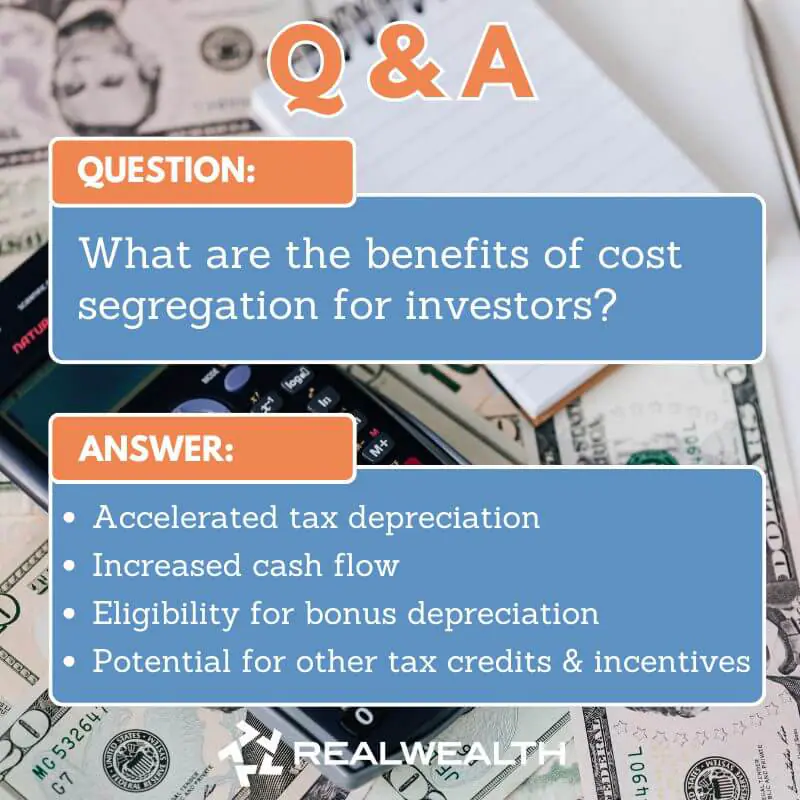
Cost segregation accelerates your depreciation deductions by breaking down your property into components that wear out at different rates.
Own rental properties directly? If you run short-term rentals or qualify as a real estate professional, you can use these turbocharged deductions against your W-2 income.
Invest in real estate syndications? You’ll get your share through K-1 statements, but you can only use those losses against other passive income.
Join RealWealth for free to start investing and view our list of vetted resource partners who specialize in this powerful strategy.
Why You Should Care About This Right Now
Congress just brought back permanent 100% bonus depreciation through the Big Beautiful Bill. That means if you move on this, you’re locking in tax advantages that’ll keep paying off.
Here’s what most people miss: whether you own properties yourself or invest in real estate syndications completely changes how cost segregation works for you. Direct owners can potentially offset their job income. Syndication investors are in a whole different ballgame. You’ll need passive income to soak up those losses.
The Basic Concept
Instead of writing off your building over the standard 27.5 years (residential) or 39 years (commercial), cost segregation lets you reclassify about 20-30% of your property into faster categories. Think of it like this: the IRS knows carpeting wears out way faster than the foundation, right?
What gets accelerated:
Everything else, including your building shell, roof, HVAC, and plumbing, stays on the regular schedule.
Here’s What It Looks Like on a $350,000 Duplex
Let’s use a typical purchase of a duplex purchased by RealWealth’s members:
You buy a duplex for $350,000. The land is worth about $70,000 (land cannot be depreciated). That leaves you with $280,000 in building basis.
Normal depreciation: you’re writing off $10,182 every year. Fine, but not exactly exciting.
With cost segregation in Year 1, you’re looking at $60,000 to $80,000 in depreciation.
If you’re in the 32% tax bracket, that’s $19,200 to $25,600 back in your pocket. Enough for another down payment, or honestly, enough to just pay cash for a property in some of RealWealth’s preferred markets.
If You Own Properties Directly
Short-Term Rentals: Your W-2 Killer
This is honestly one of the best tax moves available if you’ve got a solid W-2 income.
When your rental averages 7 days or fewer per stay AND you materially participate (we’ll explain what that means below), the tax rules for vacation rental property treat your depreciation losses as non-passive.
Translation: You can use them to offset your regular job income.
A real example: A nurse making $180,000 bought a $425,000 vacation duplex in Southwest Florida. After running a cost segregation study, she generated $95,000 in Year 1 depreciation. Her taxable income dropped to $85,000. Federal tax savings? About $30,400.
Now, “material participation” means you need to hit one of these:
- 500+ hours per year spent working on the rental
- OR 100+ hours AND more than anyone else (including any property managers)
The IRS will absolutely come asking for proof, so track your hours. Use a spreadsheet, use an app, use whatever you like, just track your hours.
Long-Term Rentals: Banking Losses for Later
Can’t hit material participation? Not a Real Estate Professional spending 750 hours annually in real estate or more time in real estate than anything else?
Your losses don’t vanish. They just sit there, waiting. They carry forward and offset:
Plenty of investors build up these “passive loss banks” over time. Then they strategically sell a property or invest in real estate syndications, and boom, those passive income losses finally get used.
Companies like our preferred partner, R.E. Cost Seg, usually say properties worth $300,000+ make sense for studies, since you’re paying $2,800-$3,250 for the analysis. Below that, the math gets iffy. Request a FREE proposal today and discover how much you could save!
The Virtual Inspection Thing
Good news: you don’t need an engineer flying out to walk your property anymore.
You’ll jump on a 30-minute Zoom call, walk them through the property with your phone, show them the flooring, fixtures, and appliances, and you’re done. Your report will appear in 2-3 weeks with minimal effort.
Want to talk through whether this makes sense for your portfolio? Schedule a free strategy session with your Investment Counselor.
If You’re Investing in Real Estate Syndications
Using cost segregation for syndications is a different animal entirely. You don’t control anything here — the sponsor decides whether to do a cost segregation study, when to run it, and how to structure everything. You receive your share via the K-1 at tax time.
But this isn’t necessarily a bad thing. These sponsors are running cost segregation on entire complexes. A $20 million apartment deal might kick out $4-6 million in Year 1 depreciation. If you invested $100,000, you’re looking at $20,000- $30,000 in depreciation, reducing your return.
Here’s the Big Limitation
Syndication depreciation ONLY works against passive income. Understanding how passive income is taxed is crucial here, as you cannot use it to offset your W-2 income. It doesn’t matter how much depreciation you receive.
What counts as passive income?
- Distributions from your other real estate syndications
- Long-term rental income (assuming you’re not a Real Estate Professional)
- Limited partnerships where you’re not active
- S-Corp income where you’re not involved in operations
The smart play? A lot of investors do both. They own short-term rentals to hit their W-2 income. Then they invest in syndications, and those investments soak up the passive losses from their long-term rentals.
Check out RealWealth Developments’ open syndication offerings if you want to see what’s available now to diversify your portfolio.
What to Ask Sponsors Before You Invest
Don’t be shy about asking:
If they’re dodgy about tax stuff, walk away. Our guide to underwriting syndications covers more about how to vet syndication deals.
The Recapture Thing Everyone Worries About
Yeah, when you sell, you’ll owe tax on that accelerated depreciation. But let’s do the actual math:
Say you save $50,000 in taxes over five years from accelerated depreciation. When you sell, you’re facing about $12,500 in recapture taxes (at the 25% rate). You’re still $37,500 ahead.
If you invested $50,000 in tax savings at 8% annually, you’d have $73,500 after five years. Even after paying the $12,500 recapture, you’re sitting on $61,000 more than you would’ve had.
The time value of your money wins every time. Ways to soften the blow:
- Do a 1031 exchange and defer the whole thing
- Time your sale for a year when your income’s lower
- Line up passive losses to offset the gains
Which Route Makes Sense for You?
Go direct ownership if:
Go with real estate syndications if:
Do both if:
Important Things To Remember
What to Do Next?
Own properties directly?
Start with whichever one’s worth the most. Contact someone like R.E. Cost Seg to get a preliminary estimate of what you’d save. If the numbers work (and they usually do for $300,000+ properties), get the study done.
Investing in real estate syndications?
Start asking these questions during due diligence. Has the sponsor done cost segregation before? Can they show you actual K-1s from past deals? What’s the depreciation projection looking like? If they can’t answer clearly, that tells you something.
Doing both?
Now you’re playing the game. Short-term rentals hit your W-2. Real estate syndications absorb the passive losses from your long-term investments. Just coordinate the timing and watch your CPA smile when they see how it all fits together.
Join RealWealth and get access to our network of vetted turnkey property teams, syndication deals, and the tax advisors who know this strategy inside and out.
Frequently Asked Questions About Cost Segregation
Yes. You file Form 3115 and basically “catch up” on all the depreciation you missed. It all hits in one tax year, and you don’t have to amend old returns. Any property placed in service after 1986 qualifies.
No. Studies cost $2,800 to $3,250 each. Focus on properties worth $300,000+ where it makes financial sense. Your $180,000 cash flow property in Ohio? Probably skip it.
They can. Passive losses from real estate syndications work against passive income from long-term rentals (assuming you’re not a Real Estate Professional). This is why a lot of people with multiple long-term rentals start adding real estate syndications to their mix.
You’re a perfect match for cost segregation. You defer the recapture by exchanging into a new property, then immediately run cost segregation on the replacement. Rinse and repeat. People build serious wealth doing this on repeat.
Join RealWealth and check out vetted property teams and investments under the Properties tab when you’re logged in. Your Investment Counselor can also help you determine which investment types have strong cost-segregation potential.
As of right now, yes. The Big Beautiful Bill brought back permanent 100% bonus depreciation. But talk to your CPA because tax laws change, and you want current info.
There’s no point. Retirement accounts don’t generate tax deductions because they’re already tax-advantaged. Cost segregation only makes sense when you’re holding properties in taxable accounts.
Keep the cost segregation study forever. Closing statements, renovation receipts, and appraisals should be kept for seven years after you sell. If you’re claiming short-term rental status, track your hours every year. Future you (and your CPA) will thank you.


